
The short answer: the model is not the main problem
Connecting an LLM to Aurora, Redshift, S3, or another enterprise data store is not enough to run Agentic AI on organizational data. The agent must know what qualifies as an active customer, how revenue is calculated, which identifier connects two systems, which records the user may access, and how much certainty is required before taking action.
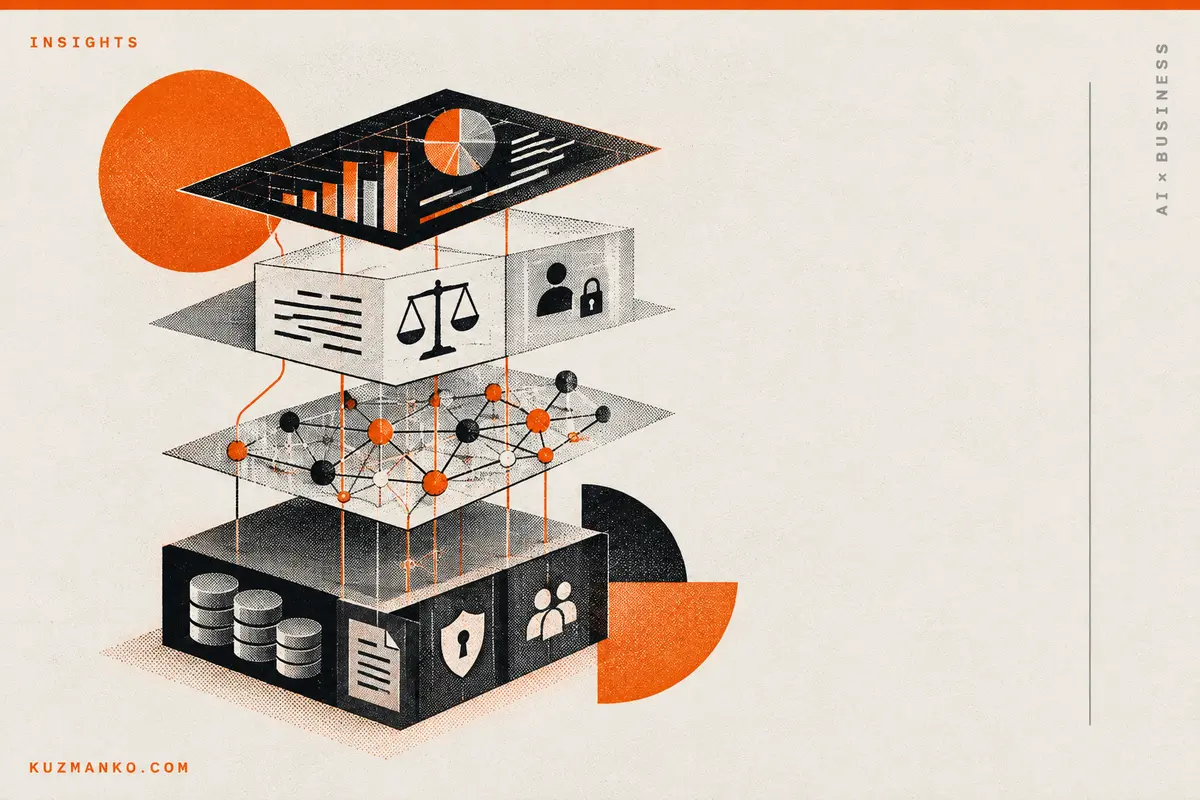
Those answers do not reside in the model. They reside in the organization's business knowledge. That is why the semantic layer is a core architectural component, not a convenient add-on. It translates business language into data structures, relationships, rules, and permissions that the enterprise can manage and audit.
When sources are connected at query time, the agent can access current data without copying every source into a new ETL pipeline. But a query-time connection does not automatically mean real time. Freshness still depends on the source, mappings, caches, and refresh policies.
Key insight: The model generates language, but the organization defines truth. An LLM can plan a query and explain a result, but business definitions, relationships, and permissions must live in a governed enterprise layer rather than in a prompt.
The management implication is straightforward. Model selection matters, but it does not resolve inconsistent data. An advanced model given ambiguous business meaning will produce an answer that is convincing, fast, and wrong.
Why RAG alone is not enough for analytics
RAG works well when the answer exists in a document, policy, contract, or textual knowledge base. It can retrieve relevant passages and ground a response in their content. Business analytics requires a different set of capabilities: calculations, joins across tables, time-based filtering, identifier resolution, permission enforcement, and rule execution.
A question such as What were sales last quarter? may sound simple, but answering it requires several decisions. Is a sale recorded on the order date or when revenue is recognized? Are refunded transactions excluded? Which exchange rate applies? Is a subsidiary included in the calculation? RAG may retrieve a document describing part of the policy, but it does not automatically turn that policy into consistent logic enforced across every query.
The main approaches differ in purpose and risk:
- RAG: Best suited to documents and procedures. Its primary advantage is content-grounded answers, while its main risk is inconsistent calculation.
- Direct text-to-SQL: Best suited to a defined data source. It can be deployed quickly, but it depends heavily on the schema and prompt.
- Semantic layer: Best suited to data distributed across multiple sources. It provides consistent business meaning but requires deliberate design and governance.
- RAG plus semantics: Best suited to complex business questions. It offers more complete context but introduces a broader architecture to operate.
For most enterprises, the right choice is not RAG or a semantic layer. Use RAG to retrieve policies and explanations, and use the semantic layer to perform calculations and access structured data. The agent connects the two and presents an answer whose origin can be explained.
What a query-time connective layer looks like
One possible architecture uses Stardog as the knowledge layer, Amazon Bedrock AgentCore to run the agent, Aurora for operational information, and Redshift for analytics. Claude through Bedrock can plan the work, select tools, and formulate the response.
The workflow looks like this:
- The user asks a business question in natural language.
- The agent identifies the intent and relevant entities.
- The knowledge layer translates business concepts into a
SPARQLquery or an equivalent semantic interface. - The mapping engine generates
SQLqueries for the appropriate sources. - Results are unified using identifiers and rules defined by the organization.
- Access policies filter the information before it returns to the model.
- The agent formulates an answer, presents its sources, and can route exceptions for human review.
Consider a Customer 360 use case. Customer details may live in an operational system, while purchase history resides in an analytical warehouse. Instead of forcing the model to guess how two schemas should be joined, the ontology defines both records as representations of the same business entity. The mapping connects them through a stable identifier, and the join occurs at query time.
This is more than a technical improvement. It reduces duplicated logic, lowers dependence on purpose-built dashboards, and allows the organization to support new questions without creating a separate data process for each one.
A semantic layer is not an upgraded glossary
A common mistake is to treat an ontology as a list of agreed terms. A useful semantic layer must express four types of knowledge:
- Entities: Customers, suppliers, orders, products, invoices, and service events.
- Relationships: A customer placed an order, an order contains a product, or an invoice belongs to a legal entity.
- Rules: How revenue is calculated, who qualifies as an active customer, and when a transaction is considered anomalous.
- Policies: Who may view particular fields, at what level of detail, and under which conditions.
Building this layer requires collaboration among data teams, domain experts, information security, operations, and management. AI is not solely a technical discipline, and relevant education matters here. Research expertise in computer science is useful, but so is research or experience that combines technology with professional processes, decision-making, and organizational governance.
A specialist who understands prompting but not revenue recognition, credit processes, supply chains, or enterprise permissions may build an impressive demonstration that does not survive real operations. Small and midsize businesses are especially vulnerable to this kind of advice because they may not have an internal team capable of detecting flawed assumptions early.
The business value: less translation, more action
In many organizations, a management question moves through a long chain. An executive describes a need, an analyst translates it, a data engineer locates the sources, a security team reviews permissions, and only then is an answer assembled. A semantic layer does not eliminate these professionals. It turns their knowledge into reusable infrastructure.
Value appears in several areas:
- Less time between a business question and a verifiable answer.
- Fewer disputes between reports that use different definitions for the same metric.
- Less duplication of data and logic across applications.
- Centralized permission enforcement rather than separate controls in every application.
- The ability to apply agents to existing processes without forcing every employee to redesign their entire routine.
The last point is particularly important. Personal AI tools require employees to learn new habits, formulate requests, and validate outputs. An agent embedded in an existing process can work behind the scenes, detect an exception, prepare a recommendation, or open a task in the system the employee already uses. It may be more technically complex, but organizational adoption can be simpler.
Data governance must act before the answer is generated
Security cannot remain a filter applied at the end. If the model has already received payment card details, medical information, or salary data it did not need, the organization has lost control even if the information is never displayed to the user.
In a well-designed knowledge layer, authorization changes the query itself. A marketing user and a fraud analyst may ask similar questions but receive different results based on role, purpose, and permitted level of detail. Bedrock AgentCore, or an equivalent runtime layer, can manage identities, tool permissions, session isolation, and action logs.
The correct principle is the minimum information required for each task. An agent should not receive broad access merely because it can technically use it. Every tool needs an identity, every identity needs defined permissions, and every action needs an auditable record.
Keep humans in the loop without making them the bottleneck
Agentic AI can execute nondeterministic processes that require judgment. That makes human oversight critical, but it does not justify requiring human approval for every query or action. If every case still needs manual sign-off, the organization pays for automation while continuing to operate the old process.
The management goal is to move people from handling every case to supervising exceptions. An employee who previously processed one workflow at a time should be able to oversee many workflows, identify patterns, and intervene only when risk, uncertainty, or impact warrants it.
An escalation policy can consider:
- Low confidence in intent recognition.
- Contradictions between data sources.
- A financial or operational action above an organizational threshold.
- A request that exceeds permissions or violates policy.
- A result that is unusual relative to business history.
This keeps a person accountable without turning them into a manual approval stamp for every agent decision.
Start implementation with meaning, not the model
A sound project does not begin by selecting an LLM. It begins with a business process for which the organization can define the question, sources, ownership, risk, and desired result.
- Choose a business decision: Define a recurring question with measurable value, a process owner, and a clear success metric.
- Map meaning and sources: Document entities, identifiers, business definitions, and gaps between systems.
- Encode policy: Define permissions, calculation rules, confidence levels, and escalation conditions.
- Connect the agent and tools: Grant narrow access to the semantic layer and only the action systems the agent requires.
- Test realistic scenarios: Run valid, ambiguous, hostile, and exceptional requests with the people who own the process.
- Measure and expand: Improve the system based on business results before adding more domains and agents.
The evaluation set should include more than an expected answer. It should specify the required data source, permitted access, necessary explanation, and expected behavior under uncertainty. Evaluating writing quality alone is not sufficient. An agent can produce excellent prose while performing the wrong calculation.
What to measure
Model metrics such as accuracy and relevance matter, but management should evaluate the entire process. Appropriate measures depend on the use case and may include:
- Time from the initial question to an approved answer.
- Percentage of queries completed without human intervention.
- Rate of justified escalations compared with unnecessary escalations.
- Number of disputes between reports about the same business metric.
- Operating cost per decision or case.
- Percentage of answers whose origin can be reproduced and explained.
- Number of permission incidents, data exposures, or improper tool uses.
Return on investment does not come only from reducing analyst hours. It also comes from fewer errors, faster decisions, and the reuse of organizational knowledge. At the same time, an excessively broad semantic layer can become an infrastructure project with no business customer. It should therefore expand through active processes, not through an upfront ambition to map the entire enterprise.
Watch out: Do not build an ontology without business owners. A knowledge model that nobody is responsible for maintaining will quickly become another source of inconsistency. Every concept and rule needs an owner, a change process, and version history.
The platform matters, but internal capability matters more
An enterprise needs an effective platform for building, deploying, and managing AI agents. It should support identity management, tool permissions, observability, evaluation, versioning, costs, and shutdown mechanisms. But no product replaces the organizational capability to understand processes and define meaning.
Claude is a strong candidate for enterprise deployment because of its planning capabilities, tool use, and pace of development. Using it still requires serious review of information security, processing regions, data retention, and enterprise agreements. OpenAI's foundation models are capable and varied, so vendor selection should be based on the task, operating environment, and risk rather than brand loyalty.
In Microsoft environments, Copilot and Copilot Studio offer an advantage through integration with existing identities, applications, and governance. The pace of improvement has increased, although implementation in a large enterprise may be less agile than with a focused provider. At the same time, n8n is entering large enterprise environments and enabling flexible orchestration. None of these tool choices removes the need for a shared layer of meaning and governance.
Claude Code and similar agentic work tools can also improve the productivity of development and data teams. They do not replace MLOps, code review, environment separation, or testing. Speed without engineering discipline simply creates new debt faster.
IT will manage an agent workforce
As the number of agents grows, IT departments will need to operate partly like human resources departments for AI agents. They will need to know who each agent is, what role it performs, which tools it may access, who its business manager is, how its performance is measured, and when it should be retired.
Every enterprise agent should have:
- A job description and defined area of responsibility.
- A business owner and a technical owner.
- Approved knowledge sources and tools.
- Action limits and escalation thresholds.
- Quality, cost, and benefit metrics.
- Version, incident, and change records.
The organization must also advance AI literacy. Employees and managers need to learn how to communicate effectively with models, examine answers, and understand limitations. Building agents without literacy creates dependence on a small team. Literacy without agent infrastructure leaves the value at the level of personal experiments.
The competitive advantage is meaning, not the model
Models improve and change quickly. Business definitions, relationships between systems, and knowledge accumulated by employees are more durable assets. An organization that encodes them in a governed semantic layer can replace a model, add an agent, or connect another system without repeating the entire process of understanding the business.
That is the real test of Agentic AI in the enterprise. It is not whether the agent can answer confidently. It is whether the organization can explain how the agent reached the answer, which data it used, which rules it applied, and why the action was permitted.
An intelligent agent without a layer of meaning is a convenient interface over data chaos. An agent connected to governed business knowledge can become reliable operational infrastructure, extending human judgment rather than merely imitating it.