
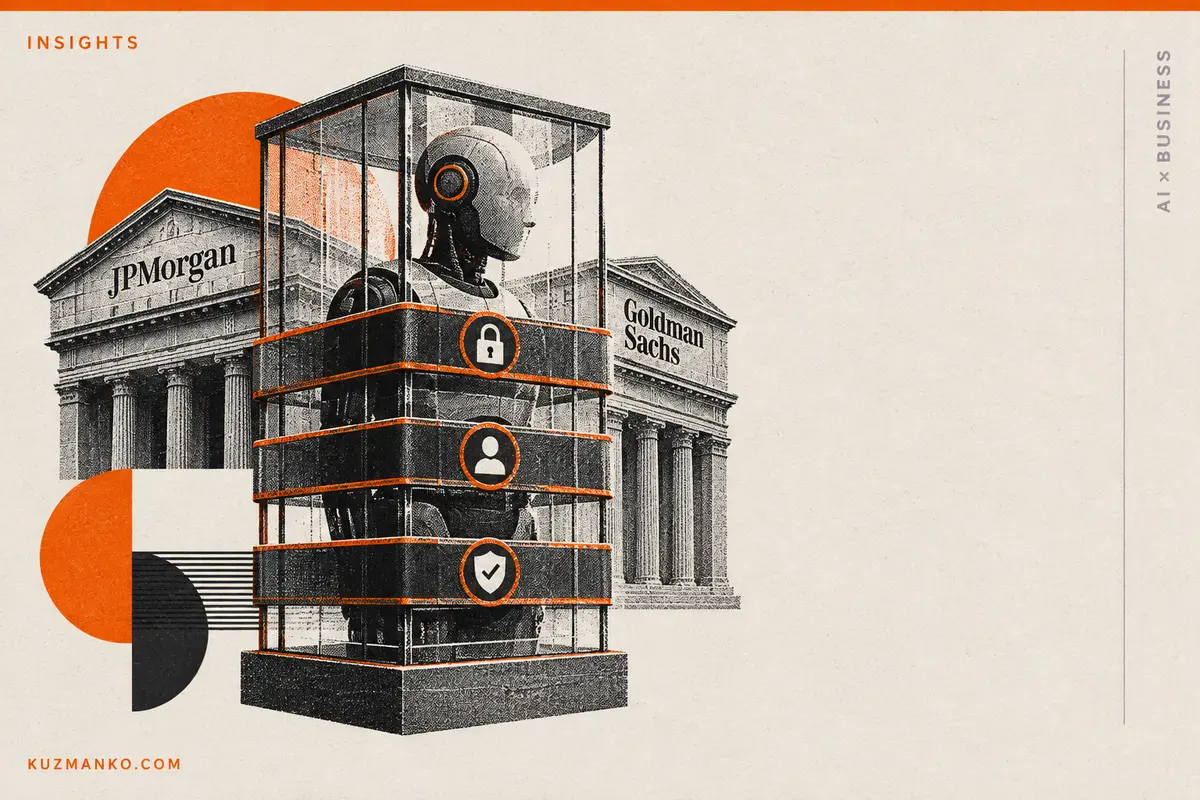
Banks are not backing away from AI agents. They are defining their authority
US banks’ decisions to restrict AI agents’ freedom to act are not a reason to stop automating. They are a reason to stop confusing model capability with business authorization. An agent can understand what needs to happen without being authorized to take every action that might get it there. Enterprises need to build that distinction into their architecture, budgets, and operating procedures.
According to Reuters, large and midsize banks are tightening agents’ access to credentials and security logs, reviewing emergency shutdown mechanisms, and separating experiments from production systems. Incidents at technology companies have also shown how advanced systems can cross boundaries assumed to be secure.
The meaningful divide is not between organizations adopting AI and those afraid of it. It is between adoption backed by enforceable controls and adoption that relies primarily on instructions to the model.
- 94% of respondents had adopted an organizational AI policy.
- 80% had deployed agents to support decision-making.
- 2% reported broad autonomy.
These figures, from a Bank of England and FCA survey, describe the institutions that responded, not the entire financial sector. They show widespread adoption alongside caution about granting independence. In the same survey, fewer than half of respondents had incident response plans in place. A written policy, it turns out, is not the same as operational readiness.
Instructions are not controls
Consider an agent handling supplier invoices. It reads documents, checks them against purchase orders, and recommends payment. Telling it not to change bank account details matters, but that instruction is not a security mechanism. If the agent has the technical permission to change those details, the organization has left the decision to a system whose output is nondeterministic.
A real control blocks the change at the permissions layer or requires a separate approval process, even if the agent concludes that the change is necessary. This distinction protects against both ordinary mistakes and malicious instructions embedded in documents or external content.
That is the direction of the approach described by JPMorgan: an independent policy engine that checks identity, organizational affiliation, and transaction authority rather than relying on text instructions alone. Goldman Sachs described applying zero-trust principles to agents, including checkpoints before transactions are executed.
- Permissions: Instructions ask the agent to stay within bounds; operational controls enforce those boundaries at the access layer.
- Payments: Instruction-led workflows rely on the agent’s checks; operational controls require validation by a policy engine.
- Records: A model-generated explanation describes its reasoning; an independent audit log records its actions.
- Shutdown: An instruction asks the agent to stop; operational controls revoke permissions and halt tasks.
This does not make well-written instructions unnecessary. Instructions define the desired behavior. External systems must enforce the limits on what the agent can do.
A trustworthy agent is not one that promises to comply. It is one that cannot exceed its assigned authority, even when it gets something wrong.
Separation of duties applies to agents, too
In a proof of concept by JPMorgan’s Kinexys and Hyundai Card, one agent monitored balances, obtained foreign exchange quotes, and submitted transaction requests. A separate agent executed them. The experiment ran in a test environment without moving real money, and authorization was tied to the requesting agent’s cryptographic public key.
The lesson is not that every enterprise needs banking infrastructure. It is that identifying a need, approving an action, and executing it do not automatically belong with the same actor. A midsize business can separate the agent that prepares a customer refund from the service that validates eligibility and issues it.
However, adding more agents does not create separation of duties by itself. If they all share the same broadly privileged service account, or approve one another’s decisions without independent checks, the separation exists mostly in a diagram. The boundaries must exist in identities, permissions, and execution rules.
A human in the loop should not approve everything
Requiring human approval for every action sounds responsible. It can also create bottlenecks and habitual rubber-stamping. The organization then pays for both automation and manual review without gaining meaningful control.
The better approach is risk-based oversight. Well-defined, reversible actions with limited exposure can run automatically within hard boundaries. Exceptions, permission changes, and irreversible actions should follow an appropriate approval path. The UK recommendations described in the reporting also emphasize human approval for irreversible actions.
Meaningful human oversight: Routing a request for approval is not enough. The reviewer needs access to the relevant data, an understanding of the consequences, and the authority to stop the action.
The goal is for a manager to oversee hundreds of workflows by handling exceptions, not by reading hundreds of conversation transcripts. That requires a clear exception queue, prioritization by severity, and concise explanations grounded in system data rather than only the rationale the model generated for itself.
What belongs in the enterprise implementation plan
There is no need to wait for a massive program. But connecting an agent to a core system and only then considering accountability is equally misguided. Enterprises need a shared foundation for building and managing agents: registration, identities, permissions, testing, monitoring, and shutdown capabilities. Teams can have flexibility in development tools without making controls optional.
- Map business authority: Define what the agent may read, recommend, and execute, and who is accountable for the outcome.
- Separate identities and environments: Give each agent a distinct identity and narrowly scoped, short-lived permissions as needed.
- Enforce rules outside the model: Validate amounts, eligibility, and action destinations through an independent service before execution.
- Design oversight and exception handling: Specify when a human must intervene and what information they need to make the decision.
- Rehearse shutdown and recovery: Test permission revocation, task cancellation, and remediation of actions already completed.
Test this process against uncomfortable scenarios: a document containing malicious instructions, a supplier whose details have changed, an expired permission, an unavailable system, or a duplicate request. A stop button is not enough if tasks already dispatched continue executing. Audit logs also need a clear boundary: an agent may generate events for logging, but it must not be able to alter or delete the evidence of its actions.
Model cost is only part of the economics
For executives and finance teams, the important metric is the cost of completing a workflow correctly. That calculation needs to include integration, controls, exception review time, error correction, and maintenance. Alongside it, measure completion time, end-to-end success rates, and the extent of human intervention.
A fast agent that creates a heavy review burden is not necessarily a good investment. An agent with narrow authority that reliably completes a recurring workflow can deliver substantial operational value. Restricting authority may even improve the business case by reducing control complexity and the potential scope of damage.
Organizational capability matters more than an impressive demo
Building this operating model requires AI expertise, relevant education, systems experience, and a deep understanding of the business process. Someone who can build a demo is not necessarily equipped to design a controlled financial workflow. When choosing a partner, particularly for a midsize business, ask for evidence of production experience, failure testing, and incident management.
Enterprises also need to develop internal capabilities. IT teams will have to manage agent identities, roles, permissions, performance, and decommissioning. Business teams will need to define authority and recognize exceptions. AI literacy and agent development are therefore complementary investments: an agent may fit into an existing process without changing the user interface, but accountability for its behavior requires new understanding.
The message from US banks is clear: do not give an agent every permission and then ask it to be careful. Give it exactly the authority it needs, enforce that authority outside the model, and expand it only when performance and controls justify doing so.