
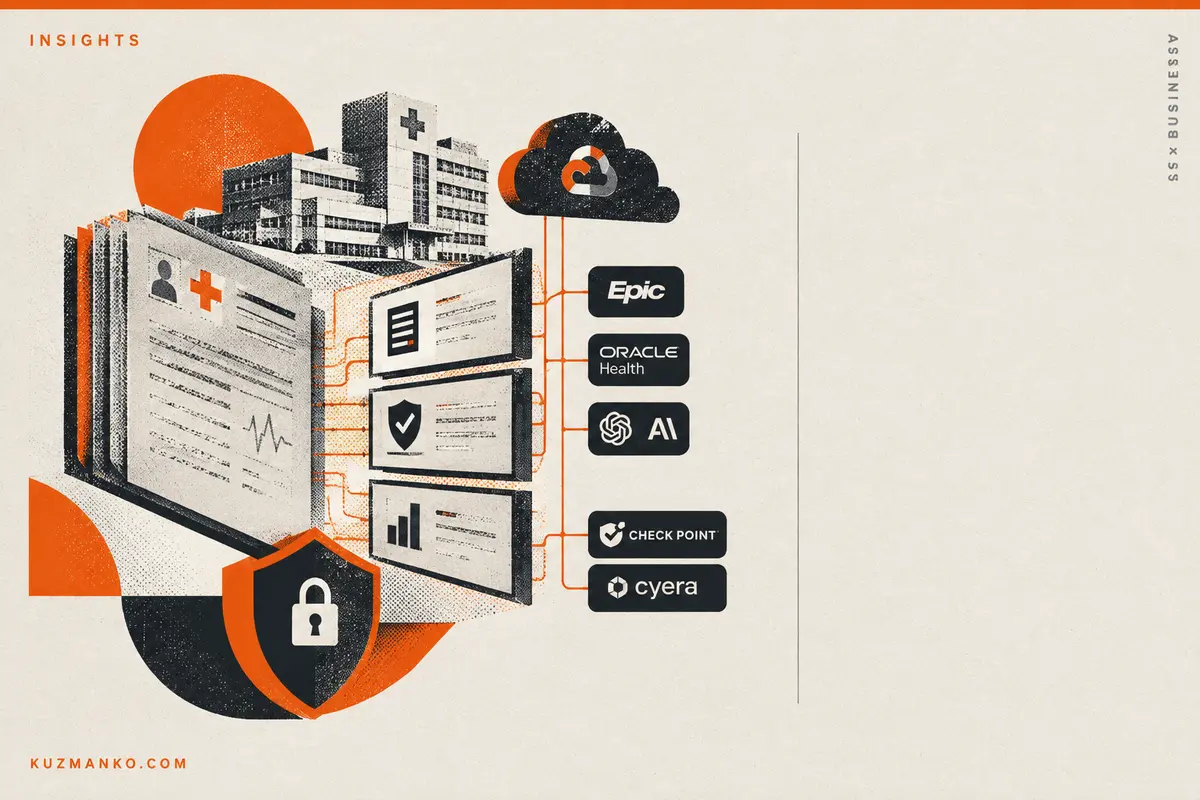
AI agents can reduce the work surrounding medical records. They do not relieve hospitals of responsibility for what happens as a result. That is the practical significance of Gemini for Healthcare: an opportunity to reduce documentation workloads, prepare information before appointments, and check insurance coverage, provided the organization can define access rights, accountability, and quality controls.
Google Cloud is offering the system in preview to Gemini Enterprise customers. For hospital executives, healthcare providers, and insurers, that is not a reason to rush into a platform purchase. It is a reason to examine which workflows still depend on someone searching across multiple systems, manually reconciling information, and copying it into the next screen.
The problem is not a shortage of information
Hospitals do not need another place to ask questions. They need a reliable way to turn fragmented information into completed work: preparing for an appointment, finding a missing document, or routing an eligibility inquiry to the right person with the right supporting evidence.
The figures published alongside the launch illustrate the scale of the burden in the United States. They should not be extrapolated directly to other healthcare systems, but they explain why cloud providers are targeting healthcare administration.
- Nearly 28 hours a week spent on documentation and administrative requirements.
- 41.9% of US physicians experience burnout.
- 25%–35% of US healthcare spending is attributed to administration.
The hours figure comes from a Harris Poll and Google Cloud survey; the burnout figure comes from a 2025 American Medical Association report; and the administrative spending estimate is attributed to the American Hospital Association. These are different sources and populations, not a basis for calculating guaranteed savings. The business case must be measured in the organization's own workflow, using its own data.
What launched, and what still needs proving
According to Google's announcement, Gemini for Healthcare includes prebuilt skills for summarizing medical records, preparing for patient appointments, checking coverage and policies, and verifying eligibility. Organizations can add custom skills, and agents are intended to execute sequences of actions within defined boundaries and under human supervision.
The connection to medical records matters. The described integrations with Epic and Oracle Health allow information retrieval, but not write-back to the record. That limits the risk of changing source data and gives organizations a way to start with preparation and support before granting agents broader authority.
However, read-only does not mean fully safe. A summary that leaves the record untouched can still omit an allergy, present an old medication as current, or combine information from different patients. The source record remains intact, but a decision based on the summary can still be compromised.
Watch out: Read-only is not zero-risk. An agent does not need to change a record to influence care or eligibility. Controls must also assess whether a summary is complete, current, and matched to the correct patient.
Evaluation therefore needs to go beyond whether an answer is correct. What is missing? What supports each assertion? How does the system behave when information is contradictory or incomplete? Verifiable citations are an important control, but the presence of a citation does not prove that it supports the conclusion.
Local fit goes well beyond language
Much of the announced offering targets the US market: CMS coverage databases, Optum's eligibility network, and prior authorization workflows. The Optum connection remains in limited release, while the NextGen Healthcare integration is under development. The procurement implication is straightforward: distinguish available capabilities from limited-release features and roadmap commitments.
In other markets, organizations need a separate assessment of interfaces with healthcare providers and insurers, local eligibility rules, and medical language that mixes abbreviations and terminology. FHIR support helps move information; it does not guarantee that an agent understands its business or clinical meaning.
Google's statement that the offering supports HIPAA compliance is not a substitute for jurisdiction-specific review. Organizations must examine applicable privacy laws, information security requirements, health authority rules, and service-provider agreements. According to the company, data stays within the dedicated organizational environment and is not used to train foundation models. Contracts and architecture still need to establish where processing happens, who can access the information, and what is retained in logs.
Design human oversight, not another bottleneck
A commitment to human oversight is not enough. If every output requires an employee to reread the entire medical record, the organization may have added a step rather than removed work.
Good design distinguishes between tasks and risk levels. An employee may be able to oversee many workflows by handling exceptions, but the same policy should not govern both assembling a document list and making a decision with clinical or insurance consequences.
- Document retrieval: The agent collects and organizes documents; controls check completeness and access permissions.
- Appointment preparation: The agent drafts a summary with sources; a clinician verifies it before use.
- Coverage inquiries: The agent cross-checks terms and documents; contradictions are escalated for review.
- Treatment decisions: The agent provides supporting information; responsibility remains with an authorized clinical professional.
These are design principles, not a specification of the product's capabilities. Each organization must decide which actions can run automatically, which require approval, and which must never be delegated to an agent. In particular, an automated recommendation must not become an eligibility denial or a treatment change without appropriate controls.
The goal is not to remove people from the process. It is to focus their attention where their judgment is genuinely needed.
Measure total handling time, not generation speed
The useful metric is not how quickly an agent produces a summary. It is how much work remains before that summary can be used safely. Verification, error correction, exception handling, and system maintenance are part of the cost, not footnotes.
Beyond licensing and model costs, budgets need to cover integration, security, professional evaluation, and ongoing support. Benefits should be measured through shorter preparation times, less rework, and more complete information. Time released is not automatically a cash saving. Its value may instead be more appointment capacity or less pressure on staff.
According to the announcement, the platform also supports models from Anthropic and OpenAI, with routing between models based on the task. That is sound in principle: not every administrative classification task needs the most expensive reasoning model. However, every change to a model or routing policy requires renewed evaluation of quality, privacy, and cost in the relevant workflow.
Start with a bounded workflow, not a sweeping promise
A good starting point is a clearly scoped process with a named accountable owner, not a project promising to connect the entire hospital. Drafting information for a scheduled appointment, for example, makes it possible to test practical value without giving an agent authority to change treatment.
- Define the workflow and boundaries: Choose a focused task and specify in advance what the agent may do and what requires approval.
- Establish a baseline: Measure the existing work and prepare representative test cases, including missing and contradictory information.
- Run in parallel: Compare the agent's outputs with the existing process without relying on them for treatment decisions.
- Introduce controlled use: Expand only after meeting predefined quality, security, and business-case criteria.
This requires a cross-functional team spanning clinical practice, operations, IT, security, legal, and AI. Relevant education, rigorous evaluation skills, and experience implementing workflows matter far more than an impressive demonstration. Familiarity with conversational tools does not qualify someone to design a system that affects care or eligibility.
User literacy must develop alongside the agent: how to check a source, when not to rely on a summary, and how to report a failure. An agent embedded in an existing system may require less behavioral change than a separate tool, but users still need to understand its limitations.
The lesson from Google's move extends beyond vendor selection. Healthcare organizations need the internal capability to define, evaluate, and manage agents over time. IT teams will manage not only integrations and licenses, but also the permissions, performance, and authority limits of a digital workforce. The advantage will not belong to whoever deploys an agent first. It will belong to whoever can prove that the workflow improved without losing control.