
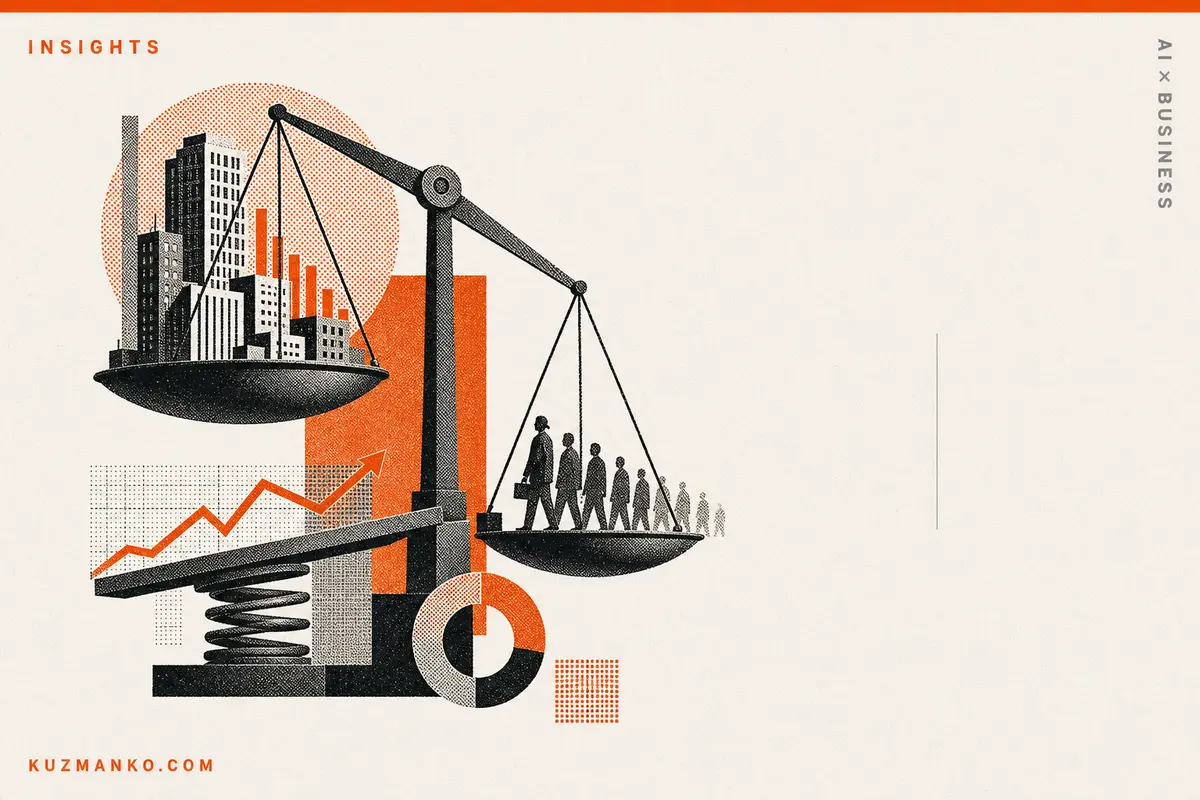
The short answer: AI is not ending work. It is changing the unit of work.
The loudest AI narrative says human work is about to disappear. The more useful enterprise view is different: AI replaces or accelerates specific processes, not complete human roles.
That distinction matters. A finance analyst, operations manager, support specialist, or developer does not perform one clean task all day. Each role is a bundle of decisions, exceptions, approvals, communications, checks, and judgment calls. AI can absorb parts of that bundle. It can also make the person responsible for the bundle far more productive. But treating a job title as a single replaceable object is bad strategy and usually bad finance.
The question is not whether AI can replace a person. The better question is which processes can be delegated to AI, which must remain human-led, and how one expert can supervise hundreds of AI-driven workflows without becoming the bottleneck.
That is where the current public debate often fails. It turns AI into a binary story: either mass unemployment or limitless productivity. Both extremes are convenient. Neither is a serious operating plan.
Why the fear narrative is so profitable
Fear is an efficient marketing mechanism. If a technology company wants to justify a huge valuation, it helps to imply that its addressable market is not software, analytics, or workflow automation. It helps to imply that the addressable market is all labor.
That is the hidden logic behind many grand claims about AI replacing work. The more total the disruption sounds, the larger the future revenue story becomes. Investors hear a platform that can eat entire categories of employment. Executives hear a tool that may cut costs. Workers hear a threat. Vendors get attention from all three.
But enterprise leaders should be careful. A narrative can move markets without being operationally true.
The layoffs across technology since 2022 are a good example. AI has certainly affected hiring plans, team structures, and productivity expectations. Yet it is too simplistic to say AI caused the whole correction. Many technology companies overhired during the pandemic, built teams around temporary digital-demand patterns, and then had to reset as consumption normalized. AI then became a convenient explanation for decisions that were already financially likely.
The result is a story that sounds cleaner than reality: workers were replaced by AI. In many cases, the truth is less dramatic. Companies reduced excess capacity, delayed hiring, raised performance expectations, and used AI as part of a broader efficiency narrative.
The enterprise reality: process replacement, not job replacement
A practical AI program begins by decomposing work.
Instead of asking, Which employees can we replace?, a serious organization asks:
- Which recurring decisions rely on pattern recognition?
- Which workflows require judgment but not full human ownership?
- Which tasks are slow because information is fragmented?
- Which processes involve repeated writing, classification, review, routing, or reconciliation?
- Which controls must remain human-owned for legal, financial, or ethical reasons?
- Which exceptions are common enough to automate but risky enough to monitor?
This is where AI creates measurable value. It can review documents, summarize customer histories, classify support cases, generate first-draft analysis, reconcile inconsistencies, create code, test workflows, propose next actions, and monitor process deviations.
But these are process improvements. They do not automatically eliminate the human system around them.
A single employee might own 30 or 40 work processes. AI may automate 10 of them, accelerate another 15, and make 5 more auditable. The role changes. The workload changes. The performance standard changes. But the human does not simply vanish from the operating model.
Human-in-the-loop is not enough. It must be human-at-scale.
Many organizations say they use a human-in-the-loop model. That phrase is often treated as a safety certificate. It is not.
If every AI output requires a person to review it manually, line by line, before anything can move, the organization has not automated the process. It has created a more complicated approval queue.
The real design challenge is this: how can a person who previously executed a few processes directly now supervise dozens or hundreds of AI-supported processes reliably?
That requires new management patterns:
- Risk-based review instead of universal review.
- Confidence thresholds for automatic routing.
- Escalation rules for unusual cases.
- Audit logs that explain what the system did and why.
- Sampling methods for quality assurance.
- Clear ownership when AI recommendations are wrong.
- Dashboards that show process health, not just model usage.
This is the operational meaning of AI maturity. It is not about buying another chatbot license. It is about redesigning supervision.
AI is not merely technical
One of the most damaging mistakes in the market is treating AI implementation as a technical deployment only. Models matter. Security matters. Integration matters. But these are not enough.
AI combines several forms of expertise:
- Deep understanding of business processes.
- Managerial experience in how work actually gets done.
- Data literacy and model literacy.
- Change management.
- Risk, compliance, and governance.
- Academic and methodological knowledge.
- Practical experience with implementation failures.
This is why self-appointed AI experts can be dangerous, especially for small and mid-sized businesses. Large enterprises usually have procurement, legal, security, architecture, and business leadership capable of filtering weak advice. Smaller companies often do not. They are more exposed to opportunistic consultants selling shortcuts, generic prompts, or unrealistic automation promises.
AI is a multidisciplinary profession. Computer science is important, but it is not the whole field. The strongest work often comes from people who can connect domain expertise, organizational behavior, economics, decision science, and applied AI.
The two tracks every company needs
Organizations should move on two tracks at the same time: AI literacy and AI agents.
AI literacy is about people. Employees need to learn how to communicate with models, challenge outputs, structure context, evaluate answers, and understand when not to use AI. This is now a core professional skill, not a side hobby.
AI agents are about systems. They perform defined work inside governed boundaries. They can retrieve information, trigger workflows, create drafts, update records, monitor queues, and escalate exceptions.
The two tracks are different. AI tools often require employees to change habits. That can be harder than it looks. A tool may be technically simple but behaviorally difficult. Agents, on the other hand, may be technically more complex to build, yet easier for employees to adopt because they can operate within existing workflows.
This is why companies need internal capability to create, manage, test, and retire AI agents. In the future, information systems departments will increasingly act like HR departments for digital workers: onboarding agents, assigning permissions, measuring performance, resolving conflicts, and enforcing policy.
Tool choices matter, but operating architecture matters more
The current enterprise AI market offers strong options, each with trade-offs.
Claude is one of the most compelling systems for broad organizational use, especially because Anthropic has shown impressive product velocity and strong language-interface thinking. Claude Code and related work-oriented capabilities are among the more practical AI tools available today. That said, enterprise adoption must address security, data exposure, identity, permissions, and governance with discipline.
Microsoft Copilot is a solid infrastructure play, particularly for organizations already standardized on Microsoft 365. Microsoft has historically moved more slowly than smaller AI-native companies, but Copilot has improved meaningfully and the release pace has increased. Copilot Studio can be a reasonable route for agent development inside the Microsoft ecosystem.
At the same time, tools such as n8n are entering enterprise environments faster than many expected. What once looked too lightweight for large organizations is now becoming viable in serious automation programs, especially where teams need flexibility, orchestration, and faster experimentation.
The tool debate is important, but it should not distract from the real requirement: every organization needs an effective platform for creating and managing AI agents. Without that foundation, AI adoption becomes a scattered collection of experiments.
What finance leaders should measure
CFOs should be skeptical of vague productivity claims. AI value must show up in operational and financial metrics.
Useful measurements include:
- Cycle-time reduction.
- Cost per processed case.
- Error-rate reduction.
- Revenue leakage prevented.
- Faster month-end or quarter-end close.
- Lower support backlog.
- Higher employee capacity without proportional headcount growth.
- Reduced rework.
- Better compliance evidence.
- Time saved in analysis, reporting, and decision preparation.
The strongest business cases usually come from workflows where volume is high, variation is manageable, and the cost of delay or error is meaningful. The weakest cases come from trying to automate ambiguous work without clear ownership, clean data, or governance.
A better executive question
The market asks whether AI will replace workers. Executives should ask something sharper:
Which decisions and processes can become partially non-deterministic, AI-assisted, and supervised at scale without increasing organizational risk?
That framing is more accurate because modern AI is not classical automation. It is not limited to rigid if-this-then-that logic. It can operate in areas that previously required human judgment: language, prioritization, classification, drafting, synthesis, and recommendation.
But because the output is probabilistic, governance becomes more important, not less. The more judgment AI performs, the more carefully the organization must define boundaries, escalation, monitoring, and accountability.
The future of work is not fewer people doing nothing
The end-of-work narrative is attractive because it is simple. It is also strategically lazy.
AI will reduce the need for some tasks. It will change entry-level work. It will pressure inefficient teams. It will expose managers who confuse activity with output. It will also create new work around supervision, orchestration, governance, model communication, agent management, and process design.
The winners will not be the companies that panic first or cut deepest. The winners will be the companies that understand work at process level, develop internal AI capability, invest in employee literacy, and build agent infrastructure with serious governance.
AI is not a magic replacement for business judgment. It is a powerful way to scale it, if the organization has the knowledge, discipline, and experience to use it well.