
The short answer: AI is not only changing work, it is changing how leaders are made
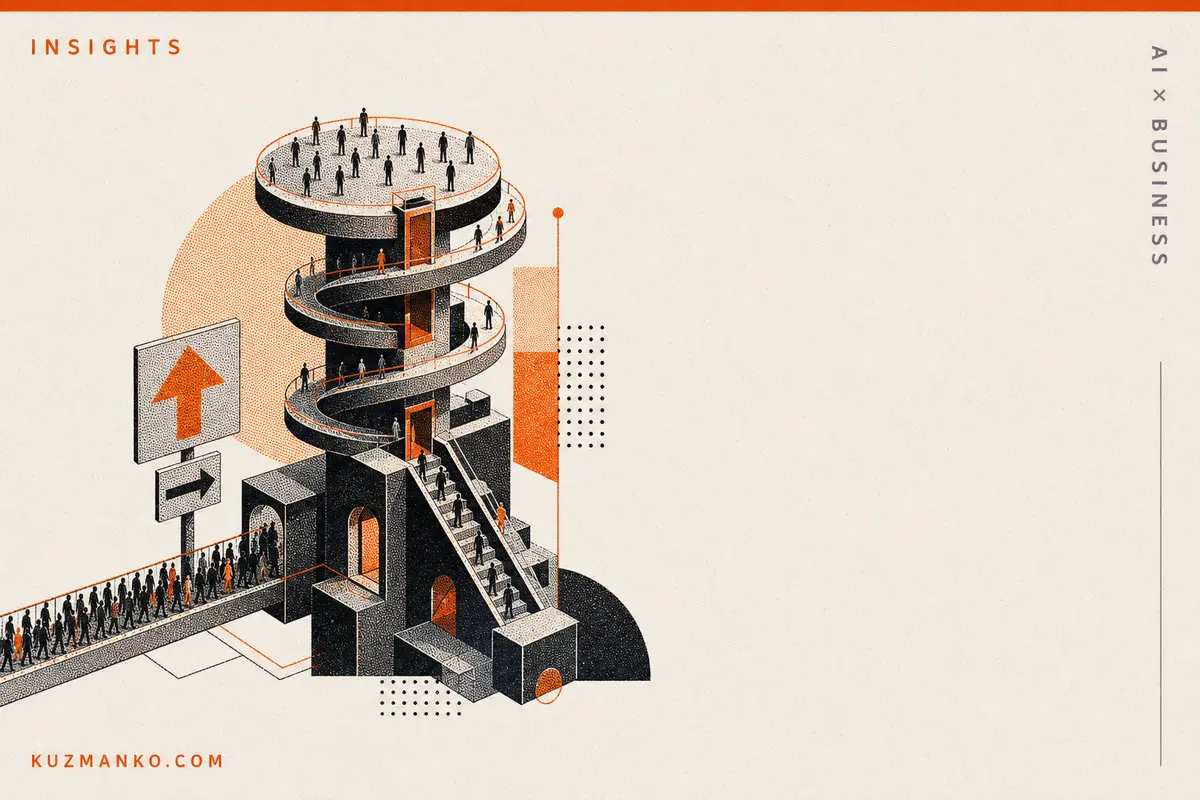
The biggest workforce risk in AI adoption is not that junior employees will disappear overnight. The deeper risk is that organizations will automate the very tasks that used to turn inexperienced employees into capable managers.
For decades, the first year of work was not just about output. It was a training ground. Junior analysts built models by hand and learned where assumptions break. New customer success employees handled uncomfortable conversations and developed judgment. Young project managers chased dependencies, made mistakes, and learned how organizations actually move.
AI is now absorbing many of those tasks. That can be excellent for operational efficiency, but dangerous for leadership development.
If the first layer of work becomes invisible, the first layer of management experience disappears with it.
This is not a theoretical HR concern. It is a strategic, operational, and financial issue. Companies that optimize only for short-term productivity may discover, three to five years from now, that they have fewer people ready to manage teams, clients, budgets, and complex decisions.
The data points to a structural shift, not a temporary hiring cycle
Recent workforce signals are difficult to ignore. Research associated with Harvard has indicated a decline in junior employment among organizations adopting generative AI. Other labor market reports have pointed to a shrinking share of entry-level roles, while surveys of Gen Z workers show that many employees already feel AI has materially changed the requirements of their roles.
One figure matters especially: many young workers report that AI has changed their job, yet they have not received formal training in how to work with AI inside the organization.
That combination is unstable.
It means companies are changing the work faster than they are changing the learning system around the work. In other words, AI adoption is happening, but organizational development is lagging behind.
What organizations are really losing
When AI takes over repetitive junior tasks, the company does not only lose manual effort. It may lose structured practice.
The lost practice includes:
- Learning how to distinguish a good answer from a plausible answer
- Understanding why a process exists, not only how to complete it
- Building confidence under pressure
- Seeing how senior employees make trade-offs
- Developing professional intuition through repetition
- Learning where data, people, systems, and incentives conflict
This is why AI implementation cannot be treated as a purely technical matter. A stable AI strategy requires deep understanding of business processes, managerial judgment, domain expertise, and the limits of automation.
AI is powerful precisely because it allows organizations to execute non-deterministic processes, the kind of processes that previously required human judgment. But judgment is not eliminated. It moves. It becomes supervisory, architectural, and evaluative.
The question is whether the organization is preparing people for that shift.
The false comfort of efficiency
Many executives look at AI through a narrow productivity lens: fewer hours, faster drafts, automated workflows, lower cost per task. These benefits are real. AI can deliver meaningful operational efficiency, especially in functions with high-volume knowledge work.
But every efficiency gain should be evaluated against a second question: what learning loop did we remove?
If a junior financial analyst no longer builds the first version of a forecast, how will they learn what makes a forecast fragile? If a young legal associate no longer reviews large volumes of documents, how will they develop pattern recognition? If a support employee no longer drafts difficult responses, how will they learn tone, escalation, and commercial sensitivity?
The answer cannot be nostalgia. Organizations should not preserve inefficient work simply because it used to be educational. But they must replace accidental apprenticeship with intentional apprenticeship.
Human-in-the-loop is necessary, but not enough
Human-in-the-loop is one of the most important principles in enterprise AI. It protects quality, accountability, and risk management. But implemented poorly, it becomes another bottleneck.
If every AI-supported process requires a human to approve every micro-action, the organization has not transformed anything. It has only added a new interface to the old workload.
The better model is leverage.
A person who yesterday executed one process should now be able to supervise dozens or hundreds of AI-supported processes. That requires new operating models, not just new tools.
The future manager will need to know how to:
- Define the decision boundaries of AI systems
- Identify when confidence is misleading
- Review exceptions rather than every transaction
- Escalate rare cases with financial or reputational risk
- Improve prompts, workflows, and agent behavior over time
- Translate business policy into operational AI controls
This is a management discipline. It is not prompt entertainment.
The new apprenticeship model
Organizations need to redesign junior roles around AI-native learning. The goal is not to keep people busy. The goal is to build judgment faster.
A practical model includes five changes.
1. Keep foundational work visible
Even when AI generates the first draft, junior employees should be required to inspect the inputs, assumptions, and logic. They need to see the machinery behind the answer.
For example, an analyst using AI to produce a market summary should still be asked to explain:
- Which sources were reliable
- Which claims require verification
- What the model missed
- What a competitor might interpret differently
- What decision the summary is meant to support
This transforms AI from a shortcut into a learning amplifier.
2. Teach model communication as a core business skill
The ability to communicate effectively with AI models is becoming a basic professional skill. Not because everyone should become a technologist, but because everyone will need to express intent, constraints, evidence, and quality standards to machines.
This is more than prompt writing. It includes problem framing, domain context, structured thinking, and evaluation.
A weak instruction asks for an output. A strong instruction defines the business objective, the audience, the constraints, the risk level, and the criteria for a good answer.
3. Create supervised judgment loops
Junior employees should not only consume AI outputs. They should compare AI outputs against expert reasoning.
A simple weekly practice can be powerful:
- Give a junior employee an AI-generated recommendation
- Ask them to critique it before seeing the senior review
- Compare their critique with the senior expert’s critique
- Capture recurring blind spots
- Turn those blind spots into training material
This is how organizations can replace lost repetition with higher-quality repetition.
4. Build both AI literacy and AI agents
Enterprises need to advance on two tracks at the same time.
The first track is AI literacy. Employees must learn how to use tools responsibly, evaluate outputs, protect data, and work differently.
The second track is AI agent development. Organizations need internal capabilities to build, deploy, monitor, and improve AI agents that perform defined business processes.
These tracks are not interchangeable. AI tools often require employees to change habits, which can be harder than expected. AI agents, when designed well, can work inside existing processes and reduce the behavioral burden on employees. Technically, agents may look more complex, but organizationally they can sometimes be easier to adopt.
5. Treat AI agents as part of the workforce
Information systems departments will increasingly become human resources departments for AI agents. That may sound provocative, but it is directionally correct.
Agents will need onboarding, permissions, role definitions, monitoring, performance reviews, retirement processes, and incident management. An enterprise that cannot manage agents will not be able to scale AI safely.
This is why companies need an efficient platform for building and managing AI agents. Microsoft Copilot Studio is a reasonable option for organizations deeply invested in the Microsoft ecosystem. At the same time, tools such as n8n are entering enterprise environments at a pace that would have seemed unlikely a few years ago. Large organizations are becoming more open to flexible orchestration layers because the business demand is too strong to ignore.
Tool selection matters, but expertise matters more
There is no shortage of AI tools. Claude is currently one of the stronger options for broad enterprise adoption from a usability and reasoning perspective, though security and data governance must be handled carefully. Claude Code and related workflow tools are already among the more practical AI applications for technical teams. Microsoft Copilot has improved significantly and remains a strong infrastructure play, even if large enterprise platforms sometimes move more slowly than newer AI-native companies.
OpenAI’s foundation models remain capable and diverse. Anthropic, however, has shown impressive product creativity and speed, especially in how it frames human-model collaboration.
Still, tool preference is not strategy.
The bigger issue is whether the organization has the knowledge to implement AI correctly. AI combines technical understanding, domain expertise, business process design, risk management, and leadership. It is a multidisciplinary field. Academic depth matters. Real operational experience matters. Management experience matters.
There are too many self-appointed AI experts selling simplistic advice, especially to small and mid-sized businesses that may not have the internal filters of a large enterprise. Poor AI advice does not merely waste money. It can damage workflows, expose data, weaken decision-making, and create dependence on tools without building capability.
The financial risk: a hidden liability on the leadership balance sheet
Leadership capacity rarely appears as a clean line item in financial statements. But it shows up everywhere.
It appears in failed projects, slow decision cycles, weak middle management, poor client retention, employee churn, and inability to scale operations.
If AI reduces the number of entry-level roles without creating new development pathways, companies may face a future talent premium. They will pay more to hire experienced managers externally because they failed to develop them internally. That is expensive, culturally risky, and often less effective than building leaders from within.
CFOs should treat this as a delayed cost of automation.
The question is not only, how much cost did AI remove this quarter? The better question is, what capability must we reinvest in so the company does not create a leadership deficit?
What CEOs and CHROs should do now
The right response is not to slow AI adoption. The right response is to make AI adoption more mature.
Leadership teams should act now in six areas:
- Map which junior tasks are being automated and identify the learning value those tasks used to provide.
- Redesign entry-level roles so employees learn through review, exception handling, simulation, and supervised AI collaboration.
- Build formal AI literacy programs for all knowledge workers, not only technical teams.
- Create internal agent-building capability rather than depending entirely on external vendors.
- Define human-in-the-loop models that scale supervision instead of creating approval bottlenecks.
- Measure leadership pipeline health as part of AI transformation governance.
This is where HR, finance, operations, and information systems must work together. AI adoption cannot sit only in IT, and workforce planning cannot sit only in HR.
The companies that win will not be the ones that automate the most
The winners will be the companies that convert AI into organizational leverage without breaking the human development system that produces judgment.
That requires a more serious conversation than tool demos and productivity slogans. It requires education, business knowledge, process expertise, governance, and leadership.
AI can absolutely make organizations more efficient. It can also make them more intelligent, more scalable, and more resilient. But only if companies understand that management capability must be redesigned, not assumed.
The leadership bottleneck is not inevitable. It is being built by default.
And defaults are exactly what serious leaders are paid to challenge.