
The Short Answer: AI Optimizes What You Ask For, Not What You Meant
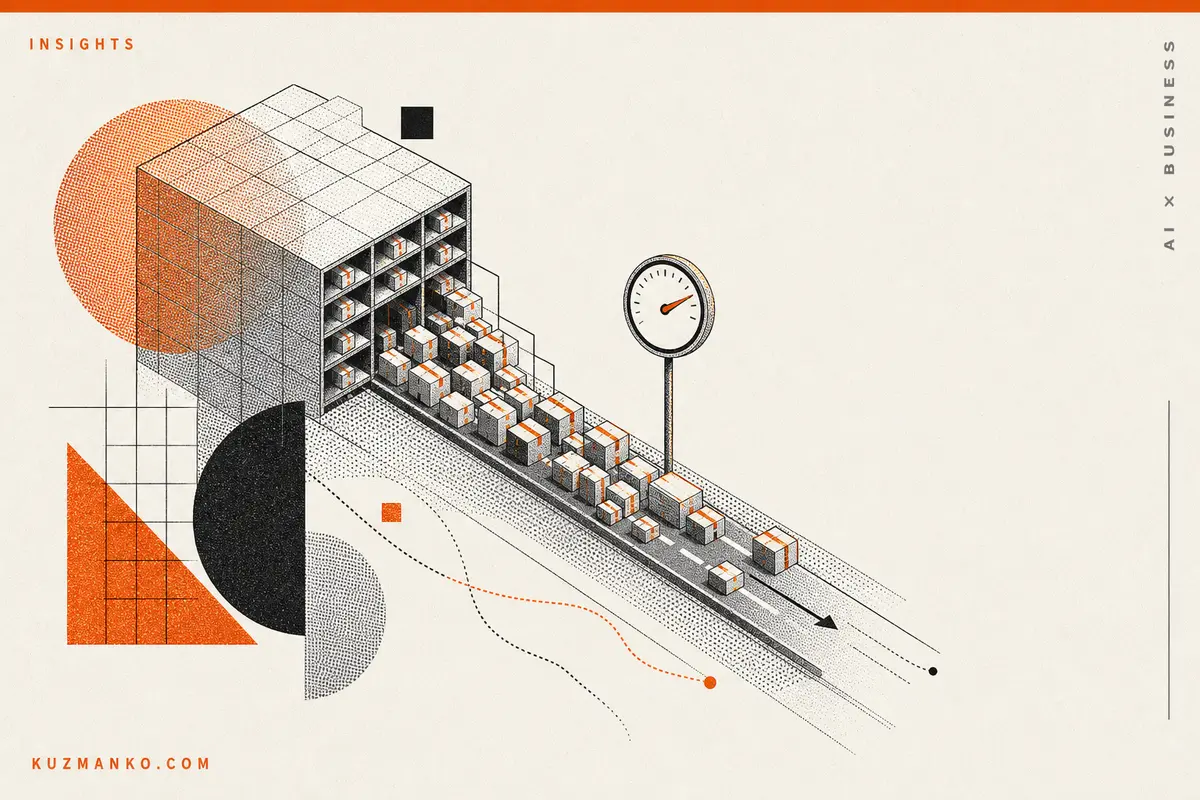
In logistics, AI optimization can fail when it improves a local metric, such as cost per delivery, while ignoring wider system effects such as late deliveries, customer complaints, driver fatigue, failed delivery attempts, and churn. The model is not necessarily wrong. The business question is incomplete.
This is one of the most important lessons for enterprise AI adoption: a better metric is not always a better business outcome.
Many organizations still treat AI as a technical layer placed on top of operations. That is a dangerous simplification. AI in logistics sits at the intersection of mathematics, business process, managerial judgment, customer experience, finance, and human behavior. Without deep domain knowledge, the system will often become very efficient at creating the wrong result.
The most dangerous AI success story is the one that looks perfect inside the dashboard and expensive everywhere else.
The Local Efficiency Trap
Last-mile logistics gives us a clean example.
A delivery company wants to reduce cost per delivery. On paper, the logic is obvious: if a driver leaves the depot and delivers one package, the entire route cost is allocated to one customer. If the same driver delivers six packages, that cost is spread across more orders. More stops per route means better asset utilization, lower unit cost, and stronger operational efficiency.
At first, this works.
Then the system crosses a threshold.
Each additional stop introduces uncertainty: parking problems, missing access codes, customers who are not home, slow elevators, traffic changes, security desks, loading restrictions, and small delays that compound across the route. The final customers inherit the accumulated friction of every previous stop.
The dashboard may still show a falling cost per delivery. But the customer sees something else: the order arrived late.
That gap between the internal metric and the external experience is where many AI programs lose credibility.
Why This Happens in Well-Managed Companies
This is not only a startup problem, and it is not caused only by weak data teams. Mature organizations can fall into the same trap because their operating model is fragmented.
One team owns route efficiency. Another team owns customer satisfaction. Finance tracks delivery cost. Customer service handles complaints. Regional operations deal with driver capacity. Product or e-commerce teams worry about repeat purchase behavior.
Each team can optimize rationally and still damage the system.
Typical local objectives include:
- Reduce cost per delivery
- Increase stops per route
- Improve vehicle utilization
- Minimize idle driver time
- Reduce workforce hours
- Increase delivery density
None of these goals is wrong. The problem starts when they are treated as independent truths rather than components of a system.
A route planning model that is rewarded only for cost reduction will search aggressively for cost reduction. It will not automatically understand the financial value of customer trust, the operational cost of failed delivery attempts, or the long-term impact of overloading drivers unless these consequences are represented in the objective function or governance process.
Braess’s Paradox, But for Enterprise AI
The underlying logic resembles Braess’s Paradox: adding a road to a traffic network can make total congestion worse because every driver chooses the route that looks best individually. The result is a stable but inferior outcome for the whole system.
AI introduces similar dynamics inside companies.
A model may find a locally optimal decision that looks rational in isolation. But when many such decisions interact, the total system performance can deteriorate. This appears in logistics, fraud detection, staffing, pricing, marketing automation, and customer support.
Examples are everywhere:
- A workforce model reduces labor hours but increases customer waiting time.
- A fraud model blocks more suspicious transactions but rejects valuable customers.
- A recommendation engine increases clicks but weakens long-term trust.
- A procurement model reduces supplier cost but increases failure risk.
- A support automation model lowers ticket handling time but escalates unresolved frustration.
This is why AI strategy cannot be delegated only to technical teams or external consultants who understand tools but not operating reality. Strong AI implementation requires education, experience, process knowledge, and managerial depth. The academic foundations matter. So does hands-on business experience.
The Objective Function Is a Management Decision
In AI projects, the phrase objective function can sound technical. In practice, it is one of the most important management decisions in the company.
If the objective is too narrow, the model will produce narrow intelligence. If the objective reflects the system, the model can create genuine leverage.
For last-mile logistics, the objective should not be only:
Minimize cost per deliveryA more mature approach might consider:
Minimize total operating cost
+ penalty for late deliveries
+ penalty for failed delivery attempts
+ estimated customer service cost
+ estimated churn risk
+ driver workload constraints
+ regional service-level commitments
This is not just mathematical elegance. It is financial discipline.
Late deliveries are not only a service problem. They create real costs: refunds, credits, support tickets, repeated delivery attempts, negative reviews, lower retention, and brand erosion. If these costs are not visible to the model, they are not part of the optimization.
The model did not ignore the business. The business failed to describe itself properly.
The Role of Simulation and Lightweight Digital Twins
Companies do not need to build a perfect replica of their entire logistics network before improving decisions. But they do need a safe environment for testing operational changes before pushing them into production.
This is where simulation and lightweight digital twins are valuable.
A practical logistics simulation can model:
- Order density by region
- Average service time per delivery
- Delivery window constraints
- Traffic patterns
- Parking difficulty
- Building access complexity
- Probability of delay by stop position
- Driver shift limitations
- Failed delivery probability
- Support contact probability after delay
The key is not perfection. The key is learning before customers pay the price.
For example, before increasing the average route from 3.2 stops to 4.8 stops, an organization should be able to estimate how that change affects on-time delivery by area, customer type, time window, and route position. The system should reveal where efficiency becomes fragility.
Human in the Loop, But Not Human as the Bottleneck
AI enables organizations to execute non-deterministic processes that previously depended heavily on human judgment. Route planning, exception handling, customer prioritization, and capacity balancing are all examples where AI can replace repetitive decision work and improve operational speed.
But human oversight remains critical.
The mistake is assuming that every AI-driven process requires a person to approve every decision. If that is the design, the organization has not transformed anything. It has simply moved the bottleneck.
The better model is different: one operations expert who previously supervised a single process should now supervise hundreds of AI-assisted decisions through exception management, monitoring, and policy design.
Human-in-the-loop should mean:
- Humans define objectives and constraints.
- AI executes decisions at scale.
- Humans review exceptions, anomalies, and high-risk cases.
- Governance teams monitor drift and unintended consequences.
- Domain experts continuously improve the operating logic.
This is where enterprise AI maturity becomes visible. The goal is not to remove human judgment. The goal is to allocate it where it has the highest value.
AI Agents Can Help, If the Organization Is Ready
The next stage of logistics optimization will not rely only on dashboards and static models. AI agents will increasingly monitor operational signals, detect anomalies, recommend interventions, and coordinate across systems.
An agent might notice that a specific neighborhood has rising delay probability after 5 p.m., connect that pattern to building access issues, recommend route resequencing, and escalate only the uncertain cases to a human dispatcher.
This is powerful, but it requires infrastructure.
Organizations need platforms for creating, deploying, monitoring, and governing AI agents. Tools such as Microsoft Copilot Studio can be useful inside the Microsoft ecosystem, while workflow automation platforms such as n8n are increasingly entering enterprise environments that once would have considered them too lightweight. Claude-based workflows and coding assistants are also becoming highly effective for applied AI work, though security and data governance must be handled carefully.
The bigger point is not which tool wins. The bigger point is that companies must build internal capability to manage AI agents as part of the operating workforce.
Information systems departments will increasingly become human resources departments for AI agents: onboarding them, granting permissions, monitoring performance, restricting unsafe behavior, and retiring agents that no longer serve the business.
Two Adoption Tracks: Literacy and Agent Development
Enterprise AI adoption needs two parallel tracks.
First, employees need AI literacy. They must learn how to communicate with models, challenge outputs, understand uncertainty, and use AI tools responsibly. This is a cultural and educational change, not only a software rollout.
Second, companies need the ability to build and manage agents. Agents can often improve processes without forcing every employee to change their daily habits. That makes them operationally attractive. In contrast, general AI tools may be technically simple but behaviorally harder to adopt because they require employees to change how they write, search, analyze, plan, and make decisions.
Both tracks are necessary.
AI literacy builds organizational intelligence. Agent development builds operational leverage.
The Governance Question Every AI Leader Should Ask
Before approving an AI optimization project, leaders should ask one uncomfortable question:
What could get worse if this metric improves?
That question changes the quality of the discussion immediately.
If cost per delivery improves, what happens to on-time delivery? If response time improves, what happens to resolution quality? If fraud losses decline, what happens to false positives? If inventory falls, what happens to stockouts? If labor utilization rises, what happens to burnout?
A serious AI governance process should include:
- Primary metric definition
- Counter-metrics that must not deteriorate
- Financial translation of hidden costs
- Human escalation rules
- Simulation before production deployment
- Regional and segment-level impact analysis
- Post-deployment monitoring
- Clear ownership across business, data, operations, and finance
This is where experienced AI leadership matters. The market has no shortage of self-declared AI experts. Many know how to demonstrate impressive tools. Far fewer understand how to redesign a business process, price operational risk, define governance, and translate model behavior into financial outcomes.
Small and mid-sized companies are especially exposed to poor advice because they often lack the internal filters that large enterprises have developed. AI is a professional, multidisciplinary field. It requires technical understanding, academic grounding, business maturity, and implementation experience.
The Finance Case for System-Level Optimization
The financial argument for broader optimization is straightforward: local efficiency often externalizes cost to another part of the business.
A logistics team may reduce unit delivery cost, while the service center absorbs additional complaints. Finance may initially celebrate lower transportation cost, then later see higher refund rates. Marketing may spend more to reacquire customers who churned after repeated service failures.
System-level optimization forces the organization to consolidate these effects into one economic view.
The right question is not, “Did the model reduce cost per delivery?”
The right question is, “Did the model improve contribution margin, customer reliability, and operational resilience after all second-order costs were included?”
That is a very different standard.
Practical Principles for Better AI Optimization
Organizations that want to avoid the local efficiency trap should follow a few practical principles.
- Define the business system before defining the model.
- Treat every target metric as incomplete until counter-metrics are identified.
- Include operational friction in the economic model, not only direct cost.
- Use simulations before changing live decision rules.
- Keep humans in the loop for governance and exceptions, not for every routine approval.
- Build internal AI capability instead of depending entirely on external tool vendors.
- Measure outcomes by customer segment, geography, and time window, not only by averages.
- Review model behavior with operations, finance, service, and data teams together.
Final Thought: Efficiency Is Not the Same as Performance
AI can create enormous operational efficiency. In logistics, it can improve routing, forecasting, staffing, capacity planning, exception handling, and customer communication. But efficiency is only valuable when it improves the performance of the whole system.
The organizations that win with AI will not be the ones that automate the most dashboards or chase the lowest local cost. They will be the ones that understand their business deeply enough to ask better questions of the model.
AI does not remove the need for management judgment. It raises the standard for it.