
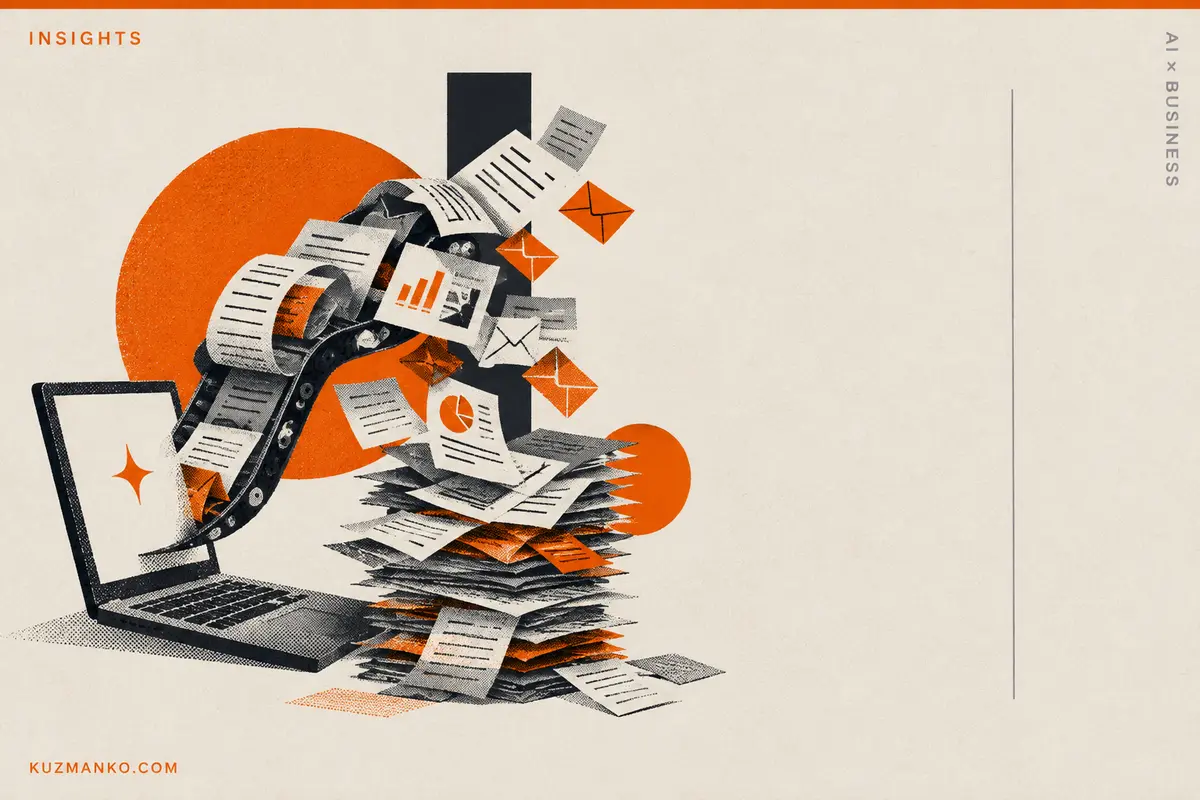
AI workslop looks professional but leaves the real work to the reader: checking facts, filling in context and figuring out what actually needs to happen. Reducing it requires organizations to measure business outcomes rather than tool usage, assign ownership of deliverables and build controls around risk.
When a company encourages employees to use AI and then penalizes them for producing bloated documents, it needs to examine its own instructions. Using a model does not remove personal accountability. But buying licenses and announcing an AI initiative is no substitute for a working implementation approach.
Key insight: The savings may change hands. A document written faster does not necessarily save the organization time. If its readers must correct, verify and interpret it, the work may simply have shifted from the writer to everyone else.
This distinction matters especially for managers. It is easy to see how quickly a presentation was created. It is much harder to see the time subsequently spent on clarification calls, corrections and reversing decisions based on faulty assumptions.
What the shift from encouraging AI to threatening dismissal reveals
At recruitment company Twill, an enterprise Claude subscription was followed by internal messages that were overly polished, lacked context and were sometimes incorrect. Founder and CEO Michelle Volberg asked employees to return to communicating in their own voices. In other reported cases, companies restricted AI-assisted writing. At public relations agency FischTank PR, an employee was dismissed after repeatedly violating such a ban.
These examples do not show that AI is useless. They expose the gap between adopting a tool and building a capability. A model can draft an excellent message even when its user has not established what happened with the client, checked the data or formed a judgment.
The phenomenon is called workslop: AI-assisted work that looks finished but does not move the task forward. Not every long document qualifies, and not every model-generated text is problematic. The test is whether the output adds information, judgment or a clear next action.
Management objectives can also be part of the problem. If employees believe they are expected to demonstrate AI usage, they may produce more deliverables rather than solve more problems. Punishing them without fixing that incentive leaves the underlying failure intact.
The metric that should replace prompt counts
A CFO needs to know more than how many employees used a tool. They need to know whether process costs fell, decision quality held up and turnaround times improved without creating downstream operational debt.
That means evaluating preparation, review, correction and exception-handling time. Usage metrics remain useful for understanding adoption, but they are not proof of productivity.
- Messages sent to the model: Measure time to an approved resolution, not just interaction volume.
- Documents generated: Track the proportion accepted without revision, not just the number produced.
- Summary length: Assess whether the summary enables a decision, not how much text it contains.
- Drafting time: Measure total work across the process, not just time spent creating the first draft.
- Active-user rate: Evaluate handling costs and outcome quality alongside participation.
The point is not to stop tracking usage. It is to put usage in its proper place. An employee who uses a model less but completes a process to a higher standard may create more value than someone who generates dozens of drafts.
The organization does not need more text. It needs less unresolved work passed from person to person.
Before the prompt, define an acceptable deliverable
Suppose an account manager asks a model to prepare an update about a delayed project. Without verified facts, the model may supply plausible explanations, soften problems and draft commitments nobody has approved. This is not merely a writing problem. It can become a commercial commitment.
Instead of asking for a professional, reassuring message, define the inputs and boundaries of the task:
- What is known for certain, and which source supports it.
- What remains unverified and must not be presented as fact.
- What decision or action the recipient needs to take.
- Which commitments require approval from an authorized person.
- What information may be entered into the tool under company policy.
This is the foundation of AI literacy. It is not just about writing a good prompt. It means understanding what the model does not know, how to check its response and when not to use it. Even a capable system such as Claude does not inherently know the business context. Choosing a working environment also requires reviewing permissions, sensitive information and terms of use.
A short policy employees can actually apply
A useful policy does more than tell employees to check every answer. It explains what to check, who is responsible and what to do when information is missing. Build it around a defined business process rather than a blanket ban on a particular tool.
- Define the deliverable and decision: Clarify who will use the output and what action it must enable.
- Set sources and boundaries: Specify permitted information, authoritative sources and claims that require verification.
- Assign accountability: Name a process owner responsible for quality and approval rules.
- Build risk-based controls: Combine automated checks, sampling and human review according to the consequences of an error.
- Measure and improve: Track total time, corrections and exceptions, then adjust the process accordingly.
These steps turn general guidance into an operating process. Routine internal communication may need relatively light controls. A price quotation, legal response or customer message about a security incident requires more rigorous review. Risk determines the depth of scrutiny, not how formal the language sounds.
Human oversight does not mean editing every paragraph
The instinctive response to workslop is to require human approval for every output. Sometimes that is necessary. As a blanket policy, however, it can eliminate the economic benefit of automation.
The goal is to let a person oversee multiple processes through exception queues, quality sampling, documentation and escalation. Automated checks can flag missing fields, violations of defined rules or amounts above a specified threshold. They cannot guarantee that the business meaning is correct, so professional judgment is still needed where appropriate.
Watch out: Do not fire someone based on an AI text detector. AI-writing detection tools are not reliable enough, on their own, to support an employment decision. Examine the output, the alleged policy violation and the fairness of the process rather than inferring misconduct from writing style.
That warning does not absolve employees of responsibility. Anyone who sends an unchecked figure or violates a clear policy should be held accountable. But a management investigation should focus on conduct and evidence, not guesses about who composed a sentence.
Two paths to adoption that does not create more noise
The first path is employee literacy: defining tasks, evaluating outputs, verifying sources and applying professional judgment. The second is building agents and controlled workflows: connecting authorized information, limiting actions, maintaining records and establishing controls.
An open-ended writing tool requires every employee to develop new working habits. A focused agent, such as one that drafts an update from a customer relationship management system, can fit into an existing process and reduce manual entry and the need to fill in details. It still needs appropriate permissions and checks. Calling it an agent does not make it immune to fabrication.
Success on both paths requires internal capability that connects information systems, domain expertise and process management. Consultant selection should likewise be based on relevant education, methodological understanding and demonstrated business experience, not just an impressive demo. A durable implementation requires knowing how to define quality, build tests and handle failures in practice.
The right leadership decision is not a choice between enthusiasm for AI and banning it. It is to choose an important process, define an acceptable deliverable and measure the work from end to end. When an organization rewards problem-solving rather than document production, AI has a real chance to save work instead of merely rewriting it.