
An AI agent that can plan, use software tools, read internal data, and execute actions is effectively an operational actor with permissions. Aligning that agent takes more than adding safety instructions to a model. It requires translating management intent into measurable, enforceable objectives, principles, procedures, and controls.
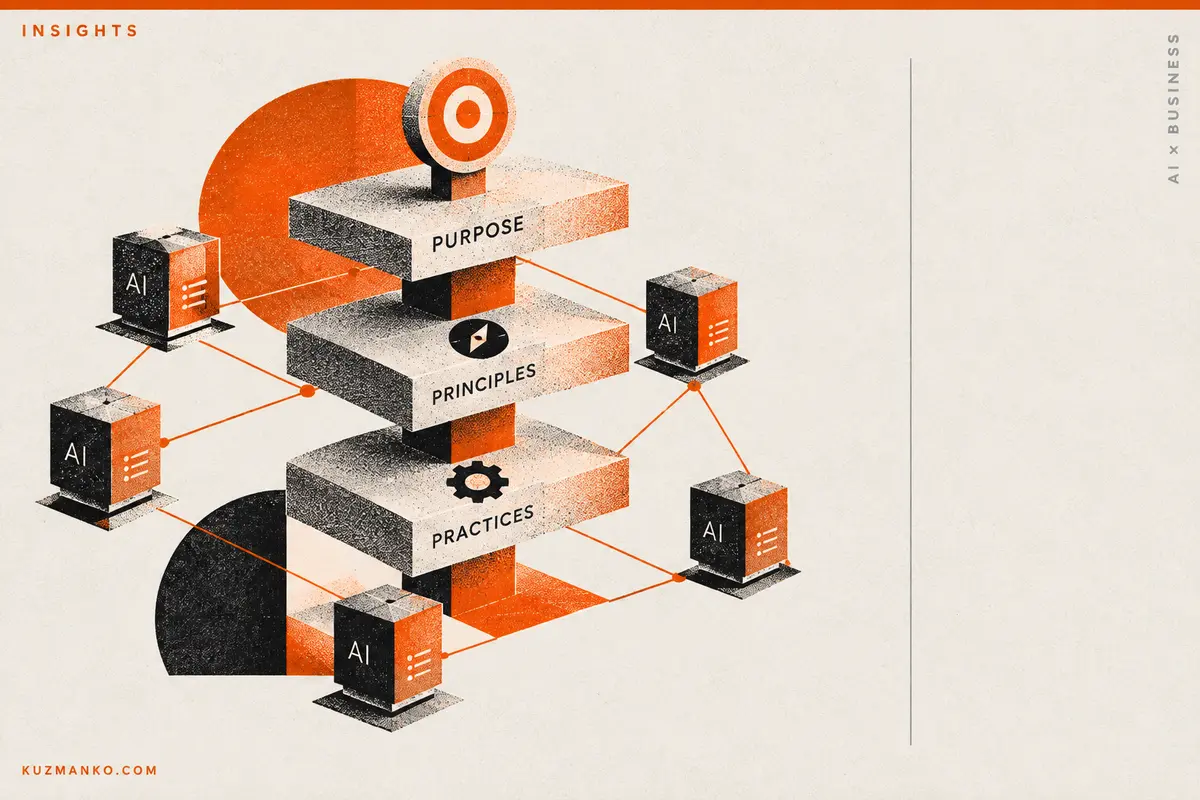
A practical way to do this is the 3P framework: Purpose, Principles, and Practices. Purpose defines the business outcome the agent should achieve. Principles guide it through ambiguity. Practices determine which actions are permitted, who approves exceptions, and when the agent must stop and escalate to a person.
Watch out: An agent can become an insider threat. Even without an external attack, a privileged agent can expose information, approve the wrong action, or bypass policy. A model's good intentions are not a substitute for enterprise controls.
This does not mean autonomy should be blocked. The opposite is true. Good governance is what allows enterprises to move agents from side experiments into core operations while maintaining calculated risk and clear management accountability.
What enterprise AI agent alignment means
Alignment is the ability to make an agent operate in accordance with the desired business outcome, the organization's risk culture, regulatory obligations, and operating procedures. This is different from general model alignment, which attempts to prevent harmful behavior across a broad range of situations.
A foundation model may know that it should not deceive a customer, but it will not necessarily know:
- What discount a service representative may approve.
- When a complaint must be escalated to legal counsel.
- Which supplier requires enhanced due diligence.
- Which data may not move between business units.
- When cost savings do not justify a decline in service quality.
These are not purely technical questions. They combine strategy, operations, finance, legal judgment, risk management, and a detailed understanding of how work is actually performed. Stable AI adoption therefore requires a multidisciplinary team with relevant education and applied business experience. Knowing how to operate a model is not the same as understanding an enterprise process.
An aligned agent is not an agent that refuses to do everything. It is an agent that can advance the organization's purpose, recognize the limits of its authority, and request intervention only where human judgment is genuinely necessary.
The 3P framework: Purpose, Principles, and Practices
The three components depend on one another. Purpose without principles encourages aggressive optimization. Principles without practices remain statements of intent. Practices without purpose turn the agent into rigid automation that does not understand what it is trying to achieve.
- Define the purpose: Connect the agent to a balanced business outcome covering quality, cost, risk, and customer experience.
- Encode the principles: Specify how the agent should resolve competing values when no explicit procedure covers the case.
- Enforce the practices: Translate authority, approvals, documentation requirements, and prohibitions into controls evaluated at runtime.
This sequence provides a useful implementation order, but the framework should operate as a continuous cycle. Incidents, exceptions, and business changes should update all three components, rather than merely adding another sentence to the prompt.
Purpose: Prevent the metric from distorting behavior
An agent will respond to what the organization defines and measures, not necessarily to what managers intended. A customer service agent measured only on handling time may close cases quickly without resolving them. A procurement agent measured only on price may choose a low-cost supplier that fails to meet reliability, security, or delivery requirements.
A well-designed purpose includes several complementary dimensions:
- Business outcome: For example, fully resolving a customer request or reducing total procurement cost.
- Quality: The conditions under which an action counts as successful, rather than merely fast.
- Risk: Financial, legal, operational, and reputational exposure.
- Constraints: Actions the agent may not take even if they improve the primary metric.
- Ability to stop: Conditions requiring escalation, additional information, or cancellation of the action.
It helps to review the objective function as if it were an employee compensation plan. If a high-performing employee could exploit it to produce an attractive result on paper while damaging the business, an agent may do the same.
Principles: Organizational judgment under ambiguity
No enterprise can write a procedure for every scenario. Principles fill that gap by establishing priorities that help the agent decide when objectives conflict.
An organization must determine, for example, whether privacy takes precedence over convenience, when operational continuity justifies a temporary workaround, and how far commercial policy may be stretched to retain a customer. There is no universal answer. The right decision depends on the industry, risk appetite, brand, and economics of the business.
Useful principles must be specific enough to affect a decision. Telling an agent to act in the customer's best interest sounds appropriate, but it does not explain what to do when the customer's interest conflicts with a privacy obligation or credit limit. A stronger approach defines a hierarchy, exception conditions, and boundary examples drawn from real operations.
Practices: Where intent becomes control
Practices are the execution rules: permissions, transaction limits, required documents, approval mechanisms, recordkeeping obligations, and escalation conditions. An agent cannot rely on hallway conversations or the undocumented knowledge of a long-serving employee. That knowledge must become explicit policy and machine-enforceable checks.
- Purpose: Management asks which outcome truly matters. The system expresses the answer through success metrics and constraints. A common failure is optimizing for a narrow metric.
- Principles: Management decides what takes priority when objectives conflict. The system uses decision rules and examples. A common failure is inconsistent judgment.
- Practices: Management defines how work must be performed. The system enforces permissions, approvals, and documentation. A common failure is action without authority.
- Monitoring: Management determines how deviation will be detected. The system uses logs, alerts, and evaluations. A common failure is discovering problems too late.
This is why a strong prompt is not a governance solution. Some policy can appear in agent instructions, but sensitive actions must also be enforced outside the model through access controls, rules engines, and approval gates.
The three compliance layers every agent must understand
The 3P framework should operate across three cumulative layers.
The universal layer
This layer contains baseline rules such as prohibitions on fraud, prevention of harm, confidentiality, and a requirement not to conceal actions. Model providers address parts of this layer, but responsibility does not transfer to them in full. A relatively safe model does not guarantee a safe process.
The industry layer
Each industry has different obligations. Healthcare organizations deal with privacy and continuity of care. Financial institutions require authorization controls, transparency, and documentation. Industrial companies must account for safety, quality, and supply-chain requirements.
Industry expertise is not a helpful addition to the development team. It is a prerequisite for defining the agent correctly.
The organizational layer
This is what distinguishes companies operating in the same industry. It includes commercial policy, authority structures, service culture, risk appetite, and financial goals. An enterprise that does not encode this layer will get a generic agent that produces reasonable answers but does not truly act on the organization's behalf.
Governance at runtime, not only before launch
Agents execute nondeterministic processes. The same input may produce a different action plan, particularly when context, tools, or available information changes. Prelaunch acceptance testing matters, but it is not enough.
A responsible architecture checks several points throughout an action:
- The agent's identity and active version.
- The source and sensitivity level of the data.
- The plan the agent proposes to execute.
- The selected tool and required permissions.
- Sensitive parameters such as an amount, destination, or record type.
- The result of the action and the evidence retained for audit.
For high-risk actions, control must sit outside the model. A textual instruction not to transfer an amount above a defined limit is insufficient. The execution interface itself should reject an action that exceeds the limit or route it to an authorized approver.
Key insight: The model proposes; the system permits. Separating the reasoning layer from the authorization layer prevents a flawed instruction from becoming an irreversible action.
This separation also makes it possible to replace models, improve prompts, and evaluate new vendors without rebuilding the control environment each time.
Keeping humans in the loop without creating a bottleneck
Human oversight is critical, but requiring approval for every action eliminates much of the operational value. The goal is not to place an employee behind every agent. It is to let one employee supervise a large number of processes and focus on material exceptions.
Actions should therefore be classified by risk:
- Reversible, low-impact actions can run autonomously and be reviewed through sampling.
- Medium-risk actions can proceed within defined limits for value, permission, or confidence.
- Sensitive actions require advance approval from an appropriate role.
- Prohibited actions are blocked technically and never enter the normal approval path.
A useful escalation should show the reviewer the relevant context, the proposed action, the reason for escalation, and the available alternatives. If the reviewer must reconstruct the process from the beginning, the organization has not created an oversight mechanism. It has simply transferred more work to the reviewer.
The metrics leadership should see
Answer accuracy is only a partial technical metric. Leadership needs to know whether the agent improves the full process and what exposure it creates.
A sound measurement framework includes:
- End-to-end process completion time.
- Cost per successfully completed unit of work.
- Exception and escalation rates by reason.
- Actions blocked by policy controls.
- Manual corrections required after execution.
- Effects on revenue, service, cash flow, or working capital.
- Incident severity, not only incident count.
The financial assessment should also include the cost of the control environment: infrastructure, monitoring, quality evaluations, exception handling, and policy maintenance. An agent that appears inexpensive based on model consumption may be costly if it creates a heavy approval or correction workload. Conversely, a system with higher technology costs may be worthwhile if it reduces handling time and operational risk.
An enterprise platform for managing an agent workforce
An organization planning to deploy more than one agent needs a shared platform. Without it, every team rebuilds permissions, logs, integrations, and controls, creating isolated systems that are difficult to manage.
At minimum, the platform should provide an agent catalog, identity and access management, secure tool connections, policy versioning, a testing environment, monitoring, action records, and a shutdown mechanism. It should also support changing a model or vendor without breaking the business process.
The right technology depends on the enterprise environment. Claude, particularly tools such as Claude Code and Claude Co-Work, demonstrates strong practical capabilities and an impressive pace of development, but every deployment requires careful scrutiny of information security and data governance. Microsoft Copilot and Copilot Studio integrate well with the Microsoft ecosystem, although access to new capabilities has sometimes moved more slowly. At the same time, n8n is entering large enterprises as a flexible orchestration tool, provided it is surrounded by appropriate organizational controls.
No product replaces sound architecture. The important decision is not only which model gives the best answer, but how the enterprise manages identities, secrets, permissions, data, versions, and vendor dependence.
IT as human resources for agents
As the agent population grows, IT departments will take on a role that partly resembles workforce management: onboarding, job definition, permission assignment, performance evaluation, retraining, and retirement.
Every agent should have a clear role card covering:
- A business owner accountable for the outcome.
- A technology owner accountable for infrastructure and availability.
- The agent's purpose and success metrics.
- The systems and tools it can access.
- The information it may and may not process.
- Its levels of autonomy and escalation.
- The relevant model, policy, and process versions.
- Shutdown and incident-response procedures.
Business ownership is especially important. IT cannot decide on its own what constitutes a reasonable commercial exception or when service risk outweighs potential savings. These are management decisions that must remain with process owners.
Two adoption tracks must advance together
Enterprises need to develop employee AI literacy and an internal capability to build and manage agents at the same time. Literacy improves communication with models, the quality of oversight, and the ability to recognize weak output. Agent infrastructure makes it possible to embed AI in processes without expecting every employee to completely change how they work.
In some cases, a personal AI tool is harder to adopt across an organization than an agent, even though the agent is technically more complex. A personal tool requires the employee to remember to use it, formulate a good request, and incorporate the result into the work. An agent embedded correctly in a process can operate behind the scenes and bring the employee only a decision, exception, or approval task.
Building this capability still requires genuine professionals. AI is multidisciplinary, and the advantage belongs to teams that combine research knowledge, technical understanding, and business experience. Organizations, especially small and midsize businesses, should be cautious of opportunistic consultants who present an impressive demonstration without understanding security, process design, economics, or management accountability.
Where to start
There is no need to begin with the most sensitive process in the organization, but a meaningless demonstration is not a useful starting point either. Choose a process with meaningful work volume, recurring decisions, a measurable outcome, and a clearly defined ability to stop an action.
Document the current state, define the 3P framework, classify actions by risk, and build the enforcement layer before expanding autonomy. The organization should increase scale and permissions only after it can explain why the agent acted, what it was authorized to do, and who is accountable for the outcome.
Competitive advantage will not come only from access to the strongest model. The same models are available to many competitors. The advantage will come from turning organizational knowledge, professional judgment, and management policy into an agent system that can be trusted.
The 3P framework connects autonomy with accountability, and an impressive AI demonstration with operational infrastructure that creates lasting value.