
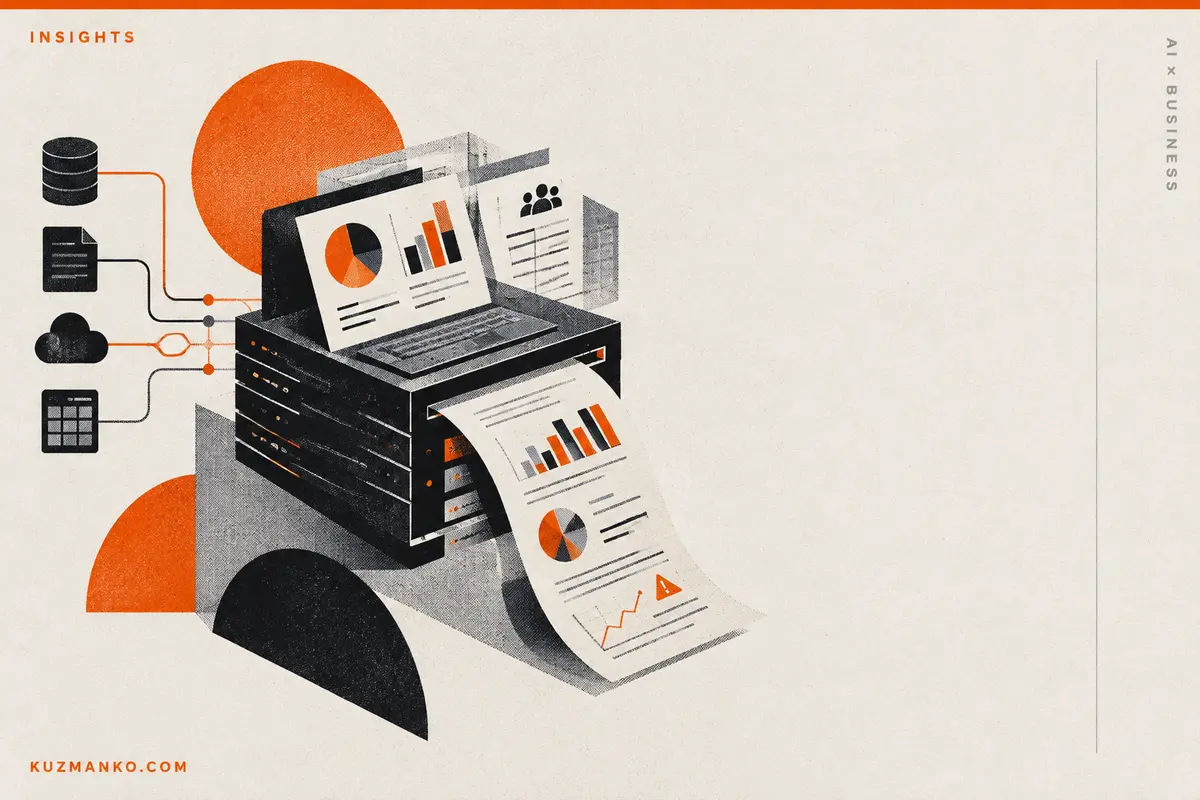
ChatGPT Work matters to enterprises because it targets an entire workflow, not just better writing. It can collect information from project systems, analyze operational and financial data, identify risks, prepare an executive presentation, and draft the weekly update. When implemented well, the Operations team moves from producing reports to supervising the system that produces them.
That is a meaningful change, but it is not a magic solution. Connecting a model to enterprise information does not make it a reliable operational system. Reliability requires a defined process, usable data, narrow permissions, control mechanisms, and clear management ownership.
Key insight: The product is not the main story. The important shift is from an assistant that drafts answers to an agent that executes an enterprise workflow under defined policies and controls.
What ChatGPT Work Changes in Practice
Operations teams spend a great deal of time on work that is not especially complex but demands concentration and coordination: chasing updates, comparing forecasts with actual performance, investigating delayed tasks, reconciling versions, and turning everything into slides executives can understand.
ChatGPT Work aims to reduce that friction through a single sequence:
- Access the project portal through Computer Use in read-only mode.
- Extract operational and financial data from existing sources.
- Calculate the current position, including weighted completion rates and forecast variances.
- Identify risks and propose management decisions.
- Populate the corporate presentation template and check for overflow.
- Draft the update, attach the PDF, and schedule delivery subject to approval.
The ability to propose a decision is the most interesting part. A traditional report says that a project is late. A useful operational system should explain what caused the variance, assess its significance, and recommend whether to move the project to at-risk status, request a recovery plan, or escalate a security exception for discussion.
An enterprise gains little from one more summary. It gains an advantage when the time between the appearance of an exception and an operational decision becomes shorter.
From Document Automation to Judgment Automation
AI is particularly useful in nondeterministic processes. A conventional rules engine can determine whether a deadline has passed. It has more difficulty assessing whether a small delay, a supplier dependency, a budget variance, and poor reporting quality together indicate a material risk. Models can create value here because they interpret context rather than checking fields alone.
However, a persuasive recommendation is not necessarily a correct one. A model may interpret incomplete information with confidence, miss a business constraint, or give too much weight to the wording used by a project manager. Enterprises should therefore separate three levels of authority:
- Read and analyze: The system collects information, calculates metrics, and summarizes exceptions.
- Recommend: The system proposes a status change, escalation, or recovery action.
- Execute: The system changes a record, sends a message, or creates a task in a target platform.
Broad automation may be appropriate at the analysis level. Recommendations can be subject to sampling and review. Actions with financial, legal, or organizational consequences should require explicit approval. This is not a temporary compromise. It is a control architecture.
Keep Humans in the Loop, but Put Them in the Right Place
Requiring approval before sending the weekly update is a sensible starting point. It is not a sufficient enterprise operating model. If an employee must reread every field, verify every figure, and approve every sentence, the organization has replaced preparation work with proofreading. It has not achieved a step change in productivity.
The goal is for someone who once supervised one process to oversee dozens of runs and eventually hundreds. To make that possible, people should focus primarily on exceptions:
- Missing information or contradictions between systems.
- A recommendation outside an approved policy.
- A change with budgetary or regulatory implications.
- Low confidence or an explanation unsupported by evidence.
- An irreversible action or communication to a sensitive audience.
Exception-based supervision requires the system to show more than its final output. It must also expose sources, assumptions, update times, and confidence levels. Human approval without that context is a ritual, not a control.
Watch out: Human approval is not insurance. When an approver receives hundreds of recommendations without prioritization or explanation, automatic approval becomes likely. Design exception thresholds, sampling, and deeper controls instead of adding an approval button to every action.
What the Operational Shift Looks Like
- Collecting updates: The manual process relies on requests and repeated follow-up. The AI-enabled process retrieves information from source systems. The right metric is collection time.
- Risk analysis: The manual process depends heavily on the individual manager. The AI-enabled process produces a consistent recommendation. The right metric is the number of exceptions detected in time.
- Executive presentation: The manual process requires direct editing. The AI-enabled process populates a template and checks the result. The right metric is time to an approved version.
- Weekly communication: The manual process requires drafting and sending. The AI-enabled process creates a scheduled draft. The right metric is the number of corrections required before delivery.
- Supervision: The manual process examines every item. The AI-enabled process directs attention to exceptions. The right metric is workload per supervisor.
This comparison shows why counting generated presentations is not enough. The business outcome is a shorter cycle time, better risk detection, and a larger volume of activity that each manager can supervise.
Information Security Starts with Permission Design
Read-only access reduces risk, but it does not eliminate it. Reading financial data, employee information, product plans, or security incidents remains sensitive even when the system cannot modify the source. The output may also combine details from several systems and expose a more sensitive picture than any individual source contains.
Before connecting ChatGPT Work to production systems, define:
- A separate service identity with strong authentication.
- Least-privilege permissions based on role and project.
- Separation between test and production environments.
- Data retention and activity logging policies.
- Data classifications that must not be passed to the model.
- Tests for prompt injection originating in source-system content.
- A mechanism for revoking access and stopping a run.
Traceability is equally important. When the system determines that a project is at risk, management needs to know which data supported that judgment. Every material recommendation should link to evidence that a reviewer can open and inspect, not merely to a polished paragraph.
Data Quality Sets the Ceiling on Value
A capable model will not repair a process in which managers fail to update status, forecasts use inconsistent formats, and the definition of risk changes between business units. It may conceal these problems behind a readable summary, which is more dangerous than an unattractive report that makes the gaps obvious.
Implementation should include an operational data contract: which fields are required, who owns each update, how frequently data must be refreshed, and what counts as an exception. The system should also distinguish among facts retrieved from a source, calculations derived from those facts, and interpretations generated by the model.
For example, a target date is a fact. The number of overdue days is a calculation. A recommendation to escalate the issue to senior management is an interpretation. When these categories are mixed together, auditing and improving the system becomes difficult.
A Sound Pilot Starts with One Process
A pilot is not a demonstration for executives. It is an operational experiment with a baseline, a defined user group, identified risks, and stopping criteria. Start with a recurring weekly process that uses information from several sources and produces an output that is easy to evaluate.
- Define the outcome: Choose one process and state what must improve for the business.
- Measure the current state: Record labor time, corrections, delays, and decision points before introducing AI.
- Restrict permissions: Begin with read-only access and systems that do not contain the most sensitive information.
- Design for exceptions: Decide which recommendations may proceed automatically and which require human review.
- Run in parallel: Compare the system's output with the existing process across several reporting cycles.
- Decide whether to scale: Expand only after the pilot meets predefined thresholds for value, risk, and adoption.
The pilot should include operational red teaming. Introduce conflicting information, leave required fields empty, place a malicious instruction inside a document, and test how the system reacts to a sudden permissions change. A system tested only against a clean scenario is not ready for enterprise work.
Metrics That Can Justify the Investment
The financial case should use a clear unit of work. Here, that unit might be one weekly reporting cycle for one project. Measure the cost before and after implementation, including user time, review time, model costs, integration maintenance, and incident handling.
Useful metrics include:
- Time from data collection to distribution of an approved update.
- Human working hours per reporting cycle.
- Number of material corrections before delivery.
- Percentage of risks detected before they become active problems.
- Response time after an exception appears.
- Number of processes one manager can supervise.
- Total cost per approved run.
ROI is not limited to hours saved. Detecting a variance early may be worth more than producing the presentation itself. Conversely, an error that reaches an executive meeting or a client can erase months of savings. Evaluation should therefore combine speed, quality, and risk.
One Tool Is Not an AI Strategy
ChatGPT Work reinforces a broader direction in the market. Model providers are moving beyond chat interfaces toward work layers that operate tools, read systems, and produce finished outputs. OpenAI offers strong and varied foundation models, but enterprises should not select a platform solely because of an impressive demonstration.
Anthropic has shown a high level of creativity and product velocity in recent years. Products such as Claude Co-Work and Claude Code are among the more effective applied tools in the market. Claude may suit broad deployment, subject to rigorous security and governance assessment.
Microsoft Copilot provides a logical foundation for organizations operating primarily inside the Microsoft ecosystem. Its pace of innovation has sometimes been slower, but it is improving, and Copilot Studio is a reasonable option for building agents connected to Microsoft infrastructure.
Even n8n, once seen as less suitable for very large enterprises, is appearing more often in enterprise environments because of its orchestration flexibility.
Platform selection should not become a beauty contest between products. It should match process requirements with platform capabilities:
- Identity and permission management.
- Integration with core systems.
- Logging, monitoring, and version control.
- The ability to switch models without rebuilding the process.
- Cost and capacity management.
- Quality testing and stop mechanisms.
A serious enterprise needs an effective platform for building and managing AI agents, even if ChatGPT Work supplies some capabilities as a packaged product. Total dependence on one vendor's interface limits the organization's ability to shape workflows, replace components, and retain control.
Two Adoption Tracks Must Move Together
The first track is AI literacy. Employees and managers need to know how to communicate with models, provide context, define constraints, verify sources, and recognize a weak response. This is a professional capability, not a collection of prompt-writing tricks.
The second track is agent development. Here, responsibility gradually shifts from individual skill to organizational infrastructure. An agent operating inside an existing process may require less behavioral change than a new tool that expects every employee to conduct a conversation with a model. The technical complexity is greater, but the required change in employee habits may be smaller.
Information systems departments may, to some extent, become human resources departments for AI agents. They will onboard agents, define roles and permissions, measure performance, manage versions, and retire agents. Without this internal capability, each automation will remain a one-off project dependent on a vendor.
Implementation Requires Professionalism, Not Enthusiasm
AI is not purely a technical matter. An executive reporting process combines financial knowledge, project management, organizational design, decision psychology, and information security. A capable developer without operational understanding may optimize the wrong stage. A process owner without sufficient knowledge of models may give the system more authority than it can safely carry.
Relevant education, multidisciplinary research, and practical business experience therefore matter. Self-appointed experts can build a persuasive demonstration within days, but a stable solution is measured across working cycles, exceptions, and organizational change. Small and midsize businesses are particularly vulnerable to opportunistic advice because they often lack professional layers that can filter unsupported promises.
The right team includes a process owner, an AI specialist, information security, information systems, and representatives from the business unit. Not everyone needs to write code, but everyone should understand what the system is allowed to do, how its performance is measured, and who is accountable when it makes a mistake.
The Bottom Line for Operations Leaders
ChatGPT Work could remove a significant amount of weekly effort, but the automated presentation is the least important part. The value lies in turning fragmented information into a documented, consistent, and timely decision while directing human attention toward the exceptions that genuinely require judgment.
The right first step is not to connect every enterprise system. Select one process, measure the current state, provide restricted access, design the human role, and determine whether the system improves decisions rather than merely producing documents faster.
An enterprise that builds this control layer will retain the capability even if it later replaces OpenAI with another provider. An enterprise that does no more than purchase a license will gain an impressive tool, but not necessarily a new operational capability.