
The short answer: Claude Tag matters because it changes where AI lives
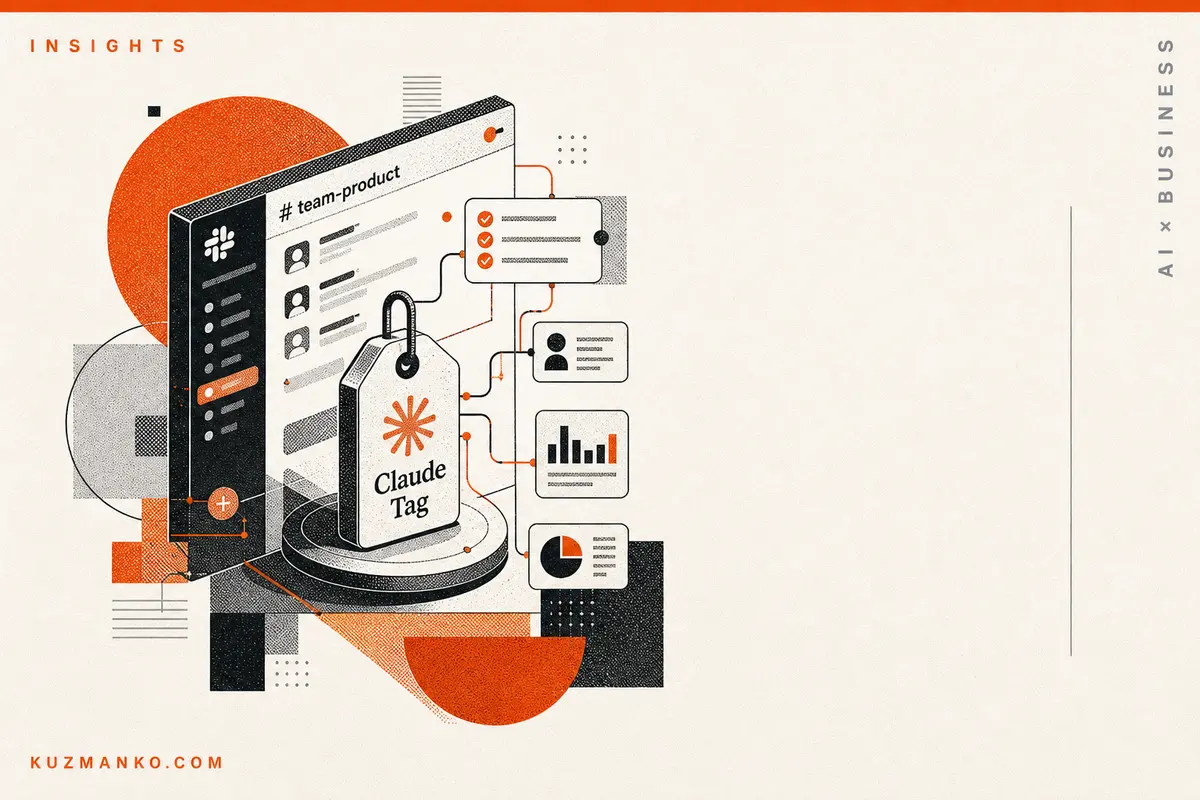
Claude Tag places Claude inside Slack as a persistent AI teammate, not as a separate chatbot employees need to remember to open. That sounds like a product feature. Strategically, it is much bigger: Anthropic is moving AI into the actual operating layer of the company.
For many organizations, Slack is where decisions are shaped, context is lost, handoffs break, and informal knowledge accumulates. By giving Claude a controlled presence inside that environment, Anthropic is making a very serious enterprise bet: the most valuable AI system is not always the one with the best standalone interface. It may be the one that understands the work while the work is happening.
The enterprise AI race is becoming a race for context. Whoever captures the working context of the organization will shape how agents, assistants, and employees make decisions.
This is why Claude Tag deserves attention from executives, CIOs, operations leaders, and finance teams. It is not only about productivity. It is about how companies will manage knowledge, accountability, and non-deterministic work at scale.
What Claude Tag actually does
Claude Tag, currently positioned as a research preview for Claude Enterprise and Claude Team customers, allows administrators to add Claude to Slack channels. Once added, team members can tag @Claude to ask questions, summarize conversations, surface context, or support ongoing work.
The more interesting part is the ambient mode. Claude can observe discussions in a channel and, within the permissions set by administrators, identify moments where relevant information is missing, old tasks may have been forgotten, or a decision could benefit from organizational context.
In practical terms, Claude becomes less like a search box and more like a colleague who has been sitting in the room for weeks.
That is the real shift.
A user no longer needs to pause, copy context, open another application, and frame a perfect prompt. Claude is present where the conversation already happens. This is exactly the kind of quiet, clean integration that can change work habits without asking employees to become AI power users overnight.
Why this is different from another workplace assistant
Most AI tools still require behavioral change. Employees must learn the tool, remember when to use it, and develop the habit of moving work into the AI interface. That is valuable, but adoption is often slower than the demo suggests.
Claude Tag follows another path. It enters an existing workflow.
That distinction matters. AI adoption has two tracks, and enterprises need both:
- AI literacy and tools that improve how employees think, write, analyze, and communicate with models.
- AI agents and embedded systems that execute or support workflows with minimal change to employee behavior.
Tools often look simple technically but are hard culturally. Agents may look more complex technically, yet adoption can be smoother when they operate inside existing processes. Claude Tag sits somewhere between both worlds. It teaches employees to interact with a model, but it also reduces the friction of doing so.
The enterprise value is operational, not cosmetic
The most immediate value of Claude Tag is not a nicer Slack experience. It is operational efficiency.
Slack is full of expensive ambiguity. Decisions are made in threads, forgotten in channels, repeated in meetings, and rediscovered during escalations. A persistent AI participant can help reduce that waste.
Claude Tag can potentially support:
- Faster onboarding into projects and channels.
- Better continuity when people are out, overloaded, or replaced.
- Automatic surfacing of prior decisions and unresolved action items.
- Reduced dependency on the one person who remembers everything.
- Better preparation for meetings, reviews, and customer updates.
- Cleaner handoffs between product, engineering, legal, finance, and sales.
For finance leaders, the case should be measured in cycle time, rework, decision latency, and management overhead. The ROI is not simply fewer minutes spent writing summaries. It is fewer mistakes caused by missing context.
The bigger strategic battle: who owns enterprise context
The most important asset in enterprise AI is not only the model. It is the context layer around the model.
Microsoft has a natural advantage through Microsoft Graph, Copilot, Teams, Outlook, SharePoint, and the broader Microsoft 365 ecosystem. Copilot is becoming better and faster, even if Microsoft’s size often makes urgent innovation harder to package and distribute. It remains a serious infrastructure layer for many companies.
Anthropic is taking a different route. Claude is increasingly effective for direct knowledge work, coding, writing, analysis, and enterprise use cases. Claude Code and collaborative Claude experiences are among the more practical AI tools currently available for adoption. With Claude Tag, Anthropic is trying to meet the end user inside the flow of work rather than only inside a dedicated AI workspace.
That is a sharp move.
The company is moving quickly and with unusual product creativity. OpenAI still has strong and diverse foundation models, but Anthropic has repeatedly shown an ability to invent new working patterns around language models rather than only improve the model underneath.
The security conversation cannot be postponed
Claude Tag also raises a serious governance question: if AI is present in Slack, what exactly can it see, remember, infer, and share?
Anthropic’s permission model is important. Administrators can define where Claude is available and what context it can access. A Claude instance supporting legal should not casually leak legal context into engineering. A sales channel should not become an accidental bridge into HR or finance.
Still, enterprise leaders should not treat this as a plug-and-play toy. The security model needs to be reviewed with the same seriousness as any system that touches sensitive knowledge.
Before broad deployment, companies should evaluate:
- Data retention and training policies.
- Channel-level and workspace-level permissions.
- Access to historical Slack content.
- Cross-channel retrieval boundaries.
- Audit logs and administrator visibility.
- Compliance with SOC 2, ISO 27001, GDPR, and internal policies.
- Treatment of customer data, legal material, financial forecasts, and source code.
Claude is one of the more attractive systems for broad enterprise deployment, but it still creates security and governance challenges. That is not a reason to avoid adoption. It is a reason to implement it professionally.
Human in the loop, but not human on every step
AI is powerful because it can execute and support non-deterministic work. It can help with tasks that previously required human judgment: summarizing uncertain information, detecting inconsistencies, prioritizing threads, drafting responses, or proposing next actions.
But human oversight remains critical.
The mistake is to assume that human in the loop means a person must approve every micro-action. If every AI-supported process requires constant manual supervision, the organization has merely created a more complicated workflow.
The better goal is leverage. The employee who previously monitored one process should be able to supervise dozens or hundreds of AI-supported processes. That requires clear escalation rules, confidence thresholds, auditability, and strong process design.
Claude Tag can be useful here because it is naturally positioned near the human conversation. It can surface issues, ask for clarification, and keep people involved where judgment truly matters.
Implementation should be led by professionals, not hype
Enterprise AI is not a purely technical field. It combines model understanding, business process design, management discipline, security, change management, and domain expertise. Academic knowledge matters. Real operational experience matters. Understanding the professional context matters.
There are many self-appointed AI experts selling shallow advice, especially to small and mid-sized businesses that do not always have the internal filters of a large enterprise. That can lead to poor architecture, weak governance, and automations that look impressive in a demo but fail in production.
Claude Tag should not be adopted because it is fashionable. It should be adopted because a company has identified specific communication and workflow failures that AI can reduce.
A practical rollout should start with a focused pilot:
- Choose two or three channels with high information density and low regulatory risk.
- Define what Claude is allowed to do and what it must not do.
- Measure cycle time, unresolved tasks, repeated questions, and meeting preparation effort.
- Train employees on effective model communication, not just button usage.
- Review security findings before expanding to sensitive departments.
- Build internal ownership in IT, operations, legal, and business units.
IT departments will become HR departments for AI agents
Claude Tag is also another sign of a larger organizational change. IT will not only manage devices, licenses, and systems. It will manage digital workers, agent permissions, behavioral policies, access rights, performance monitoring, and decommissioning.
In that sense, IT will increasingly resemble an HR department for AI agents.
Organizations will need internal capabilities to create, deploy, manage, evaluate, and retire AI agents. They will also need platforms that make agent creation and governance efficient. Microsoft Copilot Studio is a reasonable option for companies deeply invested in the Microsoft ecosystem. At the same time, tools such as n8n are entering larger enterprise environments in ways that would have seemed unlikely a few years ago.
The message is simple: every serious organization needs an AI agent management layer. Claude Tag may not be that entire layer, but it is part of the movement toward it.
What executives should take from Claude Tag
Claude Tag is not just a Slack feature. It is a signal that AI is becoming an integrated part of enterprise workflow, quietly and practically.
For leadership teams, the key questions are:
- Which internal conversations generate the most lost context?
- Where do employees repeatedly ask the same questions?
- Which handoffs create the most operational friction?
- What knowledge is trapped in Slack, meetings, and informal communication?
- Where can AI assist without creating unacceptable compliance risk?
- How will humans supervise many AI-supported workflows rather than babysit one?
The organizations that answer these questions well will gain more than productivity improvements. They will build a new operating model, where AI is not a side tool but a managed participant in the business.
Anthropic’s move is interesting because it is not loud. Claude Tag does not try to replace the workplace. It enters it. That is precisely why it may matter.