
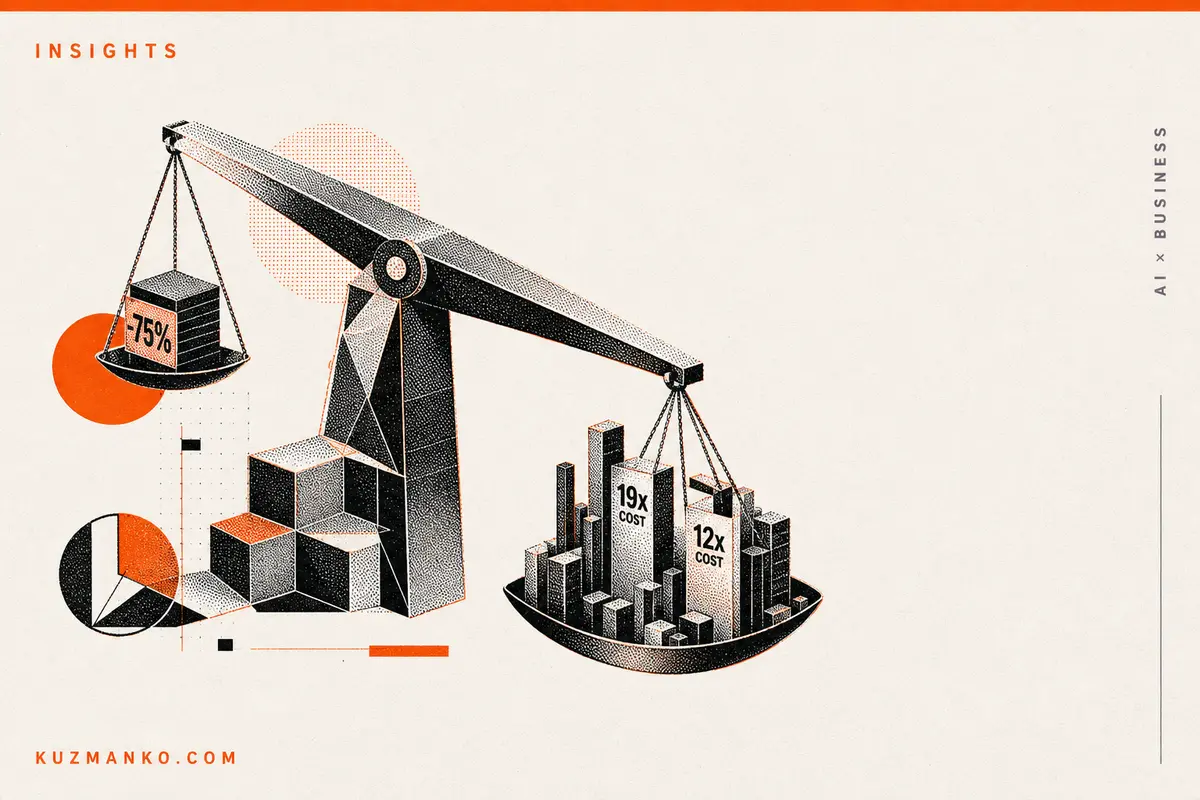
DeepSeek’s decision to make a 75% price cut permanent is not just another pricing update in the AI market. It is a signal that the next phase of model competition will be fought not only on capability, but on cost-per-intelligence: how much useful reasoning, generation, and automation an organization can buy per dollar.
For developers and product teams, the appeal is obvious. If an API can deliver acceptable quality at a fraction of the cost of premium American models, the business case changes overnight. More experiments become possible. More workflows can be automated. More AI features can be shipped without the CFO asking why inference costs are growing faster than revenue.
But here is the uncomfortable answer enterprise leaders need early:
DeepSeek may be economically attractive, but relying on Chinese-controlled AI infrastructure for sensitive organizational workflows can create a double risk: exposure of business data to model providers and dependency on technology that may be influenced by a foreign state whose interests may not align with Israel or Western markets.
Price matters. Sovereignty matters more.
The real meaning of DeepSeek’s price move
DeepSeek’s reported pricing for its V4 Pro model places it among the most aggressive options in the global LLM market. The economics are powerful: low input costs, low output costs, and a quality level that can be good enough for many product and operational use cases.
This matters because AI adoption is no longer limited by curiosity. It is limited by unit economics.
A customer support automation flow that looked expensive with a premium model may suddenly become viable. A document processing pipeline that was previously tested on a small sample can now run across millions of pages. A product company that avoided AI features because of margin pressure can now reconsider.
That is the strategic brilliance of DeepSeek’s move. It lowers the psychological and financial barrier to adoption.
It also creates a trap.
When AI becomes cheap, organizations may skip the governance work. They may move from prototype to production before asking where the data goes, who controls the infrastructure, what legal system applies, and what happens if access changes during a geopolitical crisis.
The double risk: data sharing and strategic dependency
The concern about sharing information with AI models has not disappeared. It has simply become more complex.
With any external model provider, enterprises must ask what data is transmitted, logged, retained, reviewed, or used for training. That question exists whether the provider is American, European, Israeli, or Chinese.
With Chinese models, however, there is an additional layer: the possibility that the company may be subject to state influence, state access requirements, export controls, national security demands, or opaque regulatory pressure. Even if the commercial API looks clean and professional, the governance environment is materially different.
For Israeli companies, this is not a theoretical issue.
AI workflows often touch:
- Customer records
- Product roadmaps
- Source code
- Financial documents
- Legal correspondence
- Security architecture
- Internal operational data
- Procurement and supplier information
- Market expansion plans
- Employee and HR data
If these flows are processed by infrastructure controlled in a jurisdiction that may not be friendly to Israel, the cost saving may be irrelevant compared with the strategic exposure.
The risk is not only that data leaks. The risk is that a company becomes operationally dependent on an external intelligence layer it does not truly control.
Cheap inference can become expensive dependency
AI systems are not like ordinary SaaS tools. Once a model becomes embedded in workflows, applications, agents, and internal decision processes, replacing it can be painful.
The more successful the deployment, the deeper the dependency.
This is especially true when organizations build AI agents. A model may start as a simple API behind a chatbot, but it can quickly become the reasoning engine behind contract review, sales qualification, inventory decisions, compliance checks, or software development assistance.
At that point, the model is not just a vendor. It is part of the operating system of the business.
If access is restricted, pricing changes, regulatory pressure grows, or the provider is forced to alter behavior, the enterprise may face operational disruption. This is vendor lock-in with geopolitical characteristics.
What should Israeli enterprises do?
The answer is not to reject every Chinese model automatically. The answer is to classify use cases with discipline.
There is a meaningful difference between using a low-cost model for public, non-sensitive content generation and using the same model for internal financial analysis, code generation, customer data processing, or defense-adjacent operations.
A sensible policy should divide AI usage into risk zones:
- Green zone: Public data, generic content, low-risk experimentation, synthetic examples, non-sensitive benchmarking.
- Yellow zone: Internal but non-confidential data, limited operational workflows, human-reviewed outputs, no customer or strategic information.
- Red zone: Personal data, source code, proprietary business logic, financial records, legal documents, security data, regulated workloads, defense-related information.
For most Israeli and Western-facing organizations, Chinese-hosted models should be treated with extreme caution in the red zone. In many cases, they should be excluded entirely unless there is a private deployment model, clear contractual protection, audited data isolation, and legal review that can withstand scrutiny.
Cost-per-intelligence is useful, but incomplete
The AI market is right to move beyond raw benchmarks. A model that scores slightly lower but costs dramatically less can be the better business choice for many tasks.
But procurement teams should not calculate AI value using model price alone.
A better enterprise formula is:
AI value = model quality + operational fit + security posture + governance maturity + cost efficiencyIf security posture and governance maturity are weak, low cost is not a bargain. It is a subsidy for future risk.
This is where many organizations make mistakes. They treat AI model selection as a technical comparison between benchmarks, context windows, latency, and token prices. Those metrics matter, but AI is not only a technical domain. It sits at the intersection of technology, business process, management, legal exposure, cybersecurity, finance, and human judgment.
That is why strong AI implementation requires deep professional knowledge, not only enthusiasm. There are many self-declared AI experts in the market. Some can demonstrate tools, prompts, and demos. Far fewer can design stable enterprise processes, assess organizational risk, and understand how AI changes operations at scale.
The human-in-the-loop principle must evolve
One common response to AI risk is to say: keep a human in the loop.
That is correct, but incomplete.
If every AI action requires one employee to approve one output, the organization has not transformed anything. It has merely added a faster assistant to the old process.
The real question is how one person who previously supervised a single process can now supervise hundreds of AI-assisted processes safely. That requires monitoring, sampling, escalation rules, audit trails, exception handling, and clear accountability.
This is especially important when lower model costs make large-scale automation economically attractive. Cheap models encourage higher volume. Higher volume increases the need for governance.
The winning organizations will not be those that connect the cheapest model to the most workflows. They will be those that build the managerial infrastructure to control non-deterministic processes at scale.
Model choice should follow architecture, not hype
For enterprise adoption, organizations should advance on two tracks at the same time.
First, they need broad AI literacy. Employees must learn how to communicate effectively with models, evaluate outputs, protect sensitive information, and understand where AI is useful or dangerous.
Second, they need an internal capability to build and manage AI agents. Agents can be more practical than general AI tools because they often fit into existing workflows with less behavioral change from employees. A well-designed agent can handle a defined process behind the scenes, while the employee continues working in familiar systems.
This is why IT departments will increasingly become something closer to HR departments for AI agents. They will onboard, monitor, evaluate, restrict, retire, and upgrade digital workers.
That requires platforms, standards, and internal competence. Microsoft Copilot Studio can be useful inside the Microsoft ecosystem. Tools such as n8n are also entering serious enterprise environments and enabling workflow automation that would have looked unrealistic in large organizations only a short time ago. Claude, including Claude Code and related work-oriented capabilities, remains highly effective in many enterprise and technical scenarios, although security architecture must be handled carefully. Copilot is improving and remains a solid infrastructure layer for Microsoft-heavy organizations, even if innovation sometimes moves more slowly inside a large platform company.
DeepSeek should be assessed within this broader architecture, not as a standalone bargain.
A practical governance checklist before using DeepSeek or any low-cost foreign model
Before adopting a low-cost model from a sensitive jurisdiction, leadership should answer these questions clearly:
- What exact data will be sent to the model?
- Is any customer, employee, financial, legal, code, or security data included?
- Where is the model hosted and which legal jurisdiction applies?
- Are prompts and outputs stored, reviewed, retained, or used for training?
- Can the provider change terms, behavior, or access without meaningful notice?
- Is there an exit plan if the model becomes unavailable or prohibited?
- Can the workload be moved to another model within days, not months?
- Are outputs logged for audit and incident response?
- Is there a human escalation mechanism for high-risk outputs?
- Has legal, security, finance, and business leadership approved the use case?
If these questions feel heavy, that is the point. AI procurement is now strategic procurement.
The board-level conclusion
DeepSeek’s price cut will pressure the entire AI market. OpenAI, Anthropic, Google, Microsoft, and others will need to respond not only with better models, but with better economics. That competition is good for customers.
Still, enterprises should resist the temptation to turn model selection into a race to the lowest token price.
For Israeli companies in particular, the geopolitical layer cannot be ignored. A Chinese AI model may be impressive, fast, and dramatically cheaper. It may also introduce a level of dependency and information exposure that is unacceptable for sensitive workflows.
The mature position is simple: use low-cost models where the risk profile allows it, avoid them where sovereignty and confidentiality matter, and build an AI architecture that can switch models without breaking the business.
Cheap AI can accelerate innovation. Ungoverned cheap AI can create liabilities that no pricing discount will cover.