
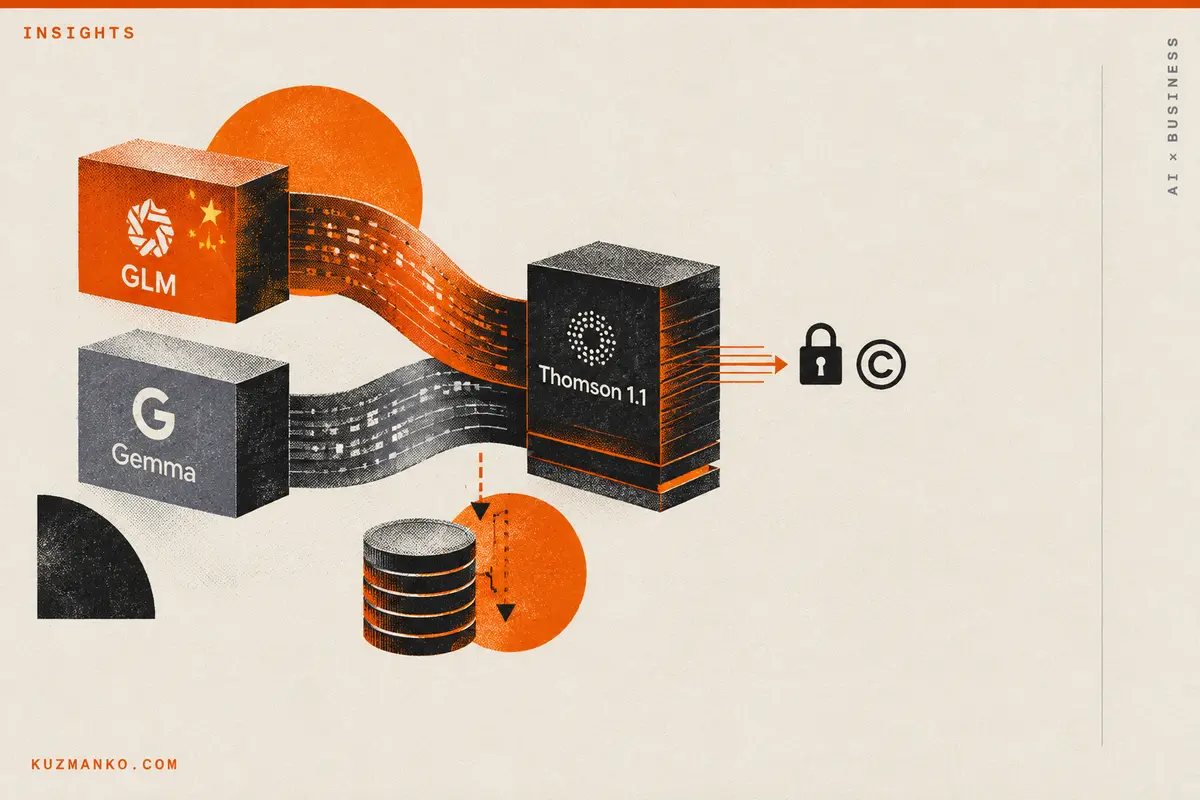
Reducing enterprise AI costs is not about choosing the cheapest model. It is about matching each task to the right model, controls, and risk tolerance. That is the business lesson from Thomson Reuters, which plans to incorporate models from China's Z.ai and Google into its next in-house model while continuing to use OpenAI and Anthropic for its most demanding work.
For enterprise leaders, this is not a recommendation to rush out and build a model lab. It is a reason to ask whether you are paying for capabilities every task actually needs, and whether lower usage costs still translate into savings once infrastructure, testing, and professional oversight are included.
- About $40 million invested in adapting the models, according to the company.
- Less than 5% of the company's tokens come from its in-house model.
These two reported figures should temper expectations of immediate savings. They do not prove the investment is unjustified. They show how much work separates a downloadable model from meaningful enterprise deployment. Token share is not a direct measure of business value, either: a short, consequential task can be worth more than thousands of routine text operations.
What Is Thomson Reuters Actually Building?
According to Business Insider, the company plans to launch Thomson 1.1 using Z.ai's GLM and Google's Gemma. Its predecessor, Thomson 1.0, was based on Alibaba's Qwen. The published information does not explain how the models are being combined, so there is no basis for assuming weight merging or any particular training method.
The reasons for the choices matter more than the vendor names. According to the company, GLM is strong at computer use, a useful capability for agents, while Gemma was selected for its small size and efficiency. Alongside performance considerations, the company also describes a preference among governments for Western models.
This is a division of labor, not a declaration of a winner. Thomson Reuters still intends to use OpenAI and Anthropic models for the hardest tasks. It sees the economic opportunity in the work in between.
Not every task needs the most powerful model. Every task needs to meet the quality and risk thresholds the business has set for it.
Look for Savings in Repetitive Work, Not Impressive Demos
Enterprises have plenty of work that goes beyond simple data entry without requiring complex professional judgment: classifying documents, extracting clauses, drafting responses, finding information, and performing initial cross-checks.
That is a sensible place to begin the economic assessment. Tax advice, by contrast, is cited in the reporting as an example of a medium-difficulty task, yet it can carry serious consequences. Moderate computational difficulty does not mean moderate business risk. A short tax answer may need stricter review than a lengthy summary of an internal document.
A sound architecture therefore does not rank tasks solely by how difficult they are for a model. It also considers the cost of error, information sensitivity, and the ability to detect failure before harm occurs.
- External model service: Useful for getting started quickly and handling complex tasks. Cumulative usage costs and vendor dependence are easy to underestimate; data handling and service terms need close scrutiny.
- Self-hosted model: Useful for stable workloads and infrastructure control. Compute, maintenance, and staffing must be included in the cost; licensing and security are key controls.
- Multiple-model architecture: Useful when tasks have different requirements. Routing and testing across models add costs; quality must be monitored throughout the workflow.
These are not vendor rankings. Each approach has a different cost structure. Even combining models, which sounds like a sensible compromise, adds complexity: you need to know when to escalate a task to a stronger model and what to do when systems disagree.
A Downloadable Model Is Not Technology You Fully Own
The term open source is often used too loosely in discussions about models. You need to establish what is actually available: the weights, inference code, training details, or only some of these. You also need to read the license for the specific version and assess its usage and redistribution restrictions.
Running a model on your own infrastructure can increase control over data and operations. It does not automatically give your organization full rights to the underlying technology, nor does it guarantee independence from the surrounding hardware and software.
AI sovereignty does not come from downloading a model, either. It is a demonstrated ability to operate, evaluate, update, and replace components without disrupting the business process.
Watch out: Token cost is not workflow cost. A cheaper model may require more attempts, more testing, and more human work. Compare the cost of completing a task to a defined quality standard, not just the cost of model usage.
Thomson Reuters' reported investment includes chips, data, and researcher salaries. Enterprises do not need to copy its budget, but they should adopt the same accounting discipline: include maintenance, quality evaluation, information security, and failure remediation.
Political Bias Is a Warning Sign, Not a Complete Acceptance Test
According to an analysis by Hirundo described in the reporting, one version of the model repeated Chinese government positions on subjects including Taiwan and the Tiananmen Square massacre. Thomson Reuters responded that the system performs better with its intended instruction set and that the next version reduces the bias.
A prospective customer should test both claims. System instructions can improve behavior, but their existence does not prove that bias has disappeared. Equally, a narrow political test is not a substitute for evaluating the whole product.
The conclusion is not that every Chinese model is unsuitable, or that Western models are free of bias. A model's origin is one part of risk assessment, alongside domain-specific performance testing. Enterprises should test relevant languages, bilingual documents, local terminology, unjustified refusals, and fabricated references. Legal and financial applications also require checks for current information and alignment with the applicable law.
How Should an Enterprise Evaluate This Approach?
Do not start by choosing a model. Start with a measurable workflow, then build a controlled pilot with clear business and technical ownership.
- Map the workflow and its current cost: Document the work, exceptions, handling time, and potential damage from errors.
- Build a domain-specific evaluation: Assemble representative examples and edge cases reviewed by subject-matter experts.
- Compare alternatives under the same conditions: Test quality, total cost, response time, and security requirements on the same tasks.
- Set operating boundaries: Define which actions can run automatically and which require approval or escalation.
- Scale based on results: Expand usage only when measurements from the live workflow justify it.
The evaluation must cover the complete system, not just the model's answer: retrieval, permissions, tool use, logging, and handoff to a person. In an agentic system, a correct answer is not enough if the agent updates the wrong record or takes an unauthorized action.
Keep Humans in the Loop Without Handing All the Work Back
Human oversight is critical, but requiring manual approval for every action can erase the operational benefit. The goal is to move people from routine execution to exception management, not give them another approval screen.
Bounded, reversible actions can remain automated, while financial commitments, irreversible changes, or sensitive professional conclusions require approval. Sampling, external rules, and anomaly monitoring matter more than the model's own statement of confidence.
Build Capabilities That Survive a Model Change
Most enterprises have no reason to start by fine-tuning a dedicated model. An existing model combined with retrieval-augmented generation, defined tools, and appropriate controls may be enough. Developing or adapting a model should be a response to a measured gap, not a desire to demonstrate technological independence.
What is worth building internally is the ability to evaluate and manage AI agents: permissions infrastructure, testing, monitoring, and model replacement. Employees also need AI literacy and the ability to challenge outputs. An agent that fits an existing workflow may require less behavioral change than a tool that asks every employee to invent a new way of working.
This is multidisciplinary work that requires deep AI expertise, a strong research foundation, and business understanding. Experience building demos is not a substitute for experience managing legal, financial, or operational processes.
The lesson from Thomson Reuters is not to buy cheap. It is to know what is worth paying for. An organization that can measure quality, control risk, and replace a model without rebuilding the workflow has a more valuable asset than access to any particular model.