
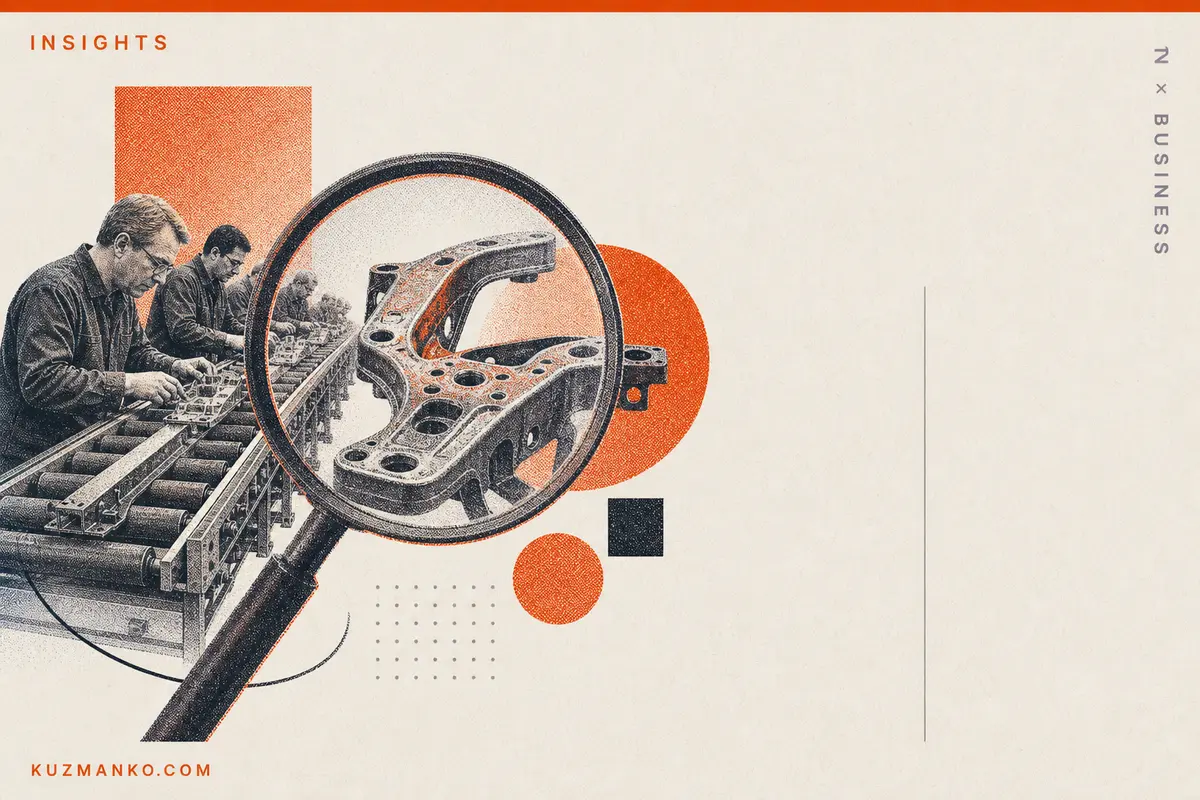
The answer is simple: AI can improve production quality, but it cannot replace experienced engineering judgment
Ford’s recent admission should be read carefully by every executive planning to automate quality control, engineering review, or operational decision-making. The lesson is not that AI failed. The lesson is that AI was asked to carry responsibility that belonged to a broader operating system: experienced people, structured knowledge, management discipline, and technology working together.
According to Bloomberg, Ford’s leadership acknowledged that the company leaned too heavily on automated quality systems. The company has now brought back hundreds of veteran technical specialists, many with decades of experience, to identify potential failures before parts reach the assembly line.
That decision is not nostalgia. It is financial discipline.
Warranty costs, recalls, rework, customer dissatisfaction, and production delays are not abstract risks. They hit the income statement directly. When a quality defect escapes into the field, the cost is often many times higher than the cost of catching it at the supplier, design, or pre-assembly stage.
AI is powerful at detecting patterns in data. Experienced engineers are powerful at recognizing when the data is incomplete, misleading, or missing the failure mode entirely.
That distinction matters.
Ford did not discover that AI is useless. It discovered that AI without domain expertise is fragile
The most dangerous misunderstanding in enterprise AI is the idea that implementation is mainly technical. It is not.
AI sits at the intersection of data science, domain expertise, process design, management, risk, and human behavior. In manufacturing, that means the model is only one part of the system. The rest includes materials knowledge, supplier history, maintenance records, testing protocols, production constraints, and the hard-earned intuition of people who have seen parts fail in the real world.
A model can analyze thousands of signals, but it may not understand why a tiny change in tolerance, temperature, coating, pressure, vibration, or supplier behavior will create a failure six months later. A veteran engineer might see that risk in minutes because they have lived through similar failures before.
This is why education and professional depth matter so much in AI. Organizations do not need more opportunistic AI slogans. They need people who understand both the technology and the business process deeply enough to know where automation adds value and where it creates hidden exposure.
The expensive mistake: treating judgment as inefficiency
Many automation programs begin with a reasonable business goal: reduce cost, improve consistency, increase throughput, and scale quality control. Those are valid objectives. AI can absolutely help achieve them.
The problem begins when human judgment is categorized as friction rather than as a control mechanism.
In complex production environments, experienced professionals often do more than approve or reject. They notice weak signals. They challenge assumptions. They connect events that were not designed to be connected. They remember the last time a supplier changed a process and a defect appeared three months later. They understand which test result is technically acceptable but operationally suspicious.
That type of knowledge is rarely captured cleanly in historical datasets. It exists in conversations, inspections, war stories, design reviews, field failures, and supplier escalations. If an organization removes that expertise before translating it into usable process intelligence, the AI system becomes faster but not necessarily wiser.
Human in the loop is essential, but it must scale
There is an important nuance here. Saying that humans must remain in the loop is correct, but incomplete.
If every AI-supported process requires a person to review every decision manually, the organization has not transformed anything. It has only added another interface. The goal is not to keep one expert approving one process at a time. The goal is to help one expert supervise hundreds of processes with better prioritization, better evidence, and better escalation.
A mature human-in-the-loop model should answer three questions:
- Which decisions can the system make automatically because risk is low and confidence is high?
- Which decisions require human review because uncertainty, novelty, or financial impact is significant?
- Which decisions should trigger expert investigation because the pattern may indicate a new failure mode?
This is where AI creates real operational leverage. It does not eliminate experts. It changes the shape of their work.
The veteran engineer should not spend the day checking routine items that a machine can classify reliably. They should spend their time on exceptions, ambiguous cases, emerging risks, and training the system to become better over time.
The best experts become trainers of the system
Ford’s most interesting move is not simply rehiring experienced engineers. It is using them to improve the automated systems themselves.
That is the right model.
The expert should become a source of structured intelligence. Their judgment can be converted into rules, labels, review criteria, examples, simulations, and escalation logic. Over time, this creates a stronger AI system because it is no longer learning only from historical data. It is learning from professional reasoning.
For enterprises, this suggests a practical methodology:
- Identify the highest-cost failure points in the process.
- Map where current data is strong and where it is weak.
- Bring domain experts into model design, not only post-deployment review.
- Define confidence thresholds and escalation paths before launch.
- Capture expert decisions as training signals.
- Measure financial impact through warranty cost, rework, cycle time, error rates, and customer outcomes.
- Improve the process continuously instead of treating deployment as the finish line.
The organizations that do this well will not have fewer experts. They will have more scalable experts.
Why this matters beyond automotive manufacturing
Ford’s case is especially visible because manufacturing defects are physical, expensive, and measurable. But the same pattern appears in finance, insurance, healthcare, legal operations, logistics, customer service, procurement, and software development.
AI is very good at helping with non-deterministic processes, the kinds of workflows that historically required human judgment. It can classify, summarize, prioritize, recommend, draft, compare, forecast, and detect anomalies. This creates enormous efficiency potential.
But non-deterministic does not mean unmanaged.
A credit decision, a medical triage recommendation, a contract review, a fraud alert, or a supplier risk assessment all require governance. The more judgment a process contains, the more carefully the organization must define responsibility, review, auditability, and exception handling.
This is why academic knowledge, professional training, and field experience are not optional in serious AI work. AI implementation is multidisciplinary. Computer science is important, but it is not enough. The strongest teams combine technical skill with business process expertise, operational experience, compliance awareness, and management maturity.
The finance view: quality automation must reduce total cost, not just headcount
Executives often justify AI programs through labor savings. That can be legitimate, but it is often too narrow.
In critical operations, the better financial question is: does AI reduce total cost of poor quality?
That includes:
- Warranty expenses
- Product recalls
- Customer churn
- Rework and scrap
- Downtime
- Supplier escalation costs
- Regulatory exposure
- Brand damage
- Management distraction
A system that reduces inspection labor but increases downstream defects is not automation. It is cost relocation. The expense simply moves from payroll to warranty, legal, operations, and customer support.
This is why AI business cases must include risk-adjusted economics. Faster is not always cheaper. Automated is not always controlled. A model that performs well in normal conditions may fail exactly when the business most needs judgment: unusual cases, new suppliers, new materials, new regulations, new customer behavior, or rare combinations of events.
AI literacy and AI agents are both required
There are two tracks every organization should advance in parallel.
The first is AI literacy. Employees need to understand how to communicate effectively with models, how to evaluate outputs, how to identify hallucinations or weak reasoning, and how to use AI without surrendering professional responsibility. This is becoming a basic workplace capability.
The second is AI agent development. Organizations need internal capability to build, deploy, monitor, and manage agents that perform specific operational tasks. Agents can often be adopted with less disruption to employee habits than broad AI tools, because they can work inside existing workflows and systems. The technical side may look more complex, but the behavioral adoption can be easier if the process is designed properly.
This has a major implication for IT departments. Over time, information systems teams will not only manage software and infrastructure. They will manage fleets of AI agents, including permissions, performance, security, lifecycle, and accountability. In that sense, IT will increasingly become a kind of human resources function for digital workers.
The tooling will vary by ecosystem. Microsoft Copilot Studio can be useful for organizations already invested in the Microsoft stack. Platforms such as n8n are also entering serious enterprise environments and enabling faster workflow automation than many large companies would have considered realistic a few years ago. Claude remains one of the strongest enterprise AI experiences in practical usage, although security and governance must be handled carefully. The specific platform matters, but the operating model matters more.
Beware the self-appointed AI expert
Ford’s lesson also exposes a broader market problem: too many AI advisors talk as if expertise in prompting or tool demos is enough to redesign operational systems.
It is not.
Small and mid-sized businesses are especially vulnerable to this. Large enterprises usually have procurement, legal, security, architecture, and operational leaders who can filter weak advice. Smaller companies may not. They can be sold an AI vision that looks impressive in a workshop but collapses when connected to real data, real employees, real customers, and real risk.
Professional AI implementation requires more than enthusiasm. It requires relevant education, practical business experience, technical understanding, change management, and the humility to respect domain experts.
The strategic takeaway: do not replace expertise, multiply it
Ford’s move should not slow enterprise AI adoption. It should make it more serious.
The right conclusion is not to retreat from automation. The right conclusion is to stop treating AI as a replacement for institutional knowledge. The better strategy is to capture that knowledge, scale it, and embed it into intelligent systems.
A strong enterprise AI program should make experienced professionals more valuable, not less. It should allow the engineer, analyst, operator, lawyer, accountant, or manager who previously supervised one process to supervise many. It should reduce routine workload while increasing attention on high-impact exceptions.
That is where AI becomes operationally meaningful.
Ford’s admission is a useful correction for the market. AI can transform production quality, but only when it is built on serious expertise. The companies that understand this will reduce costs, improve quality, and move faster. The companies that ignore it may automate their way into more expensive mistakes.