
Google’s AI summaries are changing the bargain between content creators and search engines: your content can answer a customer’s question without bringing that customer to your website. That does not mean enterprises should stop investing in SEO. It means they should stop measuring its value solely through visits and build a business reason for the relationship to continue beyond the initial answer.
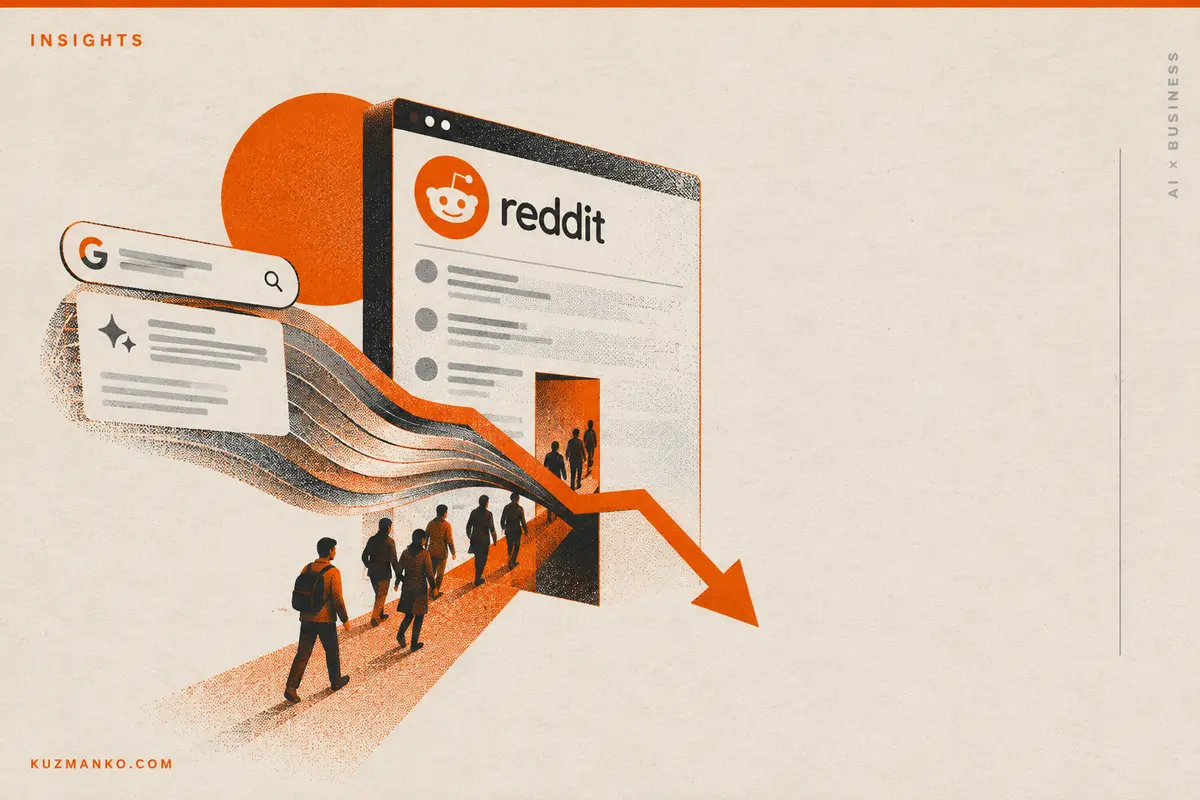
Reddit illustrates the risk. According to Similarweb figures cited in the report, global visits to the site fell between October 2025 and October 2026. Meanwhile, Reddit reported growth in weekly active unique users. That apparent contradiction is where the important management discussion begins.
- −13% change in visits, according to Similarweb.
- +16% change in weekly active unique users, according to Reddit.
The first figure measures visits; the second measures weekly active unique users. They describe different populations, use different measurement definitions and come from different sources. You cannot subtract one from the other, nor conclude from declining visits alone that business activity weakened by the same proportion.
What can we actually learn from Reddit’s decline?
Reddit’s management attributes weaker search traffic partly to Google’s AI summaries. The mechanism is straightforward: someone who gets an answer on the search results page has less reason to visit the discussion that supplied the information.
But analytical discipline matters. The figures cited do not isolate the contribution of AI summaries from other possible causes of the decline. Ranking changes, audience mix, seasonality and the experience of accessing the site may also play a role. A plausible mechanism, management commentary and conclusive causal evidence are three different things.
Executives do not need perfect proof before managing the risk. If a significant share of customer acquisition depends on answers that can be delivered outside your website, that is a business dependency worth mapping now.
Your content can keep influencing customer decisions while the website that funded its creation gets fewer opportunities to engage those customers.
This is different from an ordinary ranking decline. Your information may still be selected, remain useful and even appear in the answer. What disappears is the click that once connected that influence to revenue.
The visibility remains. The customer touchpoint disappears.
Consider a payroll software company that publishes an expert guide to employee onboarding. An answer engine may summarize the steps accurately. The reader gets useful information but may never see the company’s demo, inquiry form or related service.
An assessment based on the organization’s characteristics, a calculator with transparent assumptions or a personalized diagnostic can offer a genuine reason to visit. Not because the company withholds the answer, but because the next layer of value requires context, data or action.
- General guide: Search can summarize the explanation and steps; a practical tool gives readers a reason to visit.
- Solution comparison: Search can summarize pros and cons; matching options to the organization’s needs adds value on the site.
- Professional expertise: Search can summarize core principles; a data-driven assessment provides a reason to continue.
- Community discussion: Search can summarize common opinions; participation and follow-up questions justify joining the conversation.
This does not mean every website needs to become a software product. It suggests a simple test: What can customers get from you that they cannot get from a summary of your content? Sometimes the answer is human expertise, sometimes access to original data, and sometimes getting a task done.
AEO matters, but it is not a revenue model
Answer engine optimization, or AEO, aims to improve the likelihood that answer systems will understand and use your content. Direct answers, clear structure, consistent definitions, sources and update dates can help. None guarantees inclusion, citation or traffic.
Separate three objectives: being a useful source, being recognized as that source and prompting a business action. They are related, but they are not interchangeable. An answer built on your expertise without clear brand attribution may serve the user more than it serves your business.
Visibility is not revenue: A mention in an AI answer may support your brand, but it is not equivalent to a lead or a sale. Measure answer visibility, identifiable traffic and business outcomes separately.
I would not replace a rankings report with a citations report and declare success. Both track intermediate metrics. Management also needs to see qualified inquiries, customer acquisition cost, close rates and contribution to profit, alongside the attribution limitations of each measurement.
Should you require a login like Reddit?
According to the report, Reddit is shifting its focus toward logged-in and app users, while encouraging an experience that requires more sign-ins. That makes sense for a platform whose value comes from community participation and an ongoing relationship.
It is not a blanket recommendation for business websites. A company that a prospective customer does not yet know may lose that customer by putting a registration screen in front of every useful piece of information. Restricting access does not create loyalty. It asks customers to pay with effort and personal information before they are convinced of the value.
The useful distinction is between content that supports discovery and a service that justifies an identified relationship. A guide can remain open. Saving an assessment, tracking a process or receiving tailored recommendations may justify an account. Data collection should be proportionate, clearly explained and privacy-conscious.
A content licensing agreement with model providers is not a substitute for a distribution strategy, either. Reddit’s agreement with Google illustrates why licensing revenue, product traffic and the long-term value of user relationships need to be evaluated separately.
An action plan that does not start with switching vendors
The right response is not to commission hundreds more automated articles. Before increasing output, understand where content contributes to the business and where that value is eroding.
- Map search dependency: Identify the services, pages and revenue streams that depend on non-branded organic traffic.
- Connect traffic to business outcomes: Evaluate inquiries, deals and contribution to profit by content group, rather than looking only at visit counts.
- Add value beyond the answer: Choose important content and connect it to a tool, assessment or service that justifies an ongoing relationship.
- Test and adjust: Compare traffic and business outcomes over time, documenting changes and measurement limitations.
This requires collaboration across marketing, sales, finance and IT. Declining traffic accompanied by better-qualified inquiries calls for a different decision than a decline that wipes out a profitable revenue source. The traffic chart alone cannot distinguish between them.
AI agents can help monitor pages, identify outdated information and propose updates. But they need approved sources, appropriate permissions and an audit trail. A professional should oversee exceptions and sensitive changes, not manually approve every trivial correction. Otherwise, automation simply moves the bottleneck to the review stage.
This is also a test of consulting quality. A promise to get your business into AI answers is no substitute for understanding analytics, customer behavior and business economics. Deep expertise and practical experience matter more than an impressive tool demonstration.
The management question is not simply how to recover the lost click. It is what kind of customer relationship is worth building when the initial answer is delivered somewhere else. An enterprise with a good answer can continue extracting value from its content without assuming search engines will keep rewarding it in the same way.