
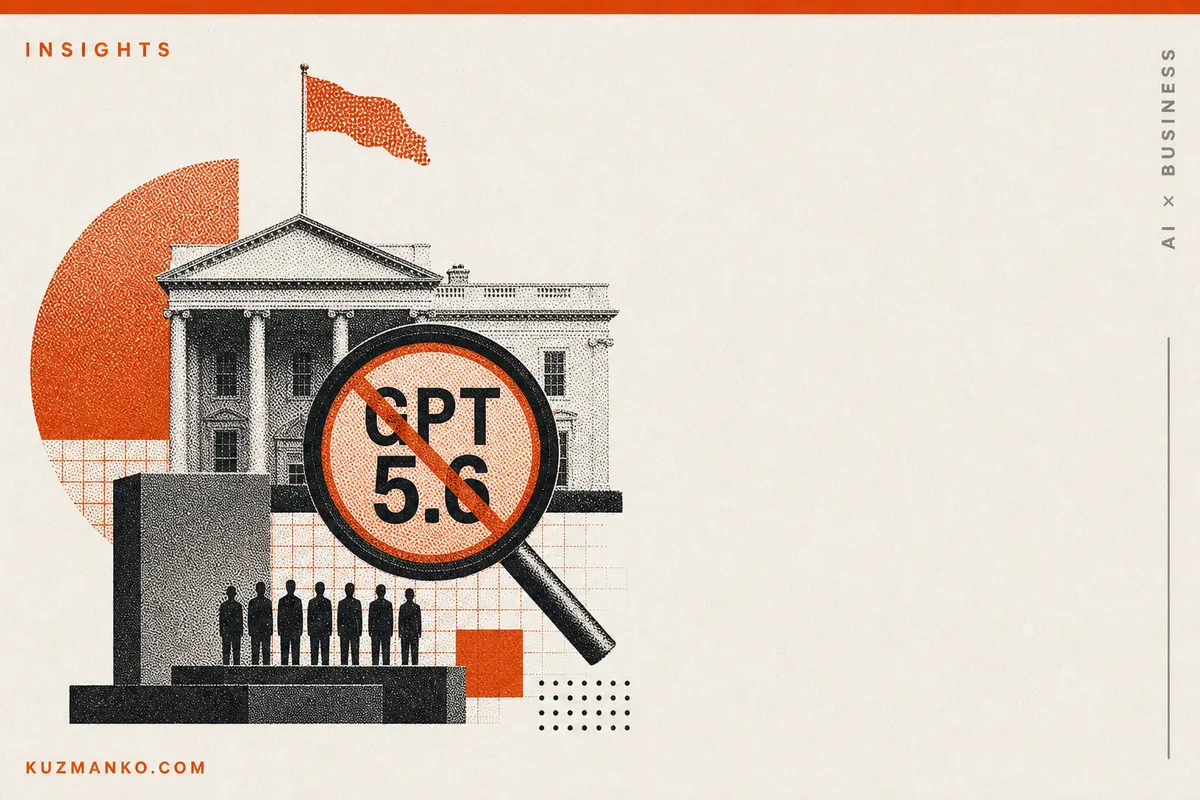
The short answer: AI model releases are becoming regulated business events
If reports are accurate, the White House has asked OpenAI to delay broad access to GPT 5.6 and release it first to selected partners under a controlled preview. That may sound like a Washington story. It is not. It is a boardroom story.
For enterprises, the message is clear: powerful AI models are no longer ordinary software updates. They are strategic infrastructure with cyber, operational, legal, and financial consequences. The release of a frontier model can change the risk profile of an organization overnight, both by improving internal productivity and by increasing the capability of attackers.
The real shift is not that governments are suddenly interested in AI. The shift is that AI capability has become operationally significant enough to justify staged access, formal approval, and enterprise-grade controls.
This is the beginning of a more mature AI market. It will frustrate product teams. It will slow some innovation. It will also force companies to build AI programs that can survive outside the innovation lab.
Why the White House intervention matters
According to the reported details, OpenAI planned to adjust the GPT 5.6 rollout so that access would be approved customer by customer during a preview period. The concern appears to be linked to national cyber risk: frontier models with strong coding, reasoning, and security capabilities could help identify vulnerabilities, automate exploitation, and accelerate offensive cyber activity.
That concern is not theoretical. Modern models can already support malware analysis, code generation, vulnerability discovery, social engineering workflows, and automated reconnaissance. The better the model becomes at multi-step reasoning and tool use, the more relevant it becomes to offensive operations.
For government, the question is: can a model be released broadly before its misuse profile is understood?
For business, the better question is: can we deploy advanced AI internally before we understand our own misuse profile?
Most organizations are not ready to answer that honestly.
The enterprise lesson: treat model access like privileged access
Companies have spent years improving identity governance, access management, cloud security, and data classification. AI model access now belongs in the same category.
A strong enterprise AI program should define:
- Which employees can access which models
- Which data categories may be used with each model
- Which tools and systems an AI agent can call
- Which outputs require human approval
- Which use cases are prohibited entirely
- Which logs must be retained for audit and investigation
- Which vendors meet security, privacy, and contractual requirements
This is not bureaucracy for its own sake. It is the minimum infrastructure required to scale AI safely.
The mistake many organizations make is treating AI adoption as a procurement decision: choose Copilot, Claude, ChatGPT Enterprise, or another platform, then train employees. That is not enough. AI adoption is a process redesign decision. It touches knowledge work, decision rights, operational controls, data architecture, and management culture.
Controlled rollout is not anti-innovation
There is a fashionable argument that any limit on frontier AI release slows the United States and helps competitors. There is some truth in that concern. A slow, unpredictable approval process could damage American AI companies, especially if competitors in other markets face fewer constraints.
But the opposite extreme is also naive. Releasing highly capable systems to everyone at once, without structured testing, is not innovation. It is unmanaged externalization of risk.
The better model is staged deployment:
- Internal red-team testing
- Trusted partner preview
- Sector-specific evaluation, especially for cyber, finance, health, and critical infrastructure
- Limited enterprise release with monitoring
- Broad release after mitigations and operational evidence
This is how serious technology should be introduced when the downside is not just a bug, but an acceleration of malicious capability.
Anthropic, OpenAI, and the race to define responsible capability
OpenAI is not alone in adopting more controlled release patterns. Anthropic has also used selective access for sensitive model capabilities, especially where cybersecurity is involved. Some people see this as safety. Others see it as marketing: scarcity creates prestige.
Both interpretations can be true.
Anthropic, in my view, has shown impressive creativity in product direction and language around model behavior. It has often moved faster in enterprise usability than many expected, and products like Claude Code and collaborative Claude workflows are among the most practical AI tools currently available for professional teams. OpenAI still has strong, diverse foundation models, but Anthropic has been unusually effective at turning model capability into working user experience.
The strategic point is not which lab wins a headline cycle. The strategic point is that model vendors are becoming part of the enterprise risk stack. Their release policies, safety controls, audit features, and integration models now matter as much as benchmark performance.
AI is not a technical project
One of the most damaging misconceptions in the market is that AI implementation is mainly technical. It is not.
Good AI implementation requires a combination of:
- Deep AI literacy
- Business process understanding
- Operational experience
- Data governance
- Security architecture
- Change management
- Domain expertise
- Management discipline
This is why shallow AI consulting is dangerous, especially for small and mid-sized businesses. Large organizations usually have enough internal maturity to filter out opportunistic advice. Smaller companies often do not. They can be pushed into fragile automations, poor vendor choices, or workflows that look impressive in a demo and fail in production.
AI is a multidisciplinary field. Academic depth matters. Practical business experience matters. Management experience matters. The best implementations are rarely built by people who only understand prompts or only understand software. They are built by teams that understand how professional judgment, data, incentives, and operational constraints interact.
Human in the loop, but not human in every loop
The debate around AI safety often repeats the phrase human in the loop. It is an important principle, but it is frequently misunderstood.
If every AI-supported process requires a human to manually approve every step, we have not created meaningful leverage. We have simply inserted AI into the old workflow and added friction.
The better goal is different: the person who previously executed or supervised one process should be able to supervise hundreds of AI-assisted processes through exception handling, sampling, escalation rules, and performance dashboards.
That is where operational efficiency appears.
Human oversight should be designed around risk:
- Low-risk tasks can be automated with periodic review
- Medium-risk tasks can use human approval for exceptions
- High-risk tasks should require explicit human authorization
- Regulated decisions should preserve audit trails and explainability
- Security-sensitive actions should use strict permission boundaries
This is the mature version of human in the loop. It does not remove people. It upgrades their role.
The agent layer is becoming the new operational layer
The GPT 5.6 release discussion also highlights a broader enterprise trend: AI agents are becoming a serious deployment pattern.
There are two parallel adoption paths every organization should pursue.
The first is AI literacy: helping employees communicate effectively with models, use AI tools responsibly, and improve their daily work. This path requires behavior change, training, and cultural adoption.
The second is AI agent development: building managed agents that execute defined workflows across systems. This path requires architecture, governance, orchestration, monitoring, and security controls.
Interestingly, agents may be technically more complex but easier for employees to adopt. A well-designed agent can operate inside an existing workflow without forcing every employee to change habits. By contrast, general AI tools often require people to learn new ways of writing, analyzing, searching, and deciding.
That distinction matters for ROI.
Enterprises will need platforms for creating, deploying, monitoring, and retiring agents. Microsoft Copilot Studio is a reasonable option for organizations deeply invested in the Microsoft ecosystem, and it is improving. At the same time, tools such as n8n are entering environments that once would have rejected them as too lightweight for large enterprises. The market is changing quickly because the need is practical: companies need an efficient way to build and govern agents.
In the future, IT departments may look more like human resources departments for AI agents. They will onboard agents, assign permissions, monitor performance, investigate incidents, manage lifecycle, and remove agents that no longer serve the business.
What CFOs and COOs should take from this
The financial implication of controlled AI release is simple: AI value will increasingly depend on readiness, not access.
If a new model becomes available only to selected partners, the organizations that benefit first will be those with mature governance, clean use cases, secure integration, and measurable business processes. Everyone else will wait, experiment, or expose themselves to unnecessary risk.
For COOs, the priority is operational mapping. Where do non-deterministic processes rely on human judgment? Which of those processes can be partially automated? Where can AI reduce cycle time without weakening control?
For CFOs, the priority is investment discipline. AI budgets should not be scattered across disconnected pilots. They should fund reusable infrastructure: data readiness, agent orchestration, security review, vendor governance, training, and measurement.
The companies that win will not be the ones with the most AI tools. They will be the ones with the clearest operating model.
A practical executive checklist
Before adopting the next frontier model, leadership teams should answer these questions:
- Do we know which business processes are suitable for AI augmentation?
- Do we have a policy for model selection and approved usage?
- Can we monitor what employees and agents are doing with AI systems?
- Do we know which data must never be sent to external models?
- Do we have a human oversight model that scales beyond manual approval?
- Can our security team evaluate AI-enabled cyber risk?
- Do we have internal capability to build and manage AI agents?
- Are we investing in employee AI literacy, not just software licenses?
- Are our advisors deeply experienced in AI, business operations, and implementation?
If the answer to most of these is no, the problem is not GPT 5.6 access. The problem is organizational readiness.
The bottom line
A controlled GPT 5.6 launch would mark a new phase in AI commercialization. Frontier models are becoming too powerful, too operationally relevant, and too security-sensitive to be treated like ordinary SaaS features.
This should not scare enterprises away from AI. The efficiency upside is enormous, especially in processes that require judgment, classification, drafting, review, investigation, and coordination. But serious adoption requires serious foundations.
AI is not just a toolset. It is a management discipline. Organizations that understand that will turn controlled model releases into an advantage. Organizations that do not will keep chasing access while others build capability.