
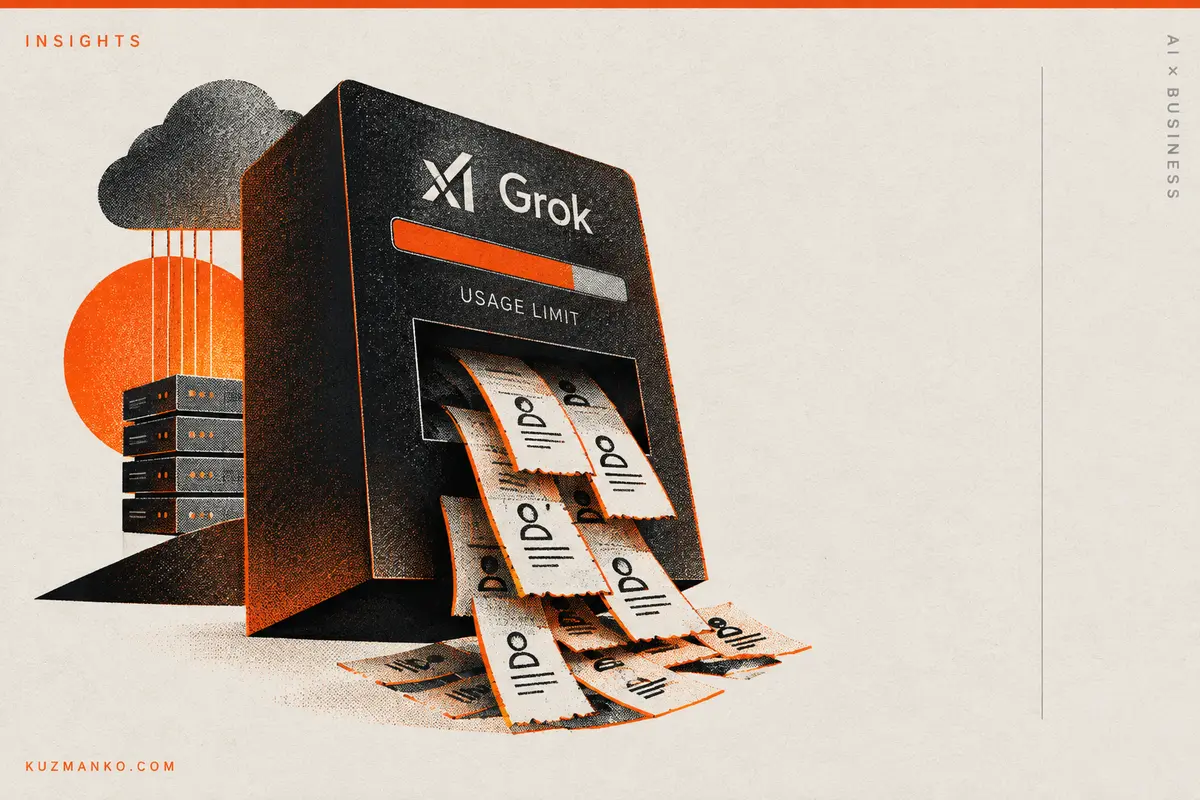
A paid AI agent subscription is not a guarantee of uninterrupted capacity. For an enterprise, the important question is not what the subscription costs. It is what it costs to complete a business process to the required standard, and what happens when the allowance runs out halfway through the working day.
According to the report on Grok Bot, paying users were blocked after exhausting their usage allowances earlier than expected. One described reaching the weekly limit with four days still to go before it reset. The same report said Elon Musk attributed the restrictions to an unsustainable gap between operating costs and revenue.
The report does not provide detailed cost data or a complete account of the subscription terms. It cannot tell us what a particular enterprise would pay. But it does expose a real management issue: an agent that performs real work must be evaluated as operational infrastructure, not just convenient software.
Watch out: A subscription is not a throughput commitment. A monthly payment does not guarantee that an agent can complete everything you assign to it. Check allowances, rate limits, service terms and options for continuing work when capacity runs out.
That distinction changes procurement. A manager can approve a relatively inexpensive subscription while creating an expensive operational dependency if an entire team comes to rely on a service that cannot support its workload.
Why AI Agents Consume More Than You Expect
In a conventional chat interaction, a user asks a question and gets an answer. An agent may break down a task, gather information, read documents, invoke tools, check results and retry failed actions. A short employee request can trigger a long sequence of operations.
Not every agent runs multiple models in parallel, and not every task needs a complex workflow. Consumption depends on the architecture, the model, the volume of information and the number of attempts. That is precisely why the number of requests an employee submits is only a partial measure of usage.
There is also variability that a demo rarely reveals. Processing a clean invoice is not the same as processing a scanned invoice with missing information. A straightforward service request is not the same as a case that requires searching several systems and resolving conflicting procedures. Exceptions can consume more computing resources and more human time.
Measure an agent's economics by work completed and approved, not by the number of answers it generates.
The Missing Budget Metric: Cost per Completed Process
Subscription fees are only one component. The business cost also includes systems integration, maintenance, quality checks, exception handling, human oversight and error correction. When a usage limit stops work, add the cost of waiting and reverting to manual processing.
A useful operating metric is:
Cost per successfully completed process = total operating and oversight costs for the period ÷ number of completed processes that met quality requirements.
This metric does not replace an assessment of business value. An agent can be worthwhile without saving many hours, for example by reducing turnaround times or serving demand that previously went unmet. But the intended benefit must be defined upfront. Automated activity is not automatically a saving.
- Subscription price: Shows the baseline expense, but not actual capacity.
- Request count: Shows interaction volume, but not the complexity of the work.
- Response time: Shows how quickly an answer arrives, but not whether the result is correct.
- Cost per successfully completed process: Shows operational efficiency, but not broader business value.
These distinctions explain why procurement based solely on per-user pricing can mislead. In an enterprise with month-end workload peaks, the monthly average may look manageable while available capacity falls short on the days that matter most.
Test the Peak Day Before Expanding Adoption
A good pilot does not end when the agent successfully performs a task. It must show that the organization can operate the agent over time, under realistic loads and exceptional conditions, without losing control of cost or quality.
- Define the business outcome: Select a process and specify what successful completion means.
- Test representative work: Include routine tasks, complex cases and typical workload peaks.
- Measure the full cost: Combine service consumption, oversight time, corrections and infrastructure costs.
- Plan a safe stop: Decide what waits, what moves to a human and what triggers an alert.
- Approve expansion: Scale usage only once quality, capacity and cost meet the agreed targets.
This requires collaboration between operations, IT and finance. Information security and legal teams should participate according to the data being processed and the actions the agent is authorized to take. Choosing a model does not resolve these responsibilities.
What Should You Ask the Provider?
- What exactly consumes the allowance: a message, a tool action, compute time or another measure?
- Is the allowance shared across employees, and what happens when a heavy user exhausts it?
- Can you monitor consumption, receive alerts and set budget limits?
- Can you purchase additional capacity, and on what terms?
- What commitments cover availability, support and changes to service terms?
- How can you preserve work in progress and resume it after a stop?
Moving to an API is not an automatic solution either. It may offer more detailed measurement and control, but still requires management of rate limits, budgets, errors and information security. Switching providers requires renewed quality testing, not just a different connection.
Keep Humans in the Loop Without Making Them the Bottleneck
Agents can perform tasks that require judgment and do not follow a single fixed path. That is also why human oversight remains critical. The question is where to place it.
If an employee has to read and approve every step, much of the potential saving may disappear. Oversight should instead reflect risk. Clearly defined, low-risk actions can run automatically after appropriate testing. Exceptions, financial commitments and sensitive actions should require approval according to organizational policy.
The objective is not to remove people from the process at any cost. It is to let them oversee many processes through an exception queue, documentation and controls. Doing that well requires domain expertise, a deep understanding of AI and management experience. Relevant education and a disciplined methodology matter far more here than an impressive demo or a promise of an agent that does everything.
Keep Adopting, but Build Organizational Capability
The lesson from the reported Grok Bot case is not that agents are uneconomical. It is that a business process should not depend on the assumption that today's subscription price will secure stable capacity indefinitely.
Enterprises need to advance on two fronts: train employees to communicate effectively with models and critically evaluate their output, while building the internal capability to create and manage agents. An agent integrated into existing systems can minimize changes to working habits. Behind the scenes, however, it still needs permissions, monitoring, version management and budget controls.
In this sense, IT also becomes responsible for managing a digital workforce: defining roles, limiting authority, evaluating performance and shutting down activity when necessary.
Before buying the next subscription, ask to see more than what the agent can do. Ask how much acceptable work it can complete, at what cost, and what happens when it stops. That is where dependable adoption begins.