
The short answer: LLMs should explain data, not become the data engine
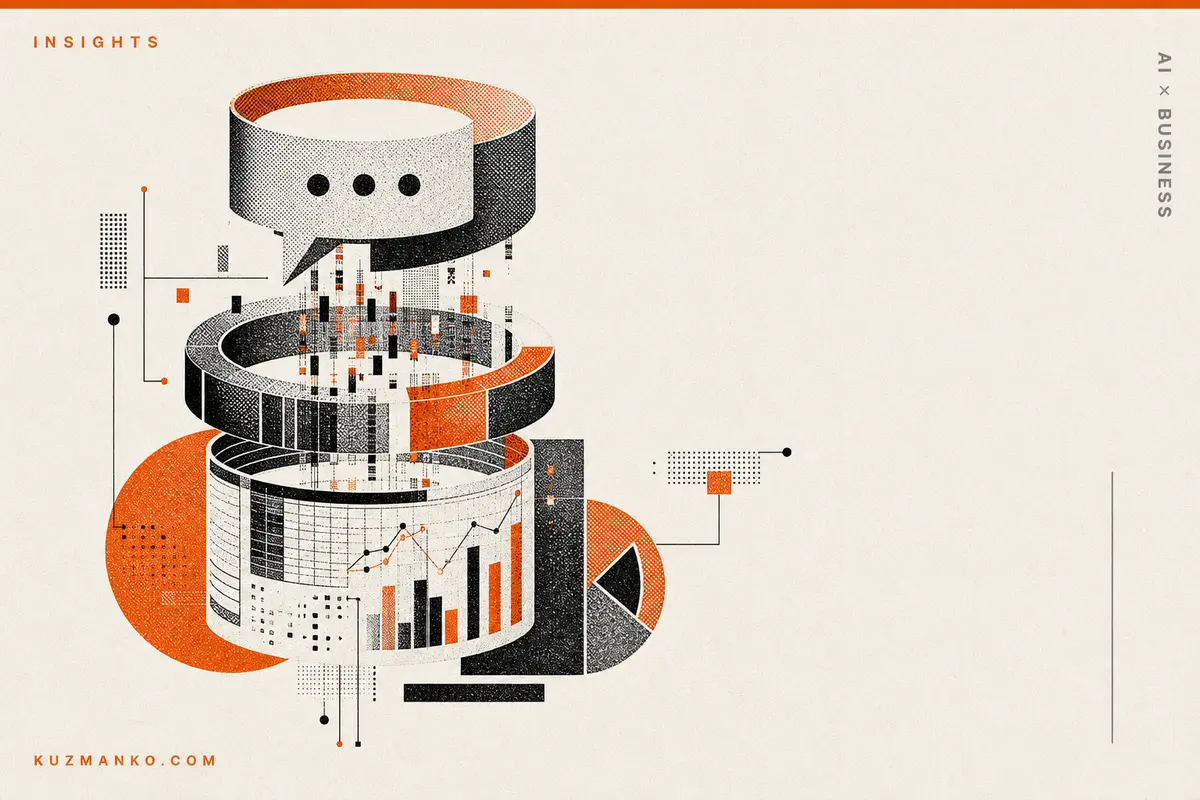
Hybrid AI is the enterprise architecture that combines large language models with deterministic analytical systems. The LLM interprets the business question, clarifies intent, generates a structured analytical request, and explains the result. A deterministic layer, such as SQL, Python, pandas, a BI semantic model, or governed APIs, performs the actual calculation against the data.
That distinction is not academic. It is the difference between an impressive demo and a system that a CFO, COO, plant manager, or compliance officer can trust.
The real problem with many enterprise AI agents is not conversation quality. The problem is trust. A response that sounds polished but is based on the wrong filter, the wrong column, or an inconsistent aggregation is more dangerous than a response that admits uncertainty.
In enterprise AI, the most important question is not whether the model can answer. It is whether the organization can prove how the answer was produced.
Why language models are not reliable calculation engines
Large language models are excellent at language, context, prioritization, explanation, classification, summarization, and judgment-like reasoning. They are also increasingly capable of using tools, writing code, and orchestrating multi-step workflows.
But their core operating principle is probabilistic generation. They predict likely continuations. That makes them powerful for ambiguous human communication, but risky when placed directly in charge of numerical truth.
In manufacturing, finance, supply chain, healthcare, insurance, and operations, a small analytical error can become a management decision. The model may select the wrong field from a complex Excel file, skip rows, misread a maturity score, apply an irrelevant filter, or produce identical outputs for different questions because the planning step was flawed.
This does not mean LLMs are weak. It means they must be used correctly.
AI is not only a technical implementation. It is a multidisciplinary practice that requires understanding models, business processes, management constraints, data governance, finance, operations, and human decision-making. Organizations that treat AI as a prompt-writing exercise usually discover the limits quickly.
The architecture that works: language on top, deterministic logic underneath
A robust enterprise AI agent should not be a free-form model wandering through spreadsheets and databases. It should be an orchestrated system with clear responsibilities.
The LLM can handle:
- Understanding the user’s natural-language question
- Identifying the intended business process
- Asking clarifying questions when the request is ambiguous
- Translating intent into a structured analytical specification
- Selecting the right tool or workflow
- Explaining findings in business language
- Recommending next actions within approved boundaries
The deterministic layer should handle:
- Filtering rows
- Selecting columns
- Joining datasets
- Calculating averages, totals, ratios, trends, and outliers
- Enforcing permissions
- Applying agreed business definitions
- Logging the query and result
- Running validations and reconciliation checks
A simple conceptual pattern looks like this:
import pandas as pd

analysis = {
    'plant': 'Plant A',
    'chapter': 'Inventory Management',
    'metric': 'improvement_potential',
    'allowed_fields': ['score', 'recommendation', 'evaluator_comment']
}

df = pd.read_excel('operational-maturity.xlsx')

result = df[
    (df['plant_name'] == analysis['plant']) &
    (df['chapter_name'] == analysis['chapter'])
][analysis['allowed_fields']]

summary = {
    'average_score': result['score'].mean(),
    'recommendations': result['recommendation'].dropna().tolist(),
    'comments': result['evaluator_comment'].dropna().tolist()
}
The LLM should not invent which columns matter. It should receive a governed mapping and use approved tools. The deterministic code performs the computation. The model then converts the verified output into an executive explanation.
The missing layer: semantic mapping
Many AI failures in enterprises come from a missing semantic layer.
Business users ask questions in business language. Data systems store information in technical structures. Between those two worlds, organizations need a mapping layer that defines what each field means, how it can be used, who may access it, and whether it can be aggregated.
For example, a maturity-assessment dataset may include hundreds of columns: scores, chapters, subchapters, evaluator notes, recommendations, strengths, weaknesses, free-text remarks, metadata, dates, site names, and department identifiers. A model should not guess which one represents operational maturity or whether a text field can be averaged.
The mapping layer should define:
- Business term to physical column name
- Field type and allowed operations
- Aggregation rules
- Data sensitivity and permission rules
- Valid filters and dimensions
- Synonyms used by business teams
- Required validation checks
- Audit and lineage requirements
This is not just data engineering. It is data governance. It is also where business expertise becomes essential.
A strong AI implementation requires people who understand both the model and the operational reality. In my experience, the best enterprise AI work is rarely done by people who only know tools. It is done by people who can connect academic understanding, business process experience, managerial judgment, and practical implementation.
Less magic, more operating discipline
The market is full of promises about autonomous AI agents. Some of the excitement is justified. Agents can materially improve productivity, reduce operational friction, and automate non-deterministic work that previously required human judgment.
But autonomy without architecture is not a strategy.
A high-quality AI agent must know when to act, when to call a tool, when to escalate, and when to stop. That is the first serious level of agentic maturity: the model does not do everything itself. It orchestrates tools that are better suited for specific tasks.
This is why platforms matter. Enterprises need a practical environment for building, deploying, monitoring, and governing agents. Microsoft Copilot Studio is a reasonable option inside the Microsoft ecosystem, especially where identity, permissions, and existing enterprise workflows are already standardized. At the same time, tools such as n8n are entering larger organizations because they offer flexible workflow orchestration that previously seemed more natural in smaller technical teams.
Claude is currently one of the strongest options for broad enterprise AI adoption, especially for reasoning, writing, and applied workflows, although security architecture must be evaluated carefully. Claude Code and collaborative coding workflows are particularly useful where AI is connected to real implementation. Copilot continues to improve and remains an important infrastructure layer, even if large enterprise vendors often move more slowly than the most aggressive AI-native companies.
The tool choice matters, but it is secondary to architecture. A weak architecture will produce weak results even with a strong model.
Human-in-the-loop should scale judgment, not create bottlenecks
Human review is essential in enterprise AI, especially where decisions affect money, safety, compliance, customers, or employees. But there is a common misunderstanding: human-in-the-loop does not mean a person must manually approve every micro-action.
If every process still needs the same amount of human supervision as before, the organization has not transformed anything. It has merely inserted AI into the old workflow.
The objective is different. A person who previously executed or supervised one process should be able to oversee dozens or hundreds of AI-supported processes through dashboards, exception queues, validation signals, and escalation policies.
Good human-in-the-loop design includes:
- Clear thresholds for automatic action
- Exception handling for unusual cases
- Confidence and validation indicators
- Full audit logs
- Role-based approval levels
- Sampling mechanisms for quality control
- Escalation paths when rules conflict
This is where operational efficiency becomes real. AI should not replace governance. It should make governance scalable.
Why internal AI capability is becoming mandatory
Organizations should move on two tracks at the same time.
The first track is AI literacy. Employees need to learn how to communicate effectively with models, evaluate outputs, structure tasks, and understand limitations. This is now a core business skill, not a niche technical ability.
The second track is agent development. Companies need internal capabilities to create, manage, monitor, and improve AI agents. Over time, information systems departments will increasingly behave like human resources departments for digital workers: onboarding agents, assigning permissions, monitoring performance, removing underperforming agents, and defining responsibilities.
This requires more than enthusiasm. It requires education, governance, architecture, and experienced leadership. The rise of self-proclaimed AI experts has created real damage, particularly for small and mid-sized businesses that may struggle to distinguish serious expertise from opportunistic consulting. AI implementation requires depth: technical knowledge, business process fluency, managerial experience, and an understanding of where probabilistic systems are appropriate.
The enterprise standard: verifiable intelligence
The future of enterprise AI will not be built on models that improvise answers from complex data environments. It will be built on hybrid systems that combine language intelligence with deterministic computation, semantic governance, validation rules, and auditability.
That may sound less glamorous than fully autonomous AI. It is also far more useful.
Executives should ask a few direct questions before approving any AI agent that touches operational or financial data:
- Which layer performs the calculation?
- Are business definitions mapped and governed?
- Can the answer be reproduced?
- What happens when the model is uncertain?
- Who approves high-impact actions?
- Are permissions enforced before the model receives data?
- Is every tool call logged?
- Can the system explain both the result and the method?
The winning organizations will not be those that simply adopt the newest model first. They will be the ones that understand what each component is good at and design the operating system around that reality.
LLMs bring interpretation, flexibility, and communication. Deterministic analytics brings reliability, consistency, and auditability. Enterprise AI needs both.