
The short answer: a job search agent is not just a smarter search box
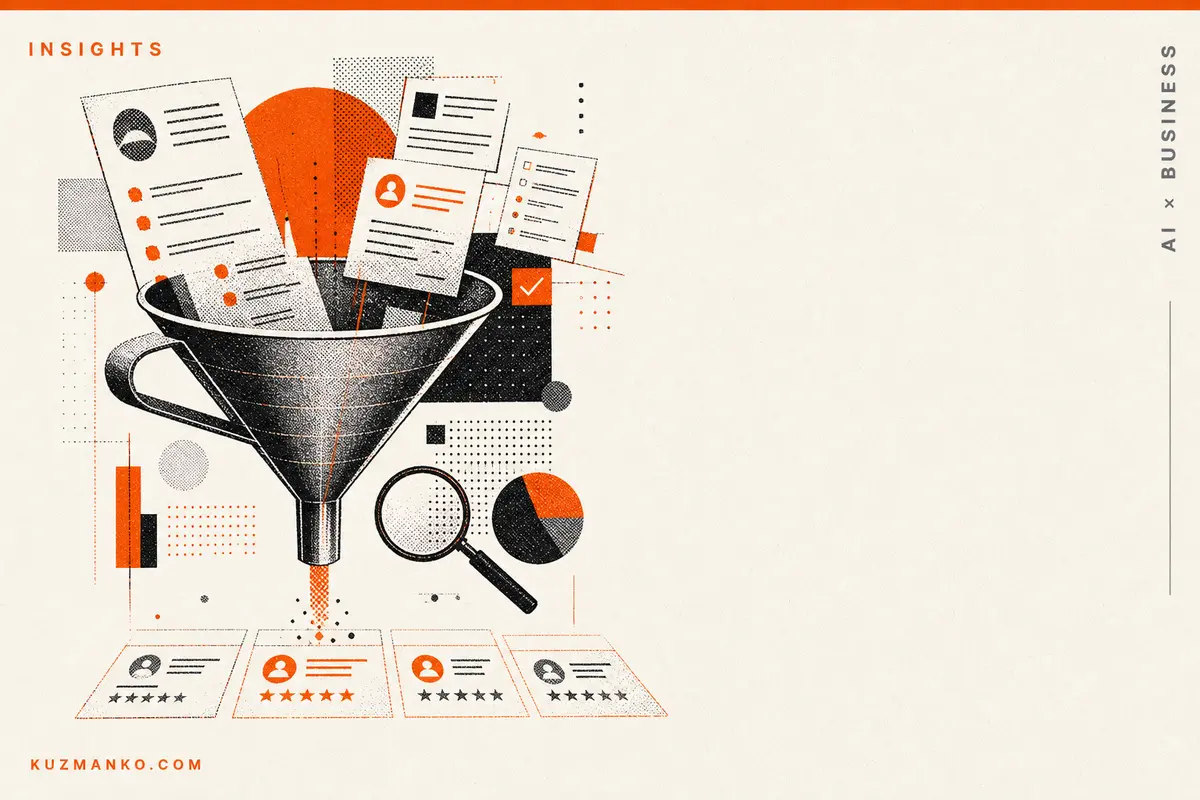
An AI job search agent reads a candidate's CV, turns it into targeted search queries, retrieves relevant job postings, scores each role against the candidate profile, and explains the reasoning behind the match.
That last part matters. A list of jobs is commodity software. A ranked shortlist with transparent reasoning is the beginning of operational AI.
The same design pattern applies far beyond recruitment. It can be used for vendor screening, lead qualification, insurance triage, support routing, document review, compliance checks, and any process where people currently scan large volumes of semi-structured information and make judgment calls.
The most interesting AI systems in business are not always the biggest models. They are often the smallest models that understand one workflow deeply enough to make it faster, auditable, and repeatable.
Why job search is a perfect agent problem
Early-career job searching has become an industrial task. Candidates scan hundreds of listings, rewrite searches repeatedly, submit applications into systems they barely understand, and often receive little feedback about fit.
The problem is not lack of information. The problem is excessive noise.
A useful job search agent should answer a few practical questions immediately:
- Which roles are realistically relevant to this CV?
- Which skills are missing or weak?
- Is the candidate overqualified, underqualified, or aligned?
- Which jobs are worth applying to first?
- What is the evidence behind the recommendation?
This is exactly where AI creates value: not by replacing all human judgment, but by reducing the amount of judgment wasted on repetitive filtering.
Recruiters face the mirror image of the same problem. They do not need another dashboard full of profiles. They need better prioritization, clear explanations, and mechanisms that can be audited when decisions affect people.
The important architecture: teacher model, student model, narrow task
One of the most promising patterns in applied AI is the teacher-student architecture. A stronger model can be used to generate examples, labels, and reasoning traces. A smaller model can then be fine-tuned to perform the operational task at lower cost and with better deployment flexibility.
In a job search scenario, the teacher model may produce training data such as:
- Search queries based on a CV
- Structured labels for job fit
- Explanations for why a role is strong, weak, or borderline
- Scores across skills, experience, education, industry, and seniority
The student model then learns the specific task. It does not need to be a general-purpose genius. It needs to be reliable at a defined workflow.
A simplified pipeline looks like this:
input: candidate CV
step 1: extract skills, education, experience, seniority, industries
step 2: generate job search queries
step 3: retrieve job postings from approved sources
step 4: score each job against the CV
step 5: explain fit and gaps
step 6: return a ranked shortlist for human review
This is a very different mindset from simply connecting a chat interface to a large model and hoping users will prompt it correctly.
Why small models can outperform bigger systems in the right workflow
Large frontier models are powerful, and platforms from Anthropic, OpenAI, and Microsoft all have legitimate enterprise roles. Claude is currently one of the strongest systems for broad organizational adoption and applied work, although security architecture must be handled carefully. Microsoft Copilot is improving and remains valuable as infrastructure, especially in Microsoft-heavy environments, even if large enterprise vendors tend to move more slowly than focused AI labs.
But for a narrow operational workflow, model size is not the first question.
The better questions are:
- Is the task clearly defined?
- Is the output format stable?
- Is the training data representative?
- Can the result be evaluated?
- Can the model run at a reasonable cost?
- Can the organization monitor failures?
Small models become attractive when the workflow is bounded. A model with roughly several billion parameters, adapted through methods such as LoRA, can be enough for query generation, classification, ranking, and explanation if the data and process are well designed.
That is the commercial lesson. AI value does not come only from buying access to the largest model. It comes from engineering the right system around the business process.
The LoRA lesson: separate the jobs inside the agent
A subtle but important technical point is that one model can still need multiple specialized behaviors.
For example, generating LinkedIn-style search queries is not the same task as writing a natural-language explanation of job fit. One expects structured output. The other expects reasoned prose.
When teams force both behaviors into one adaptation layer, they often create output contamination. Structured formats start appearing in explanations. Long prose starts appearing where strict JSON was expected. The model has learned the domain, but the product experience becomes unstable.
A cleaner design is to separate the specialist heads:
- One adapter for query generation
- One adapter for job fit evaluation
- One shared base model where appropriate
- One orchestration layer that controls the sequence
- One human review layer for sensitive decisions
This is not just a technical detail. It is product discipline.
AI implementation is not a technical-only exercise. It requires deep understanding of the professional domain, operational constraints, management priorities, and the financial logic of the process. That is why academic grounding and serious field experience matter. The market has too many self-appointed AI experts who can produce impressive demos but cannot design stable business systems.
The explanation layer is where trust begins
A job recommendation without explanation is hard to trust. A score of 87 percent means very little unless the system can show the evidence.
A better agent should explain fit across dimensions such as:
- Skills match
- Experience relevance
- Education and certifications
- Industry alignment
- Seniority level
- Location or work model
- Missing requirements
This makes the system debatable. A candidate can challenge it. A recruiter can inspect it. A product team can improve it.
That is critical because recruiting decisions involve people, careers, and potential bias. If an AI system silently ranks candidates or jobs without explanation, it creates operational risk and reputational risk. If it exposes its reasoning, it becomes easier to audit, improve, and constrain.
Human in the loop, but not human on every click
Human oversight is essential in AI systems that affect employment. But there is a common mistake: designing AI so that every small action requires human approval.
If every recommendation, every filter, and every micro-decision requires a person, the organization has not automated a process. It has added another screen.
The better goal is leverage. A person who previously reviewed one process manually should now supervise hundreds of agentic actions through exception management, sampling, alerts, and quality dashboards.
In a job search product, that may mean:
- The agent ranks 300 roles into a shortlist of 20
- The human reviews only the top results and edge cases
- The system flags uncertain matches
- The candidate controls final application decisions
- The model's explanations remain visible and editable
This is the right interpretation of human in the loop. Not constant human intervention. Scaled human supervision.
What enterprises should learn from this pattern
Recruiting is only the example. The strategic lesson is broader: companies need internal capability to build, deploy, manage, and govern AI agents.
This capability should develop on two parallel tracks.
First, AI literacy. Employees must learn how to communicate effectively with models, assess output quality, identify hallucinations, and understand where AI is useful or dangerous.
Second, agent development. Organizations need platforms and practices that allow them to build agents quickly, connect them to approved systems, monitor performance, and retire them when they no longer work.
Microsoft Copilot Studio can be a reasonable option for organizations deeply invested in the Microsoft ecosystem. Tools such as n8n are also entering serious enterprise environments, including places where they would once have seemed unlikely. The point is not one preferred tool. The point is the need for a managed agent platform.
Information systems departments will increasingly become human resources departments for AI agents. They will onboard agents, assign permissions, monitor performance, investigate incidents, and manage lifecycle risk.
The finance case: operational efficiency with measurable controls
A job search agent creates value in ways finance teams can understand.
For candidates, it reduces wasted applications and improves targeting. For recruiters, it reduces screening time and increases the quality of shortlists. For job platforms, it can improve engagement and conversion. For universities and career centers, it can support more students without linearly increasing staff.
The metrics should be practical:
- Time saved per candidate
- Application relevance rate
- Interview conversion rate
- Recruiter review time
- False positive and false negative rates
- User trust scores
- Bias and fairness indicators
- Cost per successful match
This is how AI initiatives should be evaluated. Not by how futuristic they sound, but by whether they improve throughput, quality, cost, and risk management.
The ethical and regulatory questions cannot be secondary
A job search agent handles sensitive information. CVs include education, employment history, location, identity signals, and sometimes demographic clues. Job postings may come from external platforms with terms of use that restrict scraping or automated retrieval.
Responsible implementation requires clear answers:
- What data is stored?
- How long is it retained?
- Can users delete it?
- Which sources are approved for job retrieval?
- How are biased recommendations detected?
- Can users see and contest the reasoning?
- Are automated decisions being made, or only recommendations?
These questions do not slow AI adoption. They protect it. Systems that ignore governance may move quickly at first, but they become difficult to scale inside serious organizations.
The real shift: from AI tools to AI workers
Traditional AI tools require people to change habits. They open a tool, write a prompt, interpret the answer, copy the result, and continue working elsewhere.
AI agents are different. A well-designed agent can operate inside an existing process with less behavioral change from employees. The technical implementation may look more complex, but adoption can be easier because the worker receives an output at the right point in the workflow.
That is why agents matter. They are not merely chatbots with more buttons. They are operational units that can perform defined tasks, produce evidence, and escalate uncertainty.
The job search agent is a small example of a much bigger organizational future: specialized AI systems that manage non-deterministic work, where judgment is required but repetition is high.
Final thought
The strongest lesson from the job search agent pattern is not that AI can find jobs. We already knew software could search.
The real lesson is that small, specialized models can convert messy human workflows into structured, explainable, supervised processes. That is where enterprise AI is heading.
Organizations that understand this will stop treating AI as a novelty layer on top of existing tools. They will build internal agent capability, invest in serious AI education, and redesign processes around supervised autonomy.
The winners will not be the companies with the most demos. They will be the companies that know how to turn judgment-heavy work into scalable, governed operations.