
The short answer: MCP makes agents governable
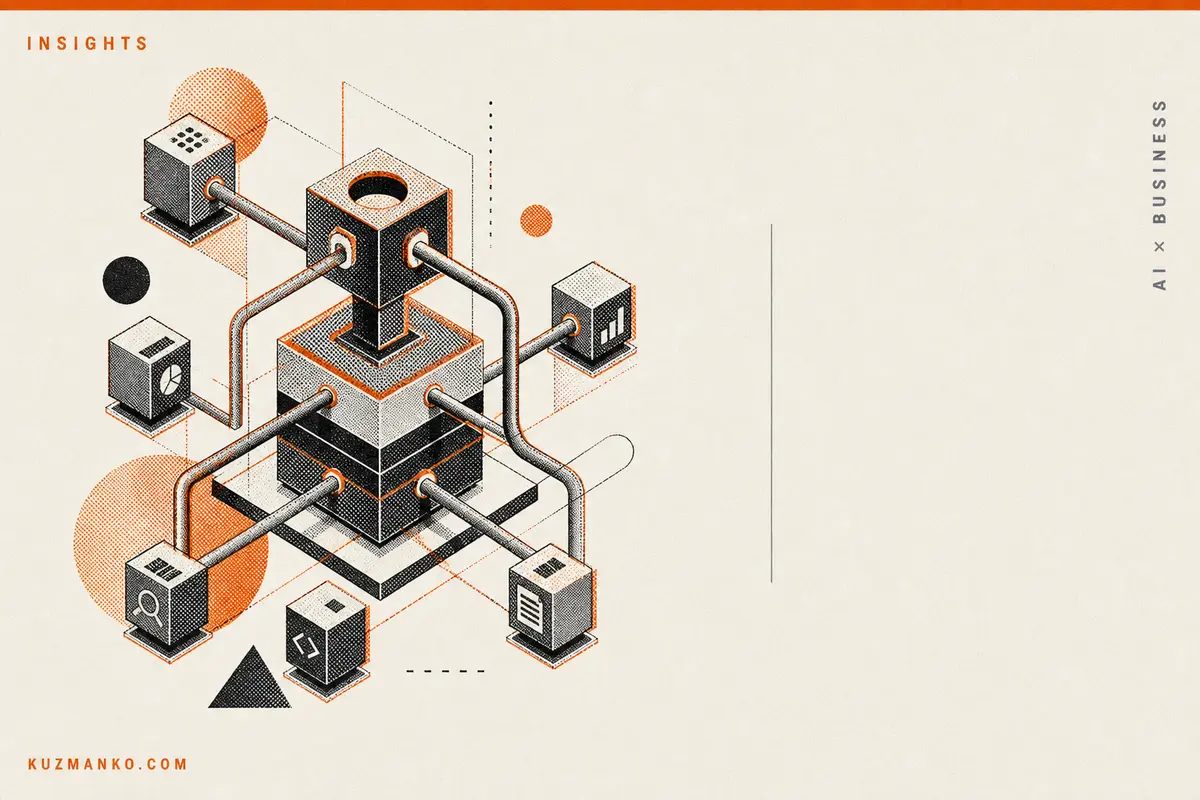
Model Context Protocol, or MCP, changed AI agent architecture because it separates the agent from the tools it uses. Instead of embedding tool definitions, permissions, schemas, and execution logic inside every agent, MCP turns tools into discoverable services with clearer contracts.
That sounds technical, but the strategic implication is much larger: MCP helps organizations move from experimental agent demos to operational AI systems that can be maintained, audited, scaled, and governed.
The enterprise value of MCP is not that it lets a model call a tool. We already had that. The value is that it gives tool usage a proper architectural boundary.
The first wave of agentic AI was often built too quickly. Teams created agents with local tool definitions, duplicated business logic, hardcoded authentication patterns, and improvised approval flows. This worked in small pilots. It breaks down when seven agents share overlapping tools, write to production systems, trigger notifications, and require human approval at different points.
MCP answers that mess with a more mature principle: tools should be managed like enterprise interfaces, not like helper functions hidden inside agent code.
Why tool calling was not enough
Traditional tool calling made agents useful. A model could search a database, call an API, create a ticket, summarize a file, or trigger a workflow. But in many implementations, the tool layer remained too close to the agent itself.
That created several problems:
- Every agent carried its own version of the tool definitions.
- Schema changes became risky because multiple agents depended on slightly different assumptions.
- Permission logic was scattered across workflows.
- Audit trails were inconsistent.
- Human approval was implemented differently by different teams.
- Tool descriptions became informal prompts instead of managed contracts.
The result was predictable: organizations had clever demos, but not reliable operating models.
This is where a protocol matters. A registry can help, but a protocol creates a stronger boundary. A tool server can serve different clients, different frameworks, and different runtime environments. A team may use Python today, TypeScript tomorrow, LangGraph this quarter, and a different orchestration layer next year. MCP reduces the strategic dependency on one library or one internal implementation pattern.
For enterprise AI, that matters more than most teams realize.
MCP separates three things that should never have been fused
A sustainable agent architecture has at least three separate layers:
- The model, which interprets intent and decides what action may be useful.
- The agent workflow, which manages state, routing, memory, retries, and business process structure.
- The tool layer, which performs real actions against systems, data, and external services.
When these layers are fused together, every improvement becomes expensive. A new CRM field requires agent changes. A new approval rule requires workflow changes. A new security requirement requires a refactor across several agents.
MCP gives the tool layer its own operating model. Tools can be described, versioned, tested, exposed, monitored, and retired more cleanly.
A simplified MCP-style tool contract is not just a developer artifact. It becomes part of the operating system for AI agents:
{
  "name": "createCustomerCase",
  "description": "Create a customer service case only after required fields are validated.",
  "inputSchema": {
    "customerId": "string",
    "caseType": "string",
    "priority": "low | medium | high",
    "summary": "string"
  },
  "requiresApproval": true
}
The important part is not the syntax. The important part is that the tool has a clear contract and a governance surface.
Stdio is convenient. HTTP is architecture.
In local development, stdio is a useful way to connect an MCP server. The tool server runs as a subprocess, and the client communicates through standard input and output. It is fast, simple, and excellent for prototyping.
But production has different priorities.
A broad enterprise environment usually needs shared services, horizontal scaling, observability, centralized deployment, and stronger operational control. For that, streamable HTTP is typically the better direction. It allows the tool server to live as a standalone service, run in a container, serve multiple clients, and fit more naturally into cloud deployment patterns.
The choice between stdio and HTTP is not just a developer preference. It answers a deeper architectural question: are the tools part of one application, or are they becoming enterprise infrastructure?
Once multiple agents and products depend on the same tools, HTTP usually wins.
Human in the loop belongs near the action
Human approval is one of the most misunderstood topics in agentic AI.
Yes, a human in the loop is critical. AI allows us to execute non-deterministic processes that previously required human judgment, but that does not mean we should remove oversight from sensitive decisions. In finance, healthcare, insurance, legal, cyber, and regulated operations, approval is not optional.
But there is a trap: if every AI process requires a person to manually approve every step, the organization has not achieved automation. It has only built a more expensive queue.
The real goal is different. A person who previously supervised one process should be able to supervise hundreds of AI-driven processes through exception handling, risk scoring, approval thresholds, and centralized control.
That is why approval logic should not be scattered inside every agent graph. Sensitive tool calls should pass through a central approval gateway. When an agent requests a high-risk action, the approval layer can pause the call, record it, present it to the right human, and resume only after authorization.
This pattern is especially important because agents are not merely chat interfaces. They are action layers.
If the action happens in the tool layer, the control point should sit near the tool layer.
MCP does not remove the need for expertise
MCP is a serious architectural improvement, but it is not magic.
It will not make a weak tool reliable. It will not prevent a model from choosing the wrong tool if the descriptions are vague. It will not replace identity management, monitoring, logging, permissions, red teaming, or business process design.
Tool descriptions themselves become a form of prompt engineering and interface design. If two tools sound almost identical, the model may choose incorrectly even when the underlying architecture is excellent.
This is why AI implementation cannot be treated as a purely technical project. Strong AI systems require knowledge of models, software architecture, business operations, management constraints, risk, and organizational behavior. Academic depth matters. Practical business experience matters. Domain expertise matters.
There are too many self-appointed AI experts selling shortcuts. Large enterprises often have the internal maturity to filter weak advice. Small and mid-sized businesses are more exposed. They can lose time, money, and trust by implementing brittle automations without understanding the operational consequences.
AI is multidisciplinary. The best work often comes from people who understand both the professional process and the AI mechanism that may improve it.
What MCP means for enterprise strategy
For executives, MCP should be viewed as part of a broader operating model for AI agents.
The main strategic questions are no longer only about which model to use. They are about how the organization will build, deploy, govern, and improve agents at scale.
Several priorities are emerging:
- Build internal capability to create and manage AI agents.
- Treat tool servers as managed enterprise infrastructure.
- Standardize approval patterns for sensitive actions.
- Invest in observability and audit trails from the start.
- Train employees to communicate effectively with models.
- Advance on both tracks: AI literacy for the workforce and agent development for operational leverage.
- Avoid locking the entire architecture into one orchestration framework too early.
This is also where the role of IT changes. Information systems departments will increasingly become something like human resources departments for AI agents. They will onboard agents, assign permissions, monitor behavior, manage lifecycle events, revoke access, and measure performance.
That may sound unusual today. It will feel normal soon.
Where MCP fits among Claude, Copilot Studio, and workflow automation
The vendor picture is becoming more interesting.
Anthropic has been moving quickly and creatively, and Claude remains one of the most compelling systems for broad enterprise adoption, though security and governance questions must be handled carefully. Claude Code and collaborative Claude-based workflows are already among the more practical AI tools for knowledge workers and technical teams.
Microsoft Copilot is a solid infrastructure play, especially inside organizations already committed to the Microsoft ecosystem. Historically, Microsoft moved more slowly than smaller AI-native companies, but Copilot has improved and the release pace has accelerated. Copilot Studio can be a reasonable path for agent implementation in Microsoft-heavy environments.
At the same time, tools such as n8n are entering enterprise environments more seriously than many expected. What once looked more suitable for smaller teams is now appearing inside large organizations because the need for flexible automation is so strong.
MCP does not replace these platforms. It can complement them by creating a cleaner tool boundary. The winning organizations will not choose tools randomly. They will design an agent infrastructure that lets platforms, models, and workflows evolve without rebuilding everything each time.
The practical implementation path
Organizations do not need to rebuild their entire AI stack overnight. A sensible MCP adoption path can be incremental.
Start with a narrow but meaningful use case. Choose a process where several agents or workflows need access to the same business capability, such as creating support cases, reading policy data, updating CRM records, or generating compliance summaries.
Then create a dedicated tool server with clear contracts, logging, access control, and versioning. Keep the first version small. Make it observable. Test it with more than one agent client. Add human approval at the tool boundary for sensitive actions.
A practical rollout sequence may look like this:
- Identify duplicated tools across agent prototypes.
- Move one high-value tool into an MCP server.
- Define strict input schemas and precise tool descriptions.
- Add logging, authentication, and permission checks.
- Introduce approval gates for sensitive operations.
- Connect two different agents or clients to the same server.
- Measure reliability, reuse, cycle time, and approval load.
- Expand only after governance patterns are proven.
This avoids the common mistake of building an ambitious agent platform before the organization understands its own operational requirements.
The bottom line
MCP changed the architecture of AI agents because it moves tool use from local agent code into a managed protocol layer. That shift creates cleaner separation, better governance, easier reuse, and a more realistic path to enterprise scale.
But MCP is only one part of the story. Successful AI adoption still depends on deep professional knowledge, strong process design, internal capability, security discipline, and human oversight that improves throughput rather than blocking it.
The organizations that win with AI agents will not be the ones with the flashiest demos. They will be the ones that understand a simple truth: agentic AI becomes valuable when it is treated as operational infrastructure, not as a collection of experiments.