
The short answer: this is not only a healthcare story
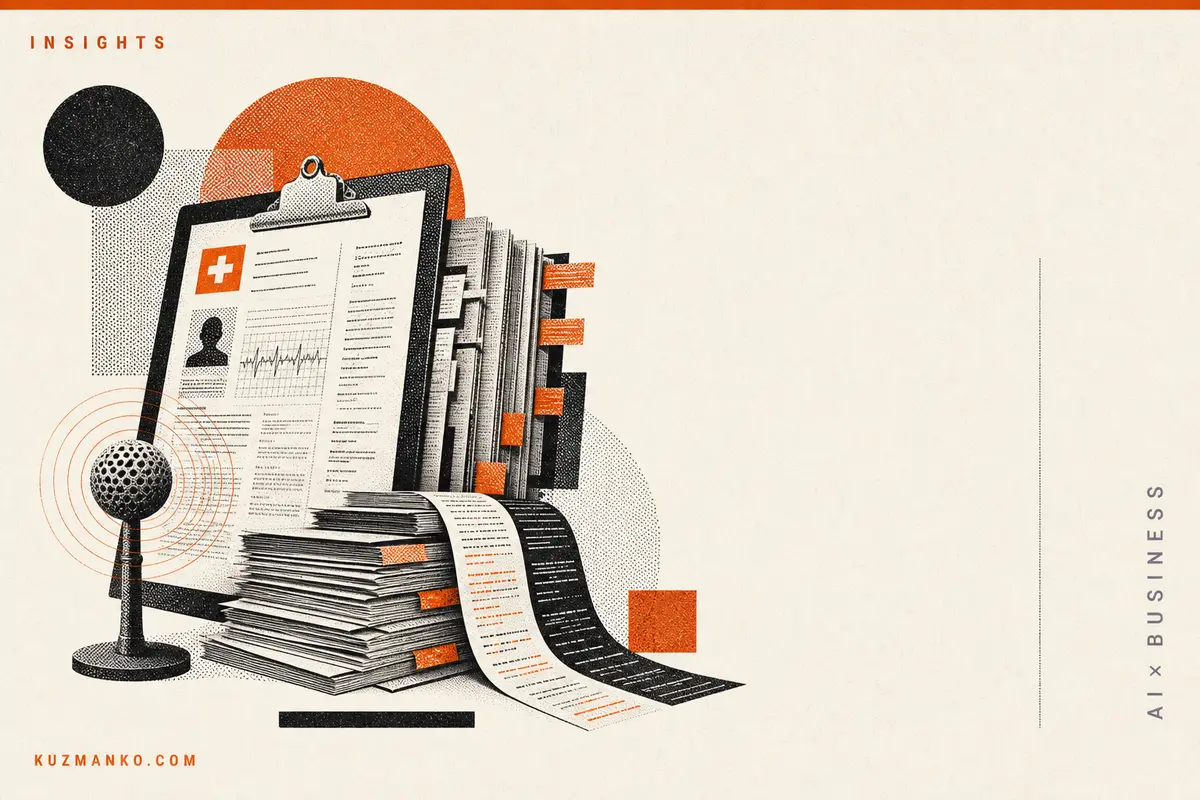
Microsoft's Dragon for Nursing is designed to reduce the documentation burden on nurses by listening to bedside interactions, extracting structured clinical information, and preparing it for entry into electronic health records. The nurse still reviews and approves the output before it becomes part of the record.
That last sentence is the key. The product is not interesting merely because it uses ambient listening or a large language model. It is interesting because it attacks a high-friction workflow where skilled professionals spend too much time translating judgment, conversation, and observation into structured system fields.
This is the same operational problem found in insurance, manufacturing, finance, logistics, legal operations, customer support, and field service. In every industry, expensive human expertise is trapped inside documentation, handovers, checks, reports, tickets, and forms.
The most valuable AI use cases are often not the most glamorous. They are the ones that convert human judgment into reliable operational throughput without removing accountability.
The nursing documentation bottleneck is a management problem
Healthcare has been digitized for years, but digitization did not always reduce work. In many hospitals, it moved the burden from paper to screens. Nurses document assessments, vitals, medications, interventions, patient responses, safety observations, and care plans inside electronic health record systems. These systems are necessary, but they are also heavy.
Reports from the U.S. healthcare system have estimated that nurses can spend a very large share of their shift on documentation. Studies of electronic health record use have repeatedly connected documentation pressure with fatigue, reduced job satisfaction, and burnout. Anyone who has managed a clinical operation knows the pattern: the better the auditability becomes, the more frontline teams feel they are serving the system rather than the patient.
Microsoft's Dragon for Nursing attempts to change that relationship. Instead of requiring the nurse to reconstruct the encounter after the fact, the system captures relevant details from bedside interactions and converts them into structured data. Before the information enters the electronic health record, the nurse reviews it.
This is human-in-the-loop design, but not in the lazy sense of asking a human to check every machine action forever. The real goal is to let one professional supervise a larger number of structured outputs with less manual effort, while preserving clinical accountability.
Why the human review step matters
AI can handle non-deterministic work better than traditional automation. Traditional software is excellent when the process is rule-based: if X happens, then do Y. But many operational processes are not like that. A nurse assessment, an insurance claim conversation, a maintenance report, or a procurement exception contains ambiguity. It requires interpretation.
That is where AI becomes valuable. It can transform unstructured language into structured operational data. But in regulated or high-risk environments, the system cannot simply decide and disappear into the database.
Human review matters for three reasons:
- It protects accountability when the output affects clinical, financial, legal, or safety outcomes.
- It trains organizational trust because professionals see what the system captured and what it missed.
- It creates a feedback loop that improves the process, the data schema, and the model configuration over time.
The danger is overcorrecting. If every AI-generated action requires the same level of human effort as doing the work manually, the business has gained very little. The design target should be supervision at scale. A nurse, analyst, engineer, or claims specialist should move from manually producing every record to validating, correcting, and escalating exceptions across many records.
The hidden issue: bad data structures create bad AI outcomes
One of the most important details in the Microsoft story is not the model. It is the structure of the flowsheets and fields inside the electronic health record.
In many institutions, the documentation schema has grown over years. Field names are inconsistent. Similar fields overlap. Some rows are outdated but still present. Some units use the same terms differently. This creates confusion for humans and models alike.
When AI output is inaccurate, executives often blame the model too quickly. Sometimes the model is the issue. But often the organization is asking AI to map real-world work into a messy operational structure that was never properly governed.
The lesson is clear: AI implementation is not a technical installation. It is process engineering, domain expertise, data governance, change management, and model capability working together.
A serious AI program should ask:
- Which fields are truly required for operational, regulatory, or financial purposes?
- Which fields are duplicated or poorly named?
- Where do experts disagree about terminology?
- Which outputs can be auto-drafted, which require approval, and which must be escalated?
- How will corrections from the field improve the system?
- Who owns the process after go-live?
This is why deep professional knowledge matters. AI projects led only as technology projects tend to become impressive demos with weak operational durability. Stable AI requires people who understand the business process, the managerial context, the risk environment, and the model behavior.
Adoption is behavioral, not only technical
Even when the technology works, adoption can fail. Nurses may not feel comfortable speaking assessments aloud. Unit managers may not protect training time. Some teams may see the system as surveillance. Others may use it only partially, which limits the benefit.
Successful adoption usually includes structured change support:
- Protected time for simulation and practice.
- Local champions who understand the work of the unit.
- Clear rules about what the AI captures and what the professional must verify.
- Feedback channels for field corrections.
- Metrics that measure operational improvement, not just tool usage.
This applies outside healthcare as well. Employees do not adopt AI because a vendor shipped a feature. They adopt it when the tool fits the rhythm of work, reduces friction, and does not threaten their professional identity.
A warehouse supervisor, a lawyer, a financial controller, and a nurse all ask the same practical question: does this help me do my job better, or does it create another layer of administration?
The same pattern in other industries
The Dragon for Nursing story is a template for a much wider class of AI applications. The pattern is simple: capture natural work, extract structured meaning, route it through the right level of review, and update the system of record.
Insurance claims
A claims adjuster speaks with a customer after a car accident. Today, the adjuster may listen, ask questions, type notes, classify damage, identify missing documents, and update the claim file. An AI system can draft the claim summary, extract vehicle details, identify liability signals, prepare a document checklist, and flag contradictions.
The adjuster should not disappear. Instead, the adjuster becomes the reviewer of a structured claim package and focuses on exceptions, negotiation, fraud indicators, and customer judgment.
Manufacturing shift handovers
In many factories, critical knowledge is still buried in shift conversations, maintenance notes, and informal WhatsApp messages. A machine behaved strangely. A technician noticed vibration. A batch required manual adjustment. These details may never reach the manufacturing execution system in a clean format.
An ambient or conversational AI layer can turn shift briefings into structured handover records, maintenance tickets, safety observations, and quality alerts. The human supervisor approves the record, while the organization gains traceability.
Field service
A technician visits a site, diagnoses a fault, replaces a component, and explains the issue to the customer. The administrative work often happens later, sometimes from memory. AI can capture the technician's spoken summary, generate the service report, update parts usage, recommend follow-up actions, and prepare the customer communication.
This improves billing accuracy, inventory planning, compliance, and customer experience. The technician spends more time fixing and less time typing.
Finance and audit
Month-end close includes explanations, reconciliations, variance comments, approvals, and evidence collection. These tasks require judgment but also create enormous documentation load. AI can draft variance narratives, match evidence to controls, identify missing approvals, and prepare review packs.
The controller remains accountable. But instead of manually assembling every explanation, the controller reviews a structured package and focuses attention on anomalies.
Legal and compliance operations
Compliance teams review policies, incident reports, third-party questionnaires, and regulatory changes. Much of the work is document-heavy and judgment-based. AI can extract obligations, map them to controls, draft review notes, and flag gaps.
The legal or compliance expert approves the final interpretation. The organization gains speed without pretending that legal accountability can be fully automated.
Customer support and sales operations
Call summaries are now a familiar AI use case, but the stronger application is operational closure. A sales conversation can update CRM fields, create follow-up tasks, identify procurement blockers, draft a proposal outline, and alert finance to pricing exceptions. A support call can update the ticket, identify product defects, trigger a knowledge-base update, and escalate churn risk.
The value is not the transcript. The value is the structured operational action that follows the conversation.
Tools are not enough. Organizations need agent infrastructure
There are two AI adoption tracks that enterprises should advance at the same time.
The first is AI literacy. Employees must learn how to communicate with models, how to validate outputs, how to use AI responsibly, and how to recognize weak reasoning. This is now a core workplace skill.
The second is agent development. Organizations need the ability to build, deploy, monitor, and govern AI agents that perform specific business functions. Agents can often be embedded into existing workflows with less behavioral change than broad AI tools, because the employee does not always need to learn a new interface. The agent can work behind the scenes, prepare outputs, route approvals, and update systems.
This is why internal capability matters. Companies should not depend entirely on external consultants or opportunistic AI personalities with shallow experience. The field is multidisciplinary. It demands technical understanding, business process experience, managerial judgment, governance, security thinking, and often academic depth.
In the future, information systems departments will increasingly look like human resources departments for AI agents. They will onboard agents, define permissions, monitor performance, manage lifecycle, evaluate risk, and retire agents that no longer serve the business.
Microsoft, Copilot, Claude, and the platform question
Microsoft has a natural advantage in enterprise distribution because it already sits inside the workflows of many organizations. Copilot and Copilot Studio are becoming more relevant for companies committed to the Microsoft ecosystem, especially where identity, permissions, Office data, Teams, SharePoint, and enterprise administration matter.
At the same time, enterprise AI buyers should be honest: innovation is not evenly distributed. Anthropic has shown impressive product creativity and speed, and Claude is currently one of the strongest options for broad professional use, although security and data governance require careful design. Claude Code and collaborative work patterns around Claude are particularly practical for teams building real AI-enabled workflows.
We are also seeing tools such as n8n enter environments that once would have rejected them as too lightweight for large enterprises. That shift matters. Organizations want faster orchestration, faster agent building, and less dependency on long development cycles.
The right platform decision is not ideological. It should be based on security, integration depth, speed of delivery, governance, user experience, and the organization's ability to maintain what it builds.
The operating model for successful AI implementation
The Microsoft nursing example points to a broader implementation model. It is not enough to buy a tool. The organization must redesign the workflow around supervised automation.
A practical operating model includes:
- Select a high-friction workflow where experts spend time translating work into records.
- Map the real process, not the official process.
- Clean the data schema before blaming the model.
- Decide which outputs are drafted, auto-approved, reviewed, or escalated.
- Build feedback loops from professional corrections.
- Train people in the new behavior, not only in the software interface.
- Measure cycle time, quality, completeness, employee burden, and financial impact.
- Create internal ownership for ongoing governance.
This approach is less exciting than a viral demo. It is also the difference between AI theater and operational improvement.
What executives should take from the nursing case
The main lesson from Dragon for Nursing is not that hospitals need ambient documentation. Some do. Others will need different tools. The real lesson is that AI creates value when it is placed at the point where professional judgment becomes operational data.
That point exists everywhere.
It exists when a nurse turns care into a record. It exists when a technician turns a repair into a report. It exists when a controller turns financial movement into an explanation. It exists when a lawyer turns regulatory language into organizational obligations. It exists when a manager turns a meeting into decisions, owners, risks, and next actions.
AI is not just a technical layer. It is a new operational layer. Organizations that understand this will redesign work. Organizations that treat it as another software feature will collect tools without changing performance.
The winning formula is not full automation and not manual control. It is accountable scale: AI drafts, structures, routes, and monitors; humans supervise, correct, decide, and improve the system.
That is the real story behind Microsoft's nursing initiative. It is a healthcare example, but the lesson belongs to every serious organization.