
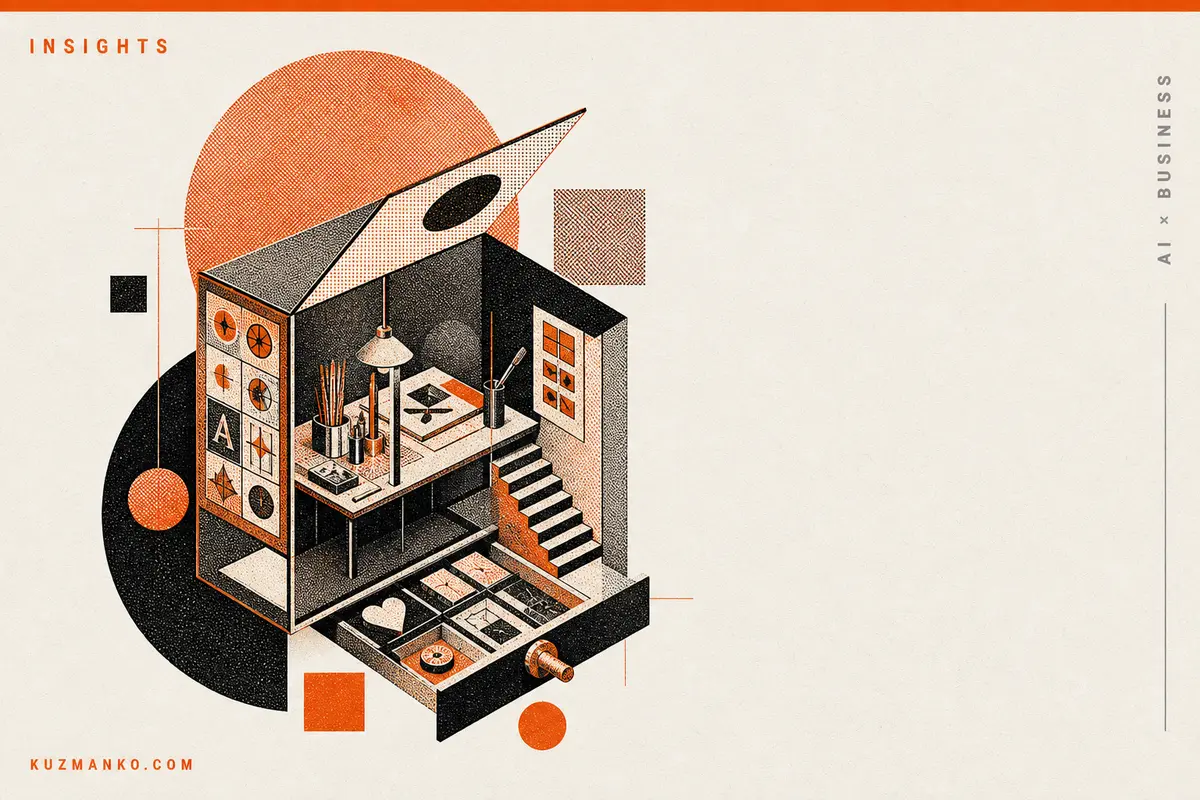
The short answer: creative AI is becoming intent-driven
The next generation of creative AI applications will not be defined by better image resolution, more style presets, or faster prompt execution. Those things matter, but they are no longer the strategic frontier.
The real shift is from generating assets to understanding intent.
A first-generation image tool asks: "What should I draw?" An AI-native creative application asks: "What are you trying to express, decide, test, or communicate?" That difference sounds subtle, but it changes the entire product model. It turns the system from a command executor into a reasoning interface.
For enterprises, this is not only a design trend. It is a signal about where software is going: less rigid workflow, more adaptive interaction, more non-deterministic decision support, and a much greater need for professional governance.
The winning AI products will not merely produce content. They will reduce the distance between human intention and operational execution.
From prompt to meaning
Most creative AI tools still behave like vending machines. You insert a prompt, choose a style, press a button, and receive an output. Sometimes the result is impressive. Often it is generic. The tool can produce, but it does not really collaborate.
That model is useful for experimentation, but it is limited for serious creative, commercial, and organizational work. Human intention is rarely captured in a single sentence. A brand team is not simply asking for "a futuristic blue abstract image." It may be trying to express trust after a merger, signal technological maturity without appearing cold, or communicate renewal to a conservative customer base.
The more valuable application does not rush to generate. It asks a few intelligent questions first:
- What emotion should the output carry?
- Who is the audience?
- What should be avoided?
- What tension or tradeoff should the work reflect?
- Is this meant to persuade, explain, comfort, challenge, or inspire?
This is where creative AI starts to become business software. It stops treating output as the goal and starts treating output as the visible layer of a deeper reasoning process.
Why this matters beyond art
It would be a mistake to classify this shift as relevant only to designers, artists, or marketing teams. Creative AI is simply the most visible laboratory for a much larger transformation in application design.
Many enterprise processes are not fully deterministic. They require judgment, interpretation, prioritization, and contextual awareness. Examples include vendor evaluation, customer response drafting, internal policy interpretation, audit preparation, product positioning, claims review, and management reporting.
Traditional software struggles with these processes because it wants fixed inputs and predictable paths. AI allows us to design systems that can operate in ambiguous environments. But this power comes with a condition: the process must be designed by people who understand both AI and the professional domain.
AI is not a purely technical implementation. Stable adoption requires deep knowledge of business processes, management reality, data boundaries, risk, user behavior, and model capabilities. This is why academic foundations, field experience, and multidisciplinary thinking matter so much. The best AI work often happens at the intersection of computer science, operations, finance, psychology, product design, and domain expertise.
The interface is becoming a conversation, not a form
For decades, business applications were built around forms, menus, dashboards, and permission structures. That will not disappear, but it will no longer be the default interaction model.
AI-native applications can behave differently. They can assemble the right flow dynamically based on user intent. Instead of forcing everyone through the same screen sequence, the system can interview the user briefly, infer context, retrieve relevant knowledge, perform actions, and present a structured recommendation.
This is a major product strategy shift.
The old model says: "Here are the fields. Fill them correctly."
The new model says: "Tell me what you are trying to achieve. I will help structure the path."
That does not mean the system should become vague or uncontrolled. Quite the opposite. The more adaptive the interface becomes, the more important it is to define process boundaries, escalation rules, audit trails, and human review points.
The human in the loop must scale
Human oversight is one of the most important principles in practical AI adoption. But many organizations misunderstand it.
If every AI process requires a human to manually approve every small step, the organization has not gained much. It has simply added a new layer of supervision. The strategic question is different: how can one person who previously executed or monitored one process now supervise hundreds of AI-supported processes safely?
That requires a better operating model:
- Humans should review exceptions, not every routine action.
- AI systems should explain confidence, uncertainty, and source logic.
- Workflows should separate low-risk automation from high-risk judgment.
- Managers should receive control dashboards, not endless approval queues.
- Governance should be embedded in the workflow, not added after deployment.
This is where creative AI teaches an important lesson. A user may not need to control every brushstroke, but they do need to guide meaning, review direction, and reject outputs that miss the intent. The same logic applies to enterprise agents. The human role changes from operator to supervisor, editor, and decision architect.
The business value is operational efficiency, not novelty
Many companies still evaluate AI through demos. A tool is shown, people are impressed, and then the organization struggles to turn excitement into measurable performance. That pattern is predictable because demos usually optimize for spectacle, not operational fit.
The real value of AI comes from improving how work moves through the organization:
- Fewer repetitive handoffs
- Faster drafting and analysis
- Better decision preparation
- Shorter cycle times
- More consistent quality
- Lower dependency on individual bottlenecks
- Stronger reuse of institutional knowledge
Creative AI applications that understand meaning are part of this efficiency story. A marketing department can produce more relevant campaign concepts. A product team can test messaging faster. A service organization can personalize communication without turning every request into a manual writing task. A finance team can transform narrative reporting from a time-consuming writing exercise into a reviewed, governed, AI-assisted process.
The financial case becomes stronger when AI is connected to throughput, labor leverage, quality control, and decision velocity.
Literacy and agents must advance together
Organizations need two parallel tracks.
First, employees must develop AI literacy. They need to understand how to communicate with models, how to frame tasks, how to evaluate outputs, and how to identify weak reasoning. The ability to work effectively with models is quickly becoming a core professional skill.
Second, companies need agent infrastructure. It is not enough to let every department improvise with disconnected tools. Enterprises need platforms for building, deploying, monitoring, and improving AI agents. In many organizations, IT departments will gradually become something like human resources departments for digital agents: onboarding them, assigning permissions, reviewing performance, retiring weak agents, and ensuring compliance.
Both tracks matter. Tools change employee behavior. Agents change process architecture. One without the other produces imbalance.
Tools are improving, but strategy still decides the outcome
The tool market is moving quickly. Claude is currently one of the strongest environments for broad professional AI work, especially where writing, reasoning, and structured collaboration matter. Claude Code and collaborative coding workflows show how practical AI can become when it is embedded directly into work rather than treated as a separate chat window. At the same time, enterprise security and data governance remain serious considerations.
Microsoft Copilot is becoming more useful as a workplace layer, although large platform companies often move more slowly than smaller AI-first competitors. Copilot Studio is a reasonable option for organizations already committed to the Microsoft ecosystem, particularly when permissions, identity, and internal systems are central to the deployment. We are also seeing tools such as n8n enter larger organizations, even in places where this would have seemed unlikely a short time ago.
The lesson is not that one tool wins forever. The lesson is that companies need the internal capability to evaluate, integrate, and govern tools as the market changes.
A poor AI strategy can fail with excellent tools. A strong AI strategy can create value even while the tool landscape continues to shift.
Beware the shallow AI expert
The growth of AI has created a market full of self-declared experts. Large enterprises often have enough internal filtering mechanisms to avoid the worst advice. Small and mid-sized businesses are more exposed. They may adopt fragile automations, send sensitive data into unsuitable tools, or redesign processes based on superficial demonstrations.
This matters because AI is not a magic layer placed on top of existing work. It is a professional discipline that combines advanced technical understanding, business experience, process analysis, risk management, change management, and practical deployment skill.
The organizations that succeed will not be the ones that chase every viral tool. They will be the ones that build institutional knowledge and partner with people who have real implementation experience.
What product leaders should do now
If you are building or buying AI applications, the key question is no longer "Can it generate?" The better question is "Can it understand the user's goal well enough to produce useful action?"
A practical evaluation checklist should include:
- Does the system clarify intent before producing output?
- Does it adapt to the user's context rather than forcing a rigid flow?
- Can it explain why it produced a recommendation or asset?
- Is there a scalable human-in-the-loop model?
- Can the organization monitor quality over time?
- Does the workflow create measurable operational efficiency?
- Are security, permissions, and data boundaries designed from the start?
- Can the application improve through feedback without becoming unpredictable?
These questions are especially important for creative tools, but they apply to almost every enterprise AI initiative.
The next creative AI advantage
The market is already flooded with synthetic content. More images, more text, more video, more variations. Abundance reduces the value of generic output.
The next advantage is meaning.
Applications that can translate personal, professional, or organizational intent into useful outputs will be more valuable than tools that simply generate attractive artifacts. The same principle will shape enterprise software: the best AI systems will not ask users to become prompt engineers for every task. They will help users express intent, structure judgment, and supervise execution at scale.
That is the real promise of the next generation of creative AI applications. Not prettier automation. Better collaboration between human meaning and machine execution.