
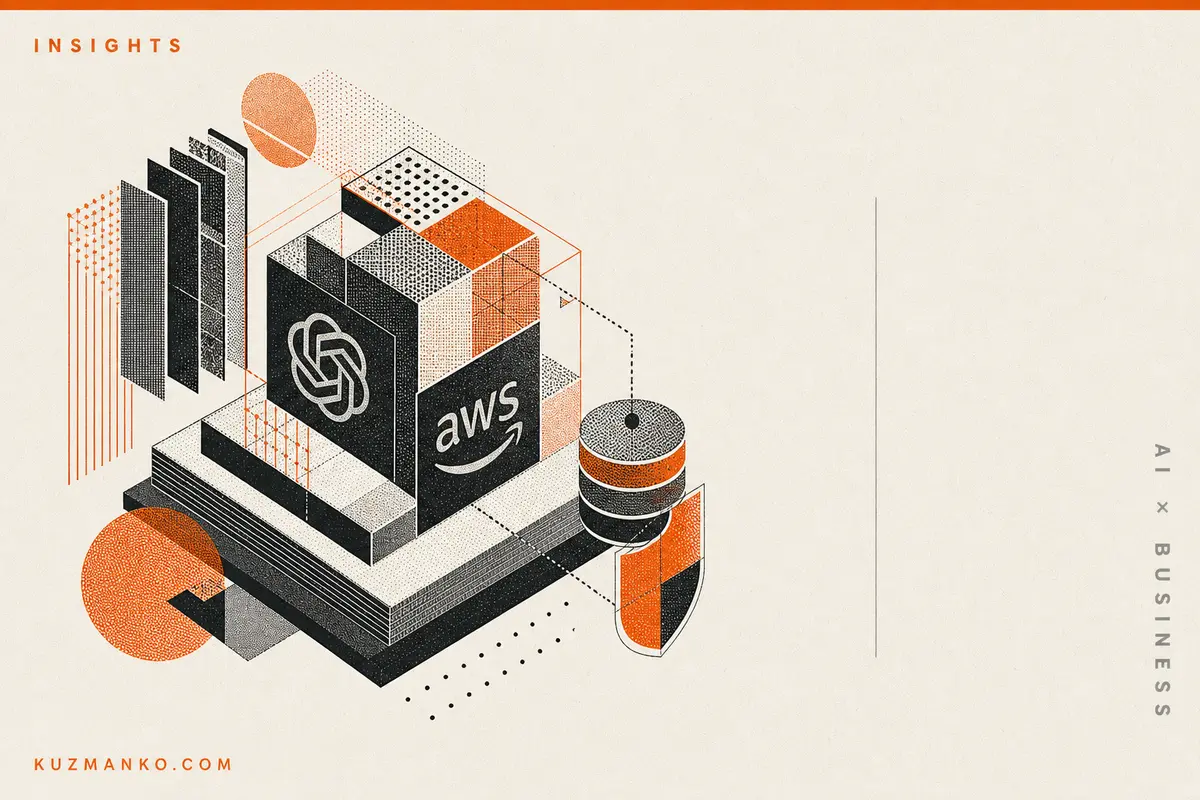
The real story is not OpenAI. It is Bedrock.
OpenAI models becoming available through Amazon Bedrock matters because it reduces one of the biggest blockers in enterprise AI: the gap between impressive experiments and controlled production deployment.
For many companies, the problem was never lack of interest in generative AI. The problem was procurement, data governance, security architecture, regulatory review, cost management, auditability, and the uncomfortable reality that model providers were often consumed outside the organization’s core technology controls.
Amazon Bedrock changes that equation. If OpenAI frontier models and Codex can be consumed inside the same AWS environment where enterprises already manage identity, encryption, monitoring, networking, logging, and compliance workflows, AI becomes less of a side experiment and more of an enterprise platform capability.
The strategic value of Bedrock is not that it gives access to one model. The value is that it gives the enterprise a governed operating layer for many models, many agents, and many business processes.
That distinction is critical. AI adoption is no longer about asking which chatbot employees like best. It is about designing infrastructure that can support non-deterministic work safely at scale.
Why Bedrock is becoming an enterprise AI control plane
As of June 2026, Amazon Bedrock has matured into much more than a model API gateway. It is a managed foundation for building, deploying, securing, evaluating, and operating generative AI applications on AWS.
The platform’s strongest advantage is model optionality. Bedrock allows organizations to access multiple model families through a unified service model, including Amazon’s own models, Anthropic Claude, Meta Llama, Mistral, Cohere, AI21, Stability AI, and now OpenAI models where available. That gives CIOs and CTOs a practical way to avoid overcommitting to a single model vendor too early.
This matters because different enterprise use cases need different capabilities. A legal summarization workflow, a customer service agent, a code modernization assistant, and a financial planning copilot do not necessarily require the same model. Some need reasoning depth. Some need speed. Some need low cost. Some need strong coding performance. Some need a model that can operate within specific regional, security, or compliance boundaries.
Bedrock’s advantage is that it lets the enterprise manage those tradeoffs from one controlled layer.
Key Bedrock capabilities that matter for enterprise AI include:
- Managed access to leading foundation models without forcing every team to create its own vendor integration.
- AWS-native security controls using IAM, VPC endpoints, AWS PrivateLink, KMS encryption, CloudTrail, CloudWatch, and existing account structures.
- Data protection posture where customer prompts and outputs are not used to train base models by default, according to AWS service commitments.
- Guardrails for Amazon Bedrock to define safety, compliance, topic restrictions, sensitive data handling, and response boundaries.
- Knowledge Bases for Amazon Bedrock to build retrieval-augmented generation over enterprise data sources.
- Agents for Amazon Bedrock to orchestrate actions, tools, APIs, and business workflows.
- Model evaluation and monitoring to compare models before scaling them into production.
- Provisioned throughput and inference controls for performance and cost predictability.
- Regional availability and GovCloud support where applicable for sensitive industries and public-sector workloads.
This is the difference between using AI and operating AI.
What OpenAI on Bedrock means for strategy
OpenAI’s entrance into Bedrock gives enterprises more leverage. It lets organizations evaluate OpenAI models against Anthropic, Amazon, Meta, Mistral, and other providers without rebuilding their entire AI architecture every time the model market shifts.
That matters because the model market is moving too quickly for rigid architecture. Anthropic has been especially strong in enterprise adoption, coding workflows, and practical agentic use cases. Claude Code and Claude’s broader work-oriented tooling have become some of the most effective AI products for real implementation. OpenAI still offers strong and diverse foundation models, and Codex on Bedrock could become highly valuable for enterprise software engineering teams.
The point is not to crown a permanent winner. The point is to build an AI foundation where model competition benefits the enterprise instead of trapping it.
A smart enterprise AI strategy should assume that:
- Model leadership will continue to change.
- Different models will win different categories.
- Security and governance requirements will become stricter.
- AI agents will move from pilots to operational responsibility.
- Internal teams will need to manage AI workers as seriously as they manage human access and software systems.
This is where Bedrock becomes strategically important. It gives enterprises a neutral operating layer for model selection, governance, experimentation, and scaling.
The finance implication: less vendor sprawl, better cost control
For finance leaders, the OpenAI on Bedrock announcement should be read through a cost governance lens.
Many companies currently have AI spend scattered across SaaS tools, direct model contracts, innovation budgets, developer subscriptions, departmental pilots, and undocumented usage. This creates the classic enterprise problem: high enthusiasm, low financial visibility.
Bedrock helps by moving AI consumption closer to cloud financial operations. When AI workloads run through AWS, organizations can use existing tagging, cost allocation, budgets, account structures, chargeback models, and procurement controls. That does not automatically make AI cheap, but it makes it governable.
The CFO should care about three specific advantages:
- Model benchmarking before commitment: teams can compare quality, latency, and cost across models for the same use case.
- Centralized spend visibility: AI costs can be linked to applications, business units, environments, and products.
- Production-grade capacity planning: provisioned throughput and performance controls support more predictable scaling for high-volume use cases.
AI ROI is not created by buying access to a better model. It is created by redesigning work, reducing cycle time, increasing throughput, improving decision quality, and maintaining control over risk. Bedrock gives finance and technology leaders a better operating structure for making those numbers real.
The operations implication: agents become manageable assets
The next major enterprise AI shift is not simply better chat. It is agentic execution.
Agents can read instructions, retrieve data, call tools, draft outputs, trigger workflows, escalate exceptions, and coordinate multi-step tasks. This is where AI starts replacing processes that previously required ongoing human judgment, not because the process was impossible to automate, but because it was too variable for traditional deterministic automation.
That does not eliminate the human. It changes the human’s role.
A weak AI implementation puts a person behind every model action. That creates the illusion of safety but destroys productivity. A strong implementation allows one experienced employee to supervise dozens or hundreds of AI-supported processes through exception handling, review thresholds, escalation policies, and audit trails.
Human-in-the-loop remains essential, but it must be designed for leverage.
For example, an AI claims review process should not require human approval for every low-risk case. It should classify confidence, detect policy ambiguity, route edge cases, and create a review queue where human expertise is focused only where it changes the outcome.
A simplified decision pattern might look like this:
{
  "workflow": "supplier_invoice_review",
  "model": "selected_by_policy",
  "confidence_threshold": 0.87,
  "auto_approve_conditions": ["matched_purchase_order", "low_variance", "approved_vendor"],
  "human_review_conditions": ["policy_exception", "new_vendor", "high_value", "low_confidence"],
  "audit_required": true
}
This is not just technical design. It is operating model design.
Why AI is not a technical project
One of the most expensive mistakes in AI adoption is treating it as a software installation.
AI combines computer science, domain expertise, management judgment, process design, risk analysis, organizational psychology, and financial discipline. The best implementations are rarely led by people who only understand APIs. They are led by teams that understand the business process deeply enough to know where judgment is required, where automation is safe, and where the organization must change its habits.
This is why education and serious professional experience matter. The market is full of self-proclaimed AI experts with impressive social media language and very little operational depth. Large enterprises often have enough internal discipline to filter poor advice. Small and mid-sized businesses are more exposed. They can lose budget, trust, and time by following generic advice that ignores governance, process ownership, security, and measurable ROI.
Academic grounding also matters. Not because every AI project needs a PhD, but because the field is multidisciplinary. Researchers and practitioners who combine AI knowledge with business process expertise, behavioral understanding, and implementation experience often have a real advantage.
AI is not only about prompts. It is about systems of work.
Bedrock versus standalone AI tools
There is a useful distinction every executive should understand: AI tools and AI agents are adopted differently.
AI tools, such as workplace copilots or writing assistants, often require employees to change daily habits. They need training, practice, communication skills, and managerial reinforcement. The capability is accessible, but adoption can be surprisingly hard.
AI agents are different. A well-designed agent can be inserted behind an existing workflow with fewer changes to employee behavior. The technical build may look more complex, but the organizational adoption can be easier if the agent works through familiar systems such as ticketing platforms, CRMs, ERPs, email queues, document repositories, or internal APIs.
This is why enterprises need both paths:
- AI literacy path: employees learn how to communicate with models, validate outputs, improve prompts, and use AI responsibly.
- AI agent path: the organization builds managed agents that execute repeatable business workflows under policy, monitoring, and review.
Bedrock is especially relevant to the second path. It gives technology teams a more controlled foundation for building, deploying, and governing agents rather than scattering automation across disconnected tools.
Where Codex on Bedrock could become powerful
Codex availability through Bedrock is particularly important for software organizations.
Developer AI has already moved beyond autocomplete. The real enterprise use cases include code review, refactoring, test generation, documentation, dependency analysis, migration planning, legacy modernization, secure coding support, and incident investigation.
If Codex can operate inside Bedrock’s security and governance perimeter, enterprises can integrate AI more directly into their engineering lifecycle without forcing teams to move sensitive code into unmanaged environments.
Practical use cases include:
- Reviewing pull requests for security and maintainability.
- Explaining legacy code before modernization.
- Generating unit tests and integration test scaffolding.
- Assisting migration from older frameworks to modern cloud-native architectures.
- Detecting risky dependencies and suggesting remediation paths.
- Supporting secure software development processes with consistent review policies.
This is also where AI for cybersecurity becomes more interesting. When AI can reason over code, dependencies, infrastructure definitions, and runtime telemetry, it can become an active layer in secure development rather than a productivity add-on.
The CIO’s new responsibility: HR for AI agents
Information systems departments are moving toward a new role. They will not only manage applications, permissions, integrations, and infrastructure. They will increasingly manage AI agents as operational actors.
That means the enterprise will need answers to questions that sound surprisingly similar to workforce governance:
- What is this agent allowed to do?
- Who owns its performance?
- Which data can it access?
- When does it escalate to a person?
- How is its output audited?
- How do we revoke its permissions?
- How do we measure whether it is improving or harming the process?
- Which model should it use for this task and why?
Bedrock’s value is that it supports this governance conversation inside an infrastructure context that many enterprises already understand. IAM policies, logs, encryption, network controls, observability, and deployment governance are not exciting marketing terms. They are what make production AI possible.
A practical adoption framework
For organizations considering OpenAI models on Bedrock, the right move is not to start with the most impressive demo. Start with operational fit.
A practical approach should include:
- Map high-judgment processes: identify workflows where employees spend time interpreting, classifying, drafting, checking, or coordinating.
- Separate tool use from agent use: decide where employees need AI literacy and where the company should build managed agents.
- Create model selection criteria: evaluate models by accuracy, latency, cost, reasoning quality, coding performance, language support, data sensitivity, and regulatory constraints.
- Design human supervision for scale: define thresholds, exceptions, escalation paths, and audit rules before production.
- Use Bedrock governance features early: apply guardrails, logging, IAM, VPC controls, retrieval boundaries, and evaluation processes from the beginning.
- Build internal capability: do not outsource all AI knowledge. Companies need internal competence to create, manage, evaluate, and retire AI agents.
- Measure business outcomes: track cycle time, cost per transaction, error rate, rework, service quality, revenue impact, and employee capacity.
This is the difference between AI theater and AI transformation.
Final view
OpenAI’s arrival on Amazon Bedrock is important, but the larger message is about enterprise maturity. The AI market is moving from model access to model operations. The winners will be organizations that can combine strong infrastructure, deep business understanding, professional AI knowledge, and disciplined change management.
Bedrock is well positioned because it does not ask enterprises to bet everything on one model or abandon their existing cloud governance. It gives them a structured way to consume multiple models, build agents, protect data, monitor usage, and scale AI into real processes.
OpenAI benefits from AWS distribution. AWS strengthens Bedrock as a serious enterprise AI platform. Customers get more choice and better governance.
But technology alone will not create the advantage. The real advantage will belong to organizations that understand that AI is not a technical shortcut. It is a new operating capability, and it must be designed with the same seriousness as finance, security, operations, and people management.