
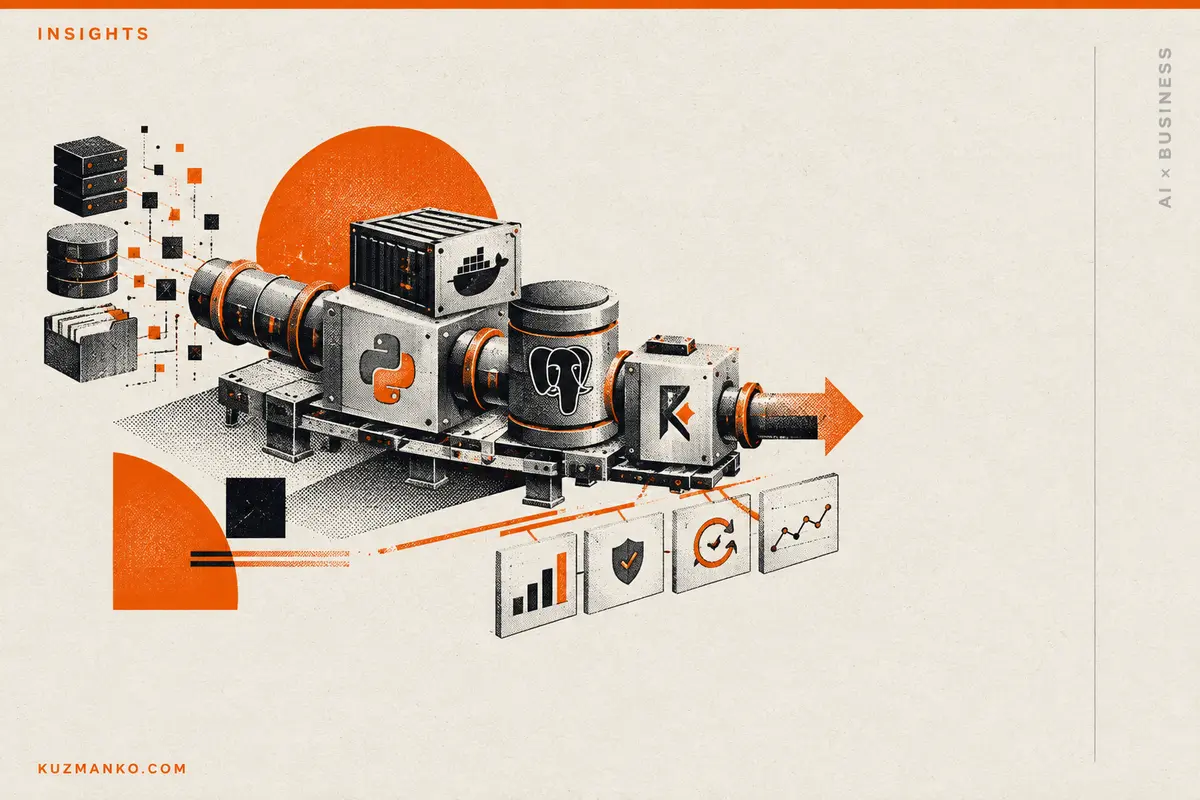
The short answer: Working code is not yet a working pipeline
A production-ready ETL pipeline performs its job consistently, recovers from failures, prevents duplicates, alerts on anomalies, and explains what happened during every run. If a Python script can retrieve data and write it to PostgreSQL, you have proved that the basic logic is feasible. You have not yet proved that the enterprise can depend on it.
That distinction matters when the data feeds executive reports, financial processes, machine learning models, or AI agents. An advanced model cannot compensate for missing data, duplicate records, or an undetected schema change. As the AI layer becomes less deterministic, the data layer beneath it must become more predictable, controlled, and explainable.
The sign of maturity is not that the pipeline succeeded once. It is that the next failure will be predictable, contained, and recoverable.
Watch out: Working code is only a proof of concept. A successful local run does not test availability, duplicates, schema changes, permissions, recovery, or operational accountability.
This is not a semantic distinction. It determines whether a problem is resolved automatically within minutes or discovered the next morning because the CFO received an empty report.
Responsibilities that should not be blurred
A common mistake is to make one script responsible for business logic, execution management, and recovery. That feels convenient at first. Over time, it creates code that is difficult to test, move between environments, or maintain without the person who wrote it.
A sound division of responsibilities looks like this:
- Application: Python handles extraction, transformation, and loading. It should not manage the enterprise schedule.
- Database: PostgreSQL enforces consistency and constraints. It should not orchestrate jobs.
- Runtime environment: Docker controls dependencies and versions. It should not define business meaning.
- Orchestration: Kestra, Airflow, or another orchestrator manages schedules, retries, and dependencies. It should not parse the data.
- Observability: Monitoring systems collect logs, metrics, and alerts. They should not make automatic semantic corrections.
This separation lets teams replace one component without dismantling the system. A container can move from development to CI or the cloud, the orchestrator can change, and the database can be upgraded without rewriting the extraction logic.
Put simply, Python should know what to execute, the orchestrator should know when and how to run it, and the database should protect the integrity of the result.
Idempotency is a recovery mechanism, not an engineering accessory
Production systems fail. Networks disconnect, APIs return temporary errors, containers stop, and databases reach connection limits. The professional question is not how to prevent every failure. It is how to make reruns safe enough that a failure does not corrupt the data.
An idempotent pipeline can process the same input again without creating duplicate or inconsistent results. In PostgreSQL, a uniqueness constraint and an explicit upsert are a practical starting point:
INSERT INTO articles (source_id, title, published_at, content_hash)
VALUES (%s, %s, %s, %s)
ON CONFLICT (source_id)
DO UPDATE SET
  title = EXCLUDED.title,
  published_at = EXCLUDED.published_at,
  content_hash = EXCLUDED.content_hash;
ON CONFLICT DO NOTHING is appropriate when an existing record must remain unchanged. DO UPDATE is appropriate when the source may correct or enrich it. This is not merely a technical choice. It expresses the business meaning of the data and the policy for preserving its history.
The idempotency key also requires judgment. An identifier supplied by the source is usually preferable to a title or ingestion timestamp. If no stable identifier exists, the pipeline can generate a hash from deliberately selected fields. A poor choice may collapse genuinely different records or, in the opposite direction, allow duplicates through.
Retries without error classification can make an incident worse
Retries are useful, but there is little value in rerunning code that failed because of an incorrect password, a missing column, or a broken data contract. Retries are mainly appropriate for transient problems such as timeouts, rate limits, and temporary service unavailability.
A mature pipeline distinguishes among failure types:
- Transient failure: Retry with progressively longer delays.
- Permanent failure: Stop, record the failure, and alert the owner.
- Invalid data: Move the affected data into quarantine for investigation.
- Partial failure: Save a checkpoint and resume from a safe position.
- Schema change: Block processing or activate a planned compatibility path.
Without this classification, the orchestrator may repeatedly add load to a service that is already failing. A mechanism intended to improve reliability then becomes a force multiplier for the incident.
A build sequence that reduces uncertainty
There is no benefit in adding Docker, orchestration, and monitoring before the ETL logic itself has been demonstrated. At the same time, the operational layer should not be postponed until the end of the project. The right approach is to advance in layers, with a clear acceptance condition for each stage.
- Prove the logic: Run extraction, transformation, and loading against both valid and exceptional inputs.
- Define consistency: Establish keys, constraints, update policies, and the expected behavior of repeated runs.
- Package the runtime: Pin versions and dependencies inside a container that can move between environments.
- Add orchestration: Define dependencies, retries, timeouts, backfills, and schedules.
- Connect observability: Measure freshness, volume, errors, and duration, then route alerts to the responsible owners.
- Rehearse failure: Disconnect a source or database and verify that the system recovers as designed.
This sequence narrows the search area when something breaks. If the code has already been tested locally against a real database, a problem that appears after packaging is more likely to be in the runtime environment. If the container behaves consistently, an issue that appears after orchestration should first be investigated in scheduling configuration, permissions, and dependencies.
What a production pipeline must actually monitor
A log entry saying that the process finished is not enough. A run can succeed technically while loading zero records, receiving stale data, or omitting a critical business field. Effective monitoring must answer business questions, not only infrastructure questions.
The baseline metrics should include:
- The time of the latest successfully completed run.
- Data freshness relative to the business commitment.
- The number of records read, rejected, inserted, and updated.
- The duration of each stage compared with its normal operating range.
- The proportion of missing values in critical fields.
- The number of retries and the original cause of failure.
- The code, container, and schema versions used in each run.
It is useful to distinguish operational success from business success. A container that returns a successful exit code has achieved operational success. If a report expected by 07:00 still shows yesterday's data, the pipeline has failed from the business perspective.
Data contracts prevent surprises between teams
Data sources change. A vendor may rename a field, an internal system may change a data type, or a product team may stop sending an event without realizing that another report depends on it. Manual investigation after the incident is not a strategy.
At minimum, a data contract should define:
- Which fields are required.
- The type and format of each field.
- Which values are allowed or implausible.
- Who owns the source and the destination.
- How changes are communicated and how much notice is required.
- What happens to data that does not satisfy the contract.
Not every change should stop the pipeline. A new optional field can be logged while processing continues. Removing a critical business identifier should stop the load or route the data to quarantine. Making that distinction requires domain knowledge, not just familiarity with a Python library.
The real cost is in operations
Architecture decisions should also be evaluated in terms of money and time. A pipeline that is quick to build but requires manual intervention every week may cost more than a slightly more sophisticated system that handles failures predictably.
For management decisions, measure:
- Hours spent manually resolving failures and rerunning loads.
- Mean time from failure detection to recovery.
- The business cost of late or incorrect data.
- The number of systems that depend on the output.
- The cost of a backfill after a prolonged failure.
- Dependence on one person who understands the script.
Good data engineering replaces operational heroics with mechanisms. The goal is not to retain an engineer who can rescue the system every night, but to build a system that does not need rescuing on most nights.
When ETL feeds AI, the control standard must rise
AI systems add a nondeterministic layer to business processes. They therefore require especially well-documented data infrastructure, including lineage, versions, permissions, quality metrics, and the ability to reconstruct the input that produced a result.
Human oversight remains critical, but requiring a person to approve every record or answer defeats the purpose. A well-designed system allows one supervisor to handle many exceptions rather than manually perform every process. To support that model, the pipeline must clearly identify confidence levels, exception types, data sources, and business context.
Key insight: People should supervise exceptions. If every output requires manual approval, automation has not increased productive capacity. The infrastructure should route only material or uncertain cases to a person.
This is also where business experience and professional training matter. AI and data engineering are not collections of technical tricks. They require an understanding of statistics, software, information security, organizational processes, and risk management. Superficial consulting may produce an impressive demonstration, but it is quickly exposed when the enterprise must define accountability, exceptions, service levels, or financial impact.
Security and ownership are not end-of-project tasks
A pipeline often touches sensitive information across several systems. Passwords must not be embedded in an image, committed to code, or stored in a file passed among developers. Secrets belong in a dedicated secrets-management mechanism, permissions should follow the principle of least privilege, and significant access should be recorded.
Every pipeline also needs an identifiable owner. Ownership cannot stop at the name of a team. It must be clear who receives an alert, who can authorize a backfill, who approves a schema change, and who communicates an impact to data consumers.
IT and data departments increasingly need to manage pipelines and AI agents as a digital workforce, including permissions, versions, performance, costs, and lifecycle. Without an enterprise platform for managing these components, the number of automations will grow faster than the organization's ability to control them.
The right production acceptance test
Before deployment, marking development as complete is not enough. The team must demonstrate the pipeline's behavior under expected scenarios:
- The same batch can be loaded twice without creating duplicates.
- When the data source is unavailable, the system retries according to a defined policy.
- A change to a critical field is detected before incorrect data is loaded.
- A selected date range can be backfilled without damaging existing data.
- Logs and metrics reveal the stage in which a failure occurred.
- The alert reaches the correct owner and includes actionable context.
- The code and schema versions responsible for every result can be reconstructed.
A pipeline that passes these tests is beginning to become an operational asset. Until then, it remains a useful script, perhaps even a well-written one, but not yet a component on which the enterprise should base decisions.
The management decision that matters
An enterprise does not need the most fashionable tool. It needs a consistent engineering standard for building, releasing, monitoring, and maintaining pipelines. Kestra, Airflow, or another orchestrator can do the job. Docker or an appropriate alternative can stabilize the runtime environment. The choice matters, but discipline matters more.
Real data engineering begins when teams stop asking whether the script runs and start asking whether the system remains reliable when the developer is not watching it. That is where the foundation for BI, automation, and AI is built without turning every failure into an enterprise-wide incident.