
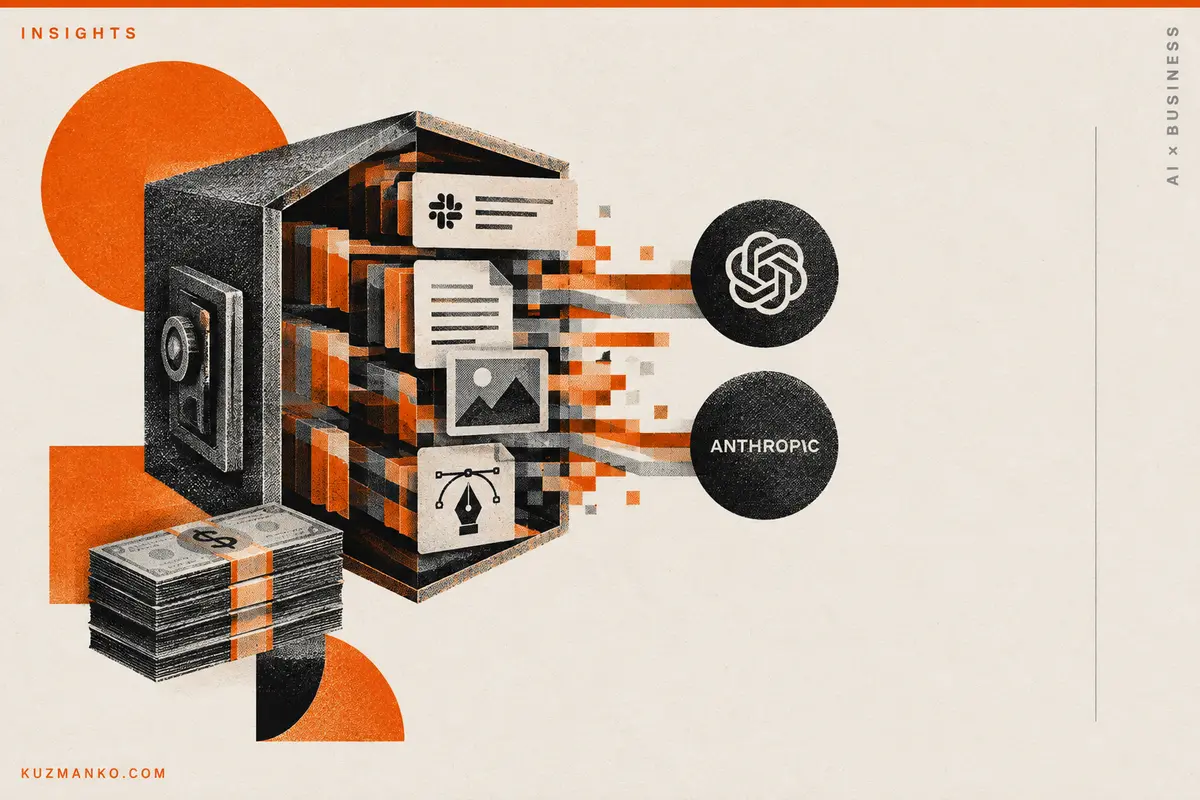
Should a company sell its internal data for AI training? Only after establishing which rights it can grant, what the deal could expose, and what that same data is worth inside the business. A substantial offer is a reason to start due diligence, not skip it.
According to reporting on Micro1, the company is offering midsize businesses between $100,000 and $2 million to license internal data. It has also announced plans to spend $1 billion over the coming year on these licenses, processing the data and supplying it to model developers, including OpenAI and Anthropic.
- $100,000: the reported lower end of the offer range.
- $2 million: the reported upper end of the offer range.
- $1 billion: the company’s stated spending plan for the coming year.
These figures describe reported offers and Micro1’s plans, not a guaranteed rate card or money already spent. But the commercial signal is clear: messages, tasks, and customer records have become raw material that AI developers are willing to pay for.
Buyers want more than documents. They want to understand how the business works
A procedure explains how a process is supposed to work. A chain of messages, tasks, and CRM updates can reveal how it actually works: who spots a problem, what information is missing, who approves an exception, and what happens when the procedure has no answer.
That is the difference between learning professional knowledge and learning to work inside an organization. A model may be able to explain a sales process yet still struggle to understand why a particular customer is waiting for approval, what they were promised, and what needs to happen next.
The connections between data sources are valuable. A Slack message might explain a change to a Monday.com task, reflected in a quote and eventually in a customer record. Each item provides a partial picture. Together, they reveal a sequence of decisions.
When a company opens its work archive, it may also be opening access to years of accumulated judgment.
That is why this should not be treated as a sale of old files. It may be a license to operational knowledge the business spent years developing.
Three uses, three risk profiles
According to the reporting, Micro1 operates through three approaches. The distinctions matter more than the broad label of data acquisition because each requires different boundaries.
- Data licensing: the developer receives data processed to protect privacy; the enterprise must examine what is transferred and which usage rights are granted.
- An agent inside the company: the developer gains practical experience and performance feedback; the enterprise must scrutinize permissions, actions, and activity logs.
- A simulation environment: the developer receives a historical snapshot of the organization; the enterprise must assess environment isolation and the extent of exposure.
In a simulation, the idea is to freeze organizational data at a particular point in time and let a developer teach a system to operate within that context. This could help develop agents that make decisions, rather than simply compose responses.
For the enterprise, however, freezing the data does not eliminate the risk. Historical information can still contain trade secrets, personal data, and commitments that remain in force. With an active agent, the review must cover not only what it reads but also what it is allowed to change, send, or trigger.
You hold the data. Do you have the right to commercialize it?
Technical control over information does not automatically confer the right to use it for any purpose. A company may hold customer correspondence, supplier files, and employee details without being entitled to transfer them for model training.
Enterprises need a legal review specific to their circumstances, covering privacy law, confidentiality obligations, intellectual property rights, and cross-border data transfers. Customers or employees in other jurisdictions may introduce additional requirements. Neither management approval nor the removal of names establishes that a deal is permissible.
Watch out: Removing names is not the end of the review. A combination of job role, dates, a business event, and financial amounts may enable reidentification. Even information that identifies no individual can expose pricing, operational weaknesses, or trade secrets.
Require a concrete explanation of how the data will be processed: what is removed, what remains, who reviews the result, and how reidentification risk is tested. A general promise of privacy protection is no substitute for examining samples and the connections between them.
Employees belong in this discussion, too. A lack of objections is not evidence of understanding or valid consent. Explain what information is being considered for transfer, why it would be used, how exposure will be limited, and where employees can raise concerns. Damaged trust can cost more than the deal brings in.
The right price is not just the number in the offer
A CFO should assess this as a licensing transaction involving a knowledge asset, not incidental revenue with no associated cost. Net proceeds depend on data mapping, advisory work, filtering, oversight, and ongoing management. The assessment must also account for business risk and the value of future options the organization gives up.
Before negotiating price, establish:
- What does the license cover? Which uses are permitted, for how long, by whom, and can rights be passed on to others?
- Is there exclusivity? Does the agreement restrict internal use or future deals?
- What reaches additional parties? Distinguish between raw data, processed data, simulation environments, and derived outputs.
- What can actually be deleted? Deleting a file from a repository is not necessarily equivalent to removing its influence from a model that has already been trained.
- How will compliance be monitored? Which audit, reporting, and incident-response rights are written into the contract?
An argument that companies should move quickly to capture a premium is a sales pitch. It is neither a valuation method nor a justification for cutting due diligence short.
Before letting others learn from your business, ask what you could learn from it
If enterprise data is worth money to a model developer, ask what it could generate inside the company. Selling is not always the best alternative. Greater value may come from controlled internal use to reduce repetitive work, improve information retrieval, or develop agents.
For example, support case histories can help build an evaluation suite for a service agent. Procedure documents can support retrieval-augmented generation, or RAG. Records of exceptions can help define when an agent should hand a decision to a person. These are different uses from training a foundation model, and they can sometimes deliver value without transferring an entire repository outside the organization.
A human in the loop should oversee exceptions and risk, not manually approve every action. Otherwise, the business adds a technology layer without freeing operational capacity. The aim is to let a professional oversee a broader scope of activity through permissions, escalation thresholds, and auditable records.
Getting there requires both employee AI literacy and the internal ability to build and manage agents. Choosing a tool does not replace understanding a process. Relevant education, business experience, and deep AI knowledge matter especially when distinguishing an impressive demonstration from a dependable system.
How to make the decision
There is no need to begin by handing over the full repository to find out whether a deal is viable. Define the boundaries first, then examine a limited dataset under appropriate agreements.
- Assign an accountable team: Bring together business leadership, finance, legal, information security, and AI expertise with practical implementation experience.
- Map assets and rights: Identify data sources, rights holders, contractual restrictions, and content that must not be transferred.
- Compare alternative sources of value: Weigh net proceeds against narrower licensing arrangements and internal use of the data.
- Evaluate a controlled sample: Test value and exposure using a limited sample within an agreed legal and security framework.
- Put oversight into the contract: Define permitted uses, recipients, audit rights, deletion requirements, and responsibility for incidents.
This process requires collaboration across disciplines. It cannot sit solely with IT or solely with legal. The organization needs to understand, at the same time, what the data can teach a system, what uses are permitted, and what the business could lose.
Micro1’s offer points to a real shift: the enterprise work archive now carries a price tag. But what someone offers is not necessarily what you are giving up. Before licensing the data, define the asset, protect your rights, and assess whether keeping it working inside your own business could produce the best return.