
The short answer: enterprise RAG needs judgment
A reliable enterprise RAG system should not behave like a smarter search bar. It should behave like a controlled evidence process.
The common demo architecture is familiar: split documents into chunks, create embeddings, retrieve the top five closest chunks, and ask an LLM to answer. It looks impressive in a proof of concept. It often fails in legal, financial, regulatory, procurement, insurance, and operational environments where a section title, date, currency, clause number, exception, or definition can completely change the answer.
The better architecture is not only retrieval-augmented generation. It is retrieval-augmented judgment.
In enterprise knowledge systems, the question is not only what text is similar? The real question is which evidence is fit to support an answer?
That distinction matters. It is the difference between a system that can be demonstrated and a system that can be deployed.
Why top-k semantic retrieval breaks in real organizations
Embeddings are powerful, but they are not a complete retrieval strategy. They compress meaning into vectors, which is useful when wording differs between the question and the source material. But enterprise documents are full of hard signals that should not be diluted into semantic similarity.
Consider a user asking: What is the non-compete obligation after termination?
A naive RAG pipeline may retrieve:
- A definition of employee obligations
- A general section about confidentiality
- A termination clause
- A non-compete clause in a different jurisdiction
- A policy summary from an outdated version
Some of these chunks may be semantically close. That does not make them equally valid. In a regulated business context, the source of the answer is part of the answer.
This is where many AI initiatives expose a deeper organizational problem. The failure is not only technical. It is a lack of domain understanding, process design, governance, and professional experience. AI implementation is a multidisciplinary discipline. It requires knowledge of models, information architecture, business operations, risk, compliance, and the actual work people do every day.
That is why self-appointed AI experts can be dangerous, especially for small and mid-sized businesses. Enterprise AI is not a collection of prompts. It is an operating model.
The missing layer: an LLM arbiter
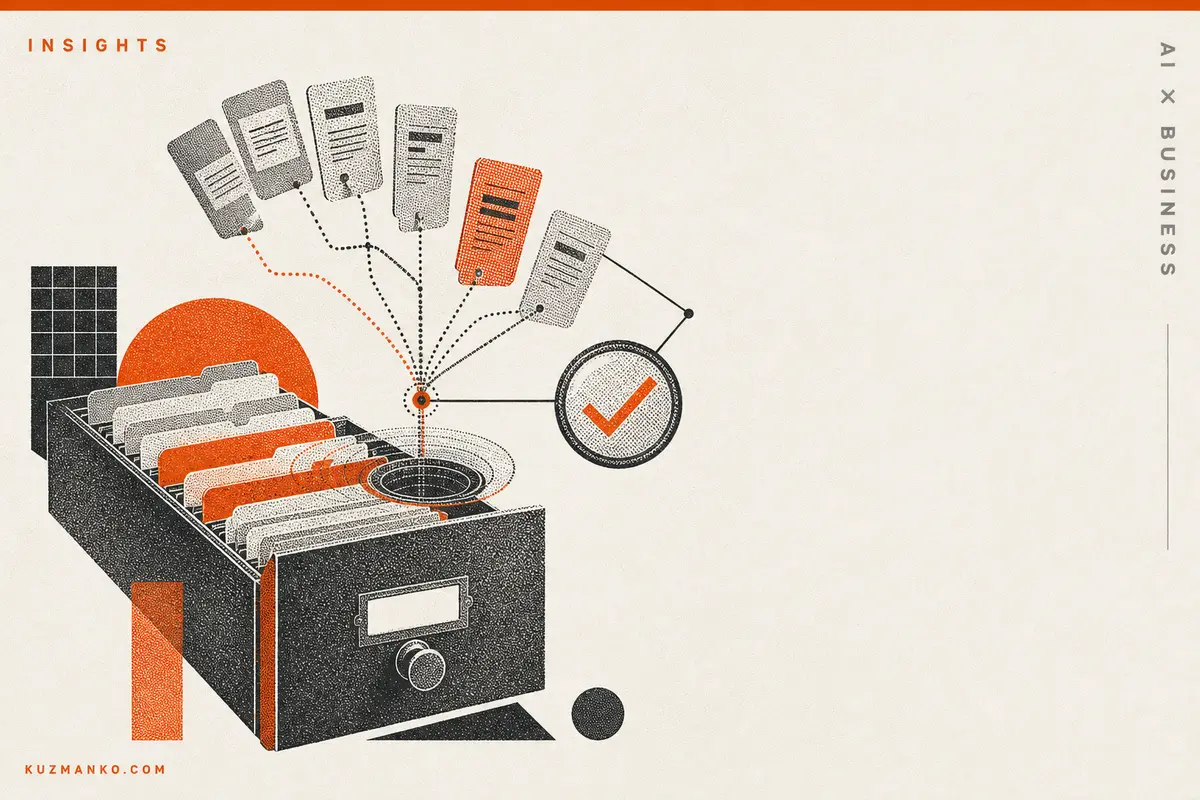
A stronger RAG architecture lets several retrieval methods propose candidates, then asks an LLM to act as an arbiter. The arbiter does not generate the final business answer immediately. First, it evaluates the evidence.
The retrieval layer may include:
- Exact keyword search
- BM25 or traditional lexical search
- Section and heading detection
- Table of contents mapping
- Clause-number and regulation-number matching
- Date, currency, and entity extraction
- Co-occurrence search
- Embedding-based semantic retrieval
- Access-control and document-version filters
Each method brings candidates with metadata. The arbiter receives a structured summary of those candidates and ranks them by evidentiary relevance, not only mathematical proximity.
A useful arbiter output might look like this:
{
  "query": "What is the non-compete obligation after termination?",
  "selectedSources": [
    {
      "candidateId": "clause-12-4",
      "role": "primarySource",
      "reason": "Directly addresses non-compete obligations after termination and includes the applicable period."
    },
    {
      "candidateId": "definition-3-1",
      "role": "supportingSource",
      "reason": "Defines restricted business activity, which is required to interpret the primary clause."
    }
  ],
  "rejectedSources": [
    {
      "candidateId": "policy-summary-2022",
      "reason": "Potentially outdated and not contractually binding."
    }
  ],
  "answerability": "answerableWithCitations"
}
This structured judgment is the heart of a serious RAG system. It creates a bridge between retrieval, generation, compliance, and auditability.
Why score fusion is not enough
Many teams combine retrieval results using methods such as Reciprocal Rank Fusion. These techniques can be useful because they merge rankings from different retrievers without requiring precise score calibration.
But rankings lose context.
A fused score does not tell the business user why a chunk was selected. Was it selected because the section title matched exactly? Because two key legal terms appeared in the same paragraph? Because a semantic vector found broad conceptual similarity? Because it appeared in a newer policy? Because it came from a privileged source?
For consumer search, that may be acceptable. For enterprise AI, it is weak governance.
A procurement director, compliance officer, financial analyst, or legal counsel should not have to accept an answer because a vector score was 0.78. They need to know:
- Which retrieval method found the evidence
- Which document version was used
- Which section or clause contained the answer
- Which terms matched the query
- Which candidates were rejected
- Why the system considered the answer supported
- Whether human review is required
That is not bureaucratic overhead. It is how AI becomes operationally useful.
Embeddings are not the default. They are one instrument.
The industry has developed a reflex: start with embeddings. In many cases, that is the wrong starting point.
If a user asks about Section 14.2, semantic similarity is not the primary signal. If a policy mentions EUR 250,000, the number matters. If a regulation refers to Article 9, the exact reference matters. If a contract uses a defined term, the definition section may be more important than a semantically similar paragraph elsewhere.
Embeddings work well when:
- Users describe concepts in language that differs from the source
- Documents are unstructured or inconsistently written
- The question is exploratory
- The domain uses synonyms and natural-language variation
- The system needs broader contextual matching
Keyword and structure-based retrieval work better when:
- The user references a clause, article, figure, amount, date, or named entity
- The document has a clean hierarchy
- Exact terminology carries legal or financial meaning
- The system must prove absence, not only find similarity
- Version control and source authority matter
The mature approach is dynamic orchestration. Use the document structure when it exists. Use exact search when the query contains hard signals. Use embeddings when language variation is the problem. Then let the arbiter evaluate the combined evidence.
The underrated capability: saying “not found”
One of the most important features in enterprise RAG is the ability to refuse an answer.
Embedding search almost always returns something. If the system asks for the top five closest chunks, it will return five chunks even when the answer does not exist. That creates a subtle but serious risk: the model may generate a confident answer from weak evidence.
A better retrieval architecture can produce a stronger negative finding. If the system searched for exact terms, known synonyms, clause references, headings, document sections, and domain entities, and none were found, it can say: The requested obligation does not appear in the available documents.
In finance, legal, and compliance workflows, a reliable negative answer is often more valuable than a creative positive one.
Human in the loop, but not human as the bottleneck
Human review remains critical, especially where the cost of error is high. But organizations often misunderstand the human-in-the-loop principle.
If every AI-assisted process requires a human to re-check every answer manually, the organization has not transformed anything. It has only added another interface.
The goal is different: one person who previously handled a single process should now be able to supervise dozens or hundreds of AI-assisted processes. That requires triage, confidence scoring, exception routing, and audit logs.
A practical RAG system should classify outputs into clear operational paths:
- High-confidence answer with strong citations
- Answer with partial support and review recommended
- Conflicting sources detected
- Outdated or low-authority source detected
- No answer found
- Access restricted
- Human approval required before external use
This is where enterprise AI creates real operational efficiency. It does not remove professional judgment. It scales it.
RAG is becoming part of the agent infrastructure
RAG should not be viewed only as a chatbot feature. In modern organizations, it becomes a core capability for AI agents.
Agents need access to reliable knowledge before they can act. A customer support agent, finance agent, HR policy agent, legal intake agent, or procurement agent must know which sources are authoritative. Otherwise, automation becomes risk amplification.
Organizations therefore need an internal platform for creating, managing, monitoring, and retiring AI agents. Information systems departments will increasingly behave like HR departments for digital workers: defining roles, permissions, onboarding, supervision, escalation paths, and performance reviews.
This is also why companies should advance on two tracks at the same time:
- AI literacy for employees, including effective communication with models
- Internal capability to design, deploy, and govern AI agents
Tools matter, but architecture matters more. Claude is currently one of the strongest systems for broad enterprise AI adoption, especially for demanding reasoning and writing workflows, although security and data governance must be handled carefully. Microsoft Copilot is improving and remains a practical infrastructure layer for many Microsoft-centric organizations. Copilot Studio can be useful for ecosystem-based agents, while platforms such as n8n are entering larger enterprise environments faster than many expected.
But no vendor choice replaces the need for strong internal AI capability. Buying tools is easy. Building trusted processes is the work.
A production-ready RAG pattern
A strong enterprise RAG architecture usually contains the following layers:
- Document ingestion and normalization
- Structural parsing of headings, clauses, tables, dates, entities, and references
- Multiple retrievers that operate in parallel
- Candidate packaging with source metadata
- LLM arbiter for evidence ranking and rejection
- Answer generation using only approved sources
- Citation and explanation layer
- Confidence, risk, and exception classification
- Human review workflow for sensitive cases
- Audit trail for retrieval, arbitration, and final response
The arbiter layer is not a luxury. It is the control point that makes the system explainable enough for real work.
What executives should ask before approving a RAG project
Leaders do not need to personally design the vector database. They do need to ask sharper questions.
Before moving a RAG system into production, executives should ask:
- Can the system explain why each source was selected?
- Can it explain why close-looking sources were rejected?
- Does it distinguish primary evidence from supporting context?
- Can it detect outdated, duplicated, or lower-authority documents?
- Can it say “not found” without inventing an answer?
- Does it route uncertain cases to the right human reviewer?
- Are retrieval decisions logged for audit and improvement?
- Does the implementation reflect domain expertise, not only technical fluency?
If the answer to these questions is vague, the organization is not ready for production. It may have a demo, but it does not yet have an enterprise knowledge system.
The real lesson
Smart RAG is not about replacing search with embeddings. It is about replacing uncontrolled retrieval with governed evidence selection.
The LLM arbiter is valuable because it introduces judgment into the retrieval process, while still producing structured, auditable output. It allows AI to support non-deterministic business processes where human judgment used to be the only option, but it does so with controls, traceability, and escalation.
This is the direction enterprise AI must take: not louder chatbots, but better decision infrastructure.
Organizations that understand this will build AI systems that improve operations, reduce risk, and scale expert judgment. Organizations that treat RAG as a technical shortcut will keep discovering that semantic similarity is not the same as truth.