
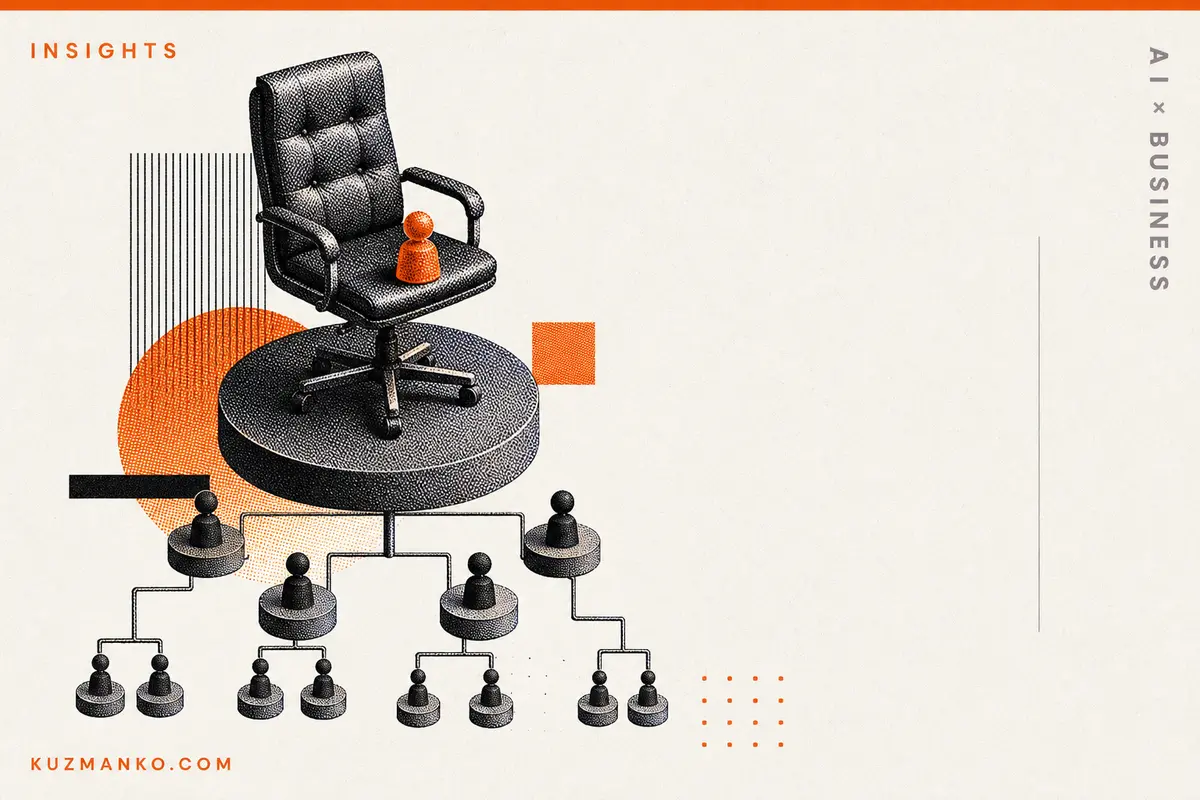
The real lesson behind Dario Amodei’s one-direct-report model
Dario Amodei reportedly runs Anthropic with only one direct report: his Chief of Staff, while the company’s day-to-day operating leadership sits with Daniela Amodei, Anthropic’s President. For a company associated with frontier AI, enormous investor attention, and extraordinary scale ambitions, that structure looks almost impossible by traditional management logic.
But the important question is not whether every CEO should copy it. Most should not.
The real question is sharper: what does organizational design look like when one capable person, supported by AI systems and agents, can perform the work that previously required an entire coordination layer?
The answer is not flat organizations. It is not fewer managers for the sake of cost-cutting. It is a new operating architecture where human judgment, AI execution, domain expertise, and governance are deliberately separated.
AI does not eliminate management. It changes what management is supposed to manage.
In the AI era, organizations should stop designing around headcount and start designing around decision density, process complexity, risk, and strategic speed.
Why the Anthropic structure matters
The Amodei model is extreme because it separates strategic leadership from operational leadership with unusual clarity. One side is focused on long-term research direction, product philosophy, culture, safety, and the broader implications of AI. The other side carries the daily organizational machine: hiring, execution, internal alignment, performance, and operational pressure.
That split is not new in principle. Many companies use a CEO-COO model. What is new is the intensity of the separation and the context: an AI-native company building tools that may themselves reshape work.
This structure sends an important message to founders and enterprise executives:
- The CEO’s highest value may be strategic cognition, not managerial availability.
- Operational excellence can be delegated if trust, authority, and accountability are explicit.
- AI-native companies may need fewer coordination layers because the work itself is more instrumented, automated, and knowledge-dense.
- A lean executive structure only works when the organization has exceptional clarity on decision rights.
Still, copying Anthropic blindly would be a mistake. A structure built on deep personal trust between sibling co-founders, elite technical talent, and a mission-driven culture cannot simply be pasted into a bank, manufacturer, hospital network, or mid-market services company.
The lesson is not one direct report. The lesson is intentional compression of the management stack.
The wrong conclusion: everyone becomes a solo operator
There is a seductive story circulating in business circles: AI will allow one person to replace a department. Sometimes that is true at the task level. A strong operator with Claude, Copilot, automation tools, retrieval systems, and well-designed agents can produce analysis, documentation, code, research, proposals, workflows, and customer communication at a level that once required a small team.
But that does not mean companies should replace teams with isolated heroes.
The better model is the AI-augmented cell: a person or small group that supervises a portfolio of AI-enabled processes, agents, and workflows. The human is not manually executing every step. The human is setting goals, reviewing exceptions, improving prompts and processes, validating outputs, and making judgment calls where ambiguity matters.
This distinction is critical.
If every AI process still requires a human to approve every micro-step, the company has not transformed. It has only moved the bottleneck. The goal is not human-in-the-loop everywhere. The goal is human-in-the-loop where judgment, risk, ethics, and accountability justify it.
A manager who yesterday supervised one process should be redesigned to supervise dozens or hundreds of processes, with risk-based escalation and measurable quality controls.
The new span of control is a span of judgment
Traditional span of control asks how many people a manager can effectively supervise. In AI-enabled organizations, that question is incomplete.
The more relevant question is: how many decisions, exceptions, agents, and workflows can one accountable person govern without reducing quality or increasing risk?
This is the new span of judgment.
It depends on several factors:
- Process determinism: Is the work rule-based or judgment-heavy?
- Risk exposure: What happens if the output is wrong?
- Data quality: Can the AI access reliable context?
- Evaluation maturity: Can the organization measure output quality?
- Domain depth: Does the human supervisor understand the business reality?
- Tooling: Are agents observable, auditable, and easy to manage?
- Culture: Does the organization trust autonomous workflows, or does it require consensus for every step?
This is why AI implementation is not only technical. It combines AI literacy, business process design, professional domain expertise, management discipline, and governance. Organizations that treat it as an IT plugin usually get fragile pilots. Organizations that treat it as operating model redesign get compounding advantage.
Which organizational structure fits which company?
There is no universal AI-era org chart. The right structure depends on company type, industry, culture, and strategic ambition. A venture-backed AI company and a regulated insurer should not share the same management model.
1. AI-native companies: the strategic core and operating core
For frontier AI labs, AI product companies, and deeply technical startups, the best structure often resembles a dual-core model.
- Strategic core: CEO, research leadership, product philosophy, safety direction, capital strategy, ecosystem positioning.
- Operating core: President, COO, Chief of Staff, people leadership, finance, go-to-market execution, internal cadence.
- Agent layer: internal AI systems supporting engineering, research operations, customer workflows, documentation, evaluation, and developer productivity.
This model works when the company’s advantage depends on exceptional thinking and speed. It requires high trust and unusually strong operators. If the operating core is weak, the strategic leader becomes trapped in escalation and the model collapses.
Anthropic is especially interesting here because it appears to combine research depth, product velocity, and organizational restraint. I also think Anthropic has shown unusual creativity in enterprise AI, especially through Claude, Claude Code, and collaborative AI workflows. OpenAI still has strong and diverse foundation models, but Anthropic has often moved with a language and product sensibility that feels more practical for serious organizational work.
2. Large enterprises: the federated AI operating model
For banks, insurance companies, retailers, telecoms, healthcare systems, manufacturers, and public-sector bodies, the right structure is rarely a fully centralized AI department. It is usually a federated model.
- Central AI office: standards, architecture, security, procurement, platform selection, model governance, evaluation methods.
- Business-unit AI owners: domain-specific process redesign, prioritization, adoption, ROI accountability.
- Agent operations team: development, deployment, monitoring, permissions, lifecycle management, incident handling.
- Risk and compliance layer: auditability, data protection, regulatory alignment, human escalation rules.
- AI literacy program: training employees to communicate effectively with models and redesign their own work.
This model recognizes a simple truth: the central team understands AI, but the business units understand the work. Stable AI implementation requires both.
In large Microsoft-based environments, Microsoft Copilot and Copilot Studio can be useful infrastructure, especially for organizations already standardized on Microsoft 365, Teams, SharePoint, and Entra. Innovation has sometimes felt slower than more aggressive AI-native vendors, although Copilot has improved significantly. At the same time, tools like n8n are entering enterprise environments that once would have rejected them as too lightweight. That shift matters because workflow automation is becoming a strategic layer, not a side utility.
3. Mid-market companies: the AI operations lead model
Small and mid-sized businesses are at the greatest risk of poor AI advice. Large organizations usually have procurement, security, architecture, and legal teams that can filter hype. Mid-market companies often rely on charismatic self-proclaimed AI experts who lack business experience, technical depth, or implementation discipline.
For these companies, the best structure is often simple:
- CEO or owner as strategic sponsor.
- One internal AI operations lead with real business authority.
- A small group of process owners from finance, sales, operations, and service.
- External experts selected for proven implementation experience, not social media visibility.
- A lightweight agent platform and clear governance rules.
The goal is not to build a research lab. The goal is to create repeatable operational leverage: faster quoting, better customer follow-up, cleaner reporting, automated reconciliations, improved knowledge retrieval, and fewer manual handoffs.
Education matters here. Academic grounding and serious professional experience are not luxuries in AI. This is a multidisciplinary field. The strongest practitioners often combine computer science, business process knowledge, domain expertise, statistics, organizational behavior, and management experience.
4. Regulated and industrial companies: the control tower model
In aviation, healthcare, energy, banking, defense, pharmaceuticals, and heavy industry, AI autonomy must be designed around risk. These organizations should use a control tower model.
- Low-risk workflows can be automated with periodic review.
- Medium-risk workflows require sampling, dashboards, and exception escalation.
- High-risk workflows require human approval, audit trails, and clear accountability.
- Critical workflows require formal validation before deployment.
The control tower does not mean bureaucracy. It means a disciplined system for deciding where humans must intervene and where AI can operate independently.
This is where many companies misunderstand human-in-the-loop. The human should not be used as a rubber stamp. The human should be placed at decision points where expertise materially changes the outcome.
5. Professional services and creative companies: the expert-plus-agents model
Consulting firms, law firms, marketing agencies, architecture studios, software boutiques, and research teams should think in terms of expert-plus-agents.
One senior professional can now coordinate research, drafting, analysis, code generation, quality checks, slide production, knowledge retrieval, and client preparation through a set of specialized AI assistants. This does not make junior talent irrelevant, but it changes the apprenticeship model.
Junior employees will need to develop judgment faster. They will be expected to supervise outputs, not just produce first drafts. Firms that still train people through repetitive manual work will struggle because AI is absorbing much of that work.
The new roles every serious organization will need
AI-era organizational design creates new roles, even as it compresses old ones. Some will sit in IT. Some will sit in operations. Some will sit inside business units.
- AI process architect: redesigns workflows around model capabilities and business constraints.
- Agent operations manager: manages agent deployment, permissions, monitoring, failures, and retirement.
- Evaluation owner: defines how quality, accuracy, cost, and risk are measured.
- Domain steward: ensures AI outputs reflect professional reality, not generic model confidence.
- Model communication coach: trains employees to brief, challenge, and refine AI systems effectively.
- AI security lead: handles data exposure, access controls, vendor risk, and model usage boundaries.
Over time, information systems departments will look less like traditional software support teams and more like human resources departments for AI agents. They will onboard agents, assign permissions, monitor performance, remove underperforming agents, manage conflicts, and ensure that each agent has a clear job description.
That may sound strange today. It will feel normal sooner than many executives expect.
Tools versus agents: two adoption tracks, both necessary
Companies should pursue two AI tracks at the same time.
The first is AI literacy. Employees need to learn how to work with models: how to ask, test, challenge, contextualize, and integrate outputs into real work. This is a behavioral transformation. It requires training, repetition, leadership expectations, and cultural permission to work differently.
The second is agent development. Agents can execute specific workflows behind the scenes, often with less disruption to employee habits. A well-designed agent can monitor an inbox, enrich CRM data, prepare a report, check documents, trigger workflows, or escalate exceptions without asking every employee to become an AI power user.
This is why agents may be easier to implement organizationally than broad AI tools, even if they look more complex technically. Tools require habit change. Agents require infrastructure, governance, and process design.
A serious organization needs both.
Claude is currently one of the strongest systems for broad enterprise knowledge work, although security and data governance must be handled carefully. Claude Code is especially compelling for technical teams. Copilot is becoming a more credible enterprise layer, particularly inside Microsoft ecosystems. Copilot Studio can serve many internal agent scenarios. n8n and similar workflow platforms are also gaining ground because companies want speed, flexibility, and ownership of automation logic.
The platform choice matters, but it is secondary to the operating model. A weak operating model will waste excellent tools.
Finance leaders should pay attention
The AI org design conversation is not only about productivity. It is about financial structure.
When one person can supervise what used to require a team, cost curves change. But the best companies will not simply cut headcount. They will reallocate human capacity toward growth, quality, customer intimacy, risk reduction, and faster experimentation.
CFOs should evaluate AI operating models through several lenses:
- Revenue per employee.
- Cycle time reduction.
- Cost per transaction.
- Error and rework reduction.
- Management layer compression.
- Working capital impact from faster processes.
- Vendor consolidation or expansion.
- Risk-adjusted automation value.
The strongest AI business cases are not generic productivity claims. They are tied to measurable process economics.
A practical design question for executives
Instead of asking which AI tool to buy, leadership teams should begin with a harder question:
If one excellent employee had ten reliable AI agents, what part of our organization would we redesign first?
That question forces the company to identify bottlenecks, not gadgets. It reveals where expertise is trapped inside manual workflows. It also exposes whether the organization has the maturity to supervise non-deterministic processes.
AI allows companies to execute processes that were previously too judgment-heavy to automate. That is the breakthrough. But non-deterministic execution requires evaluation, escalation, and accountability. Without those, automation becomes operational theater.
What leaders should take from Amodei’s example
Dario Amodei’s one-direct-report structure is not a template. It is a provocation.
It tells us that the future organization may have fewer reporting lines, fewer coordination rituals, and fewer layers between strategy and execution. But it also tells us that trust, talent density, governance, and operating discipline become more important, not less.
For some companies, the right AI-era structure will be a visionary CEO paired with a powerful operator. For others, it will be a federated AI office with strong business ownership. For regulated industries, it will be a control tower. For professional services, it will be expert-led teams amplified by agents. For mid-market companies, it will be a practical AI operations lead who knows the business deeply enough to avoid expensive nonsense.
The winners will not be the companies with the most AI pilots. They will be the companies that redesign management itself.
A trillion-dollar company with one direct report is not the end of management. It is a sign that management is becoming more architectural, more judgment-based, and far less dependent on the old assumption that every growing organization needs more layers.
That assumption is now negotiable.