
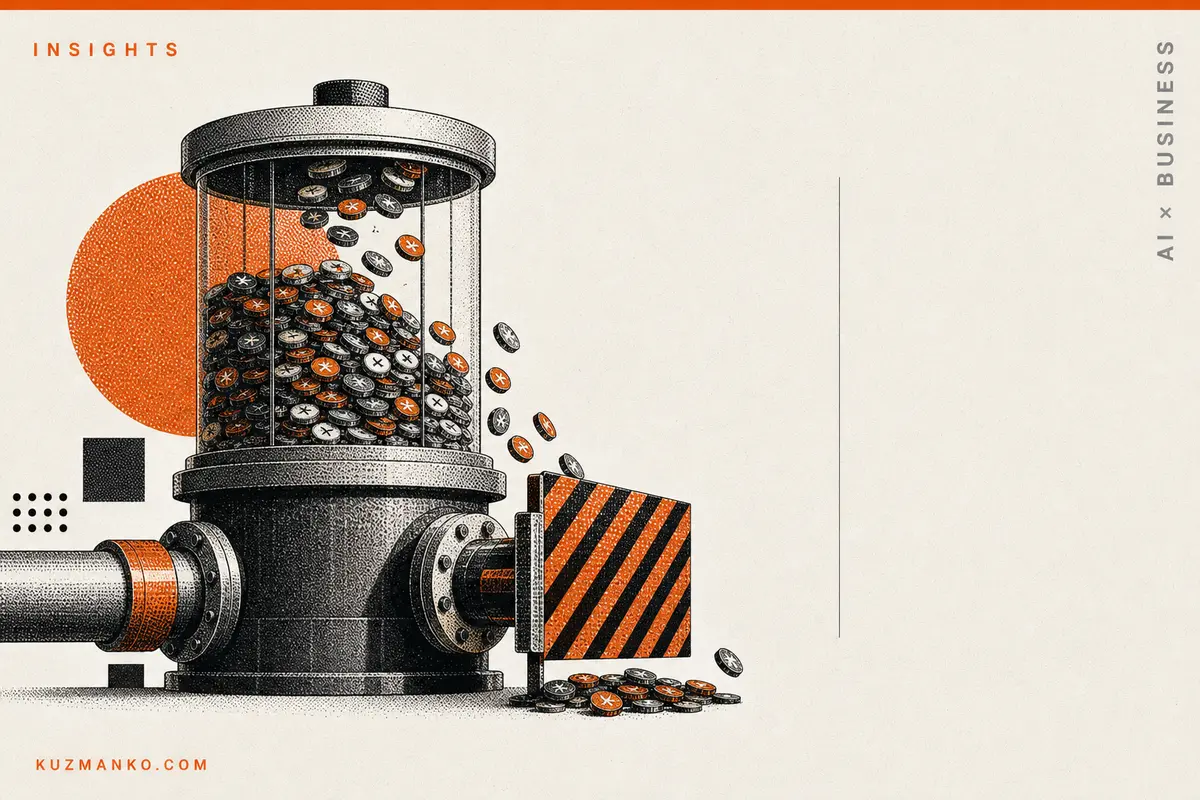
Tokenmaxxing - מונח חדש-ישן ומאחוריו גישה שגויה שאומצה בצורה עיוורת. על פי הדיווח של Financial Times מהיום, Google הטילה מגבלות על השימוש של Meta במודלי Gemini לאחר ש-Meta הפכה לאחת מצרכניות ה-AI הגדולות ביותר במגזר הארגוני. לפי הדיווח, המגבלות יצרו עיכובים ושיבושים בפרויקטי AI פנימיים של Meta, ואילצו אותה לזוז ממדיניות של צריכה מקסימלית, שכונתה Tokenmaxxing, לגישה מבוקרת וחסכונית יותר.
אני מנסה ללא הצלחה להבין את הגישה, אבל אין בה היגיון, בטח בעידן אג'נטי. מעבר לעובדה ששימוש בסוכנים אוטונומיים בצורה עיוורת הוא בעייתי ולא יעיל בצד העסקי, הדבר היחיד שהוא יכול לתרום הוא \"שריפת טוקנים עיוורת\". שימוש אידיוטי בסוכני AI שעבור פעולות פשוטות שורפות כמויות טוקנים אדירות זה לא אימוץ AI, זו דיגרדציה. אין שום בעיה לבנות סוכן אוטונומי. בשביל זה לא צריך להבין תהליך, להבין טכנולוגיה או להתאים פתרון. פשוט זורקים פעולות שאתמול לא עלו שקל על סוכן שמתחיל לשרוף טוקנים לחישובים פשוטים, פניות API מיותרות, אחסון מידע ב-DB, והנה הגענו לגביע הקדוש: \"מיקסום שימוש בטוקנים\". לא רק שלא מדובר בהתייעלות, מדובר בנזק. תהליך AI חכם יהיה יותר חסכוני, ישתמש ברכיבי AI בתוך תהליך מורכב שרובו בנוי מתחנות דטרמיניסטיות. כן, זה תהליך שיצרוך פחות טוקנים ויהיה יעיל וחכם יותר. סוף סוף מתחילים להבין זאת.
The Real Story Is Not Meta. It Is the Cost of Bad AI Architecture
The immediate headline is simple: Google reportedly told Meta that its Gemini usage had reached a limit. That matters because Meta is not a small startup misreading a pricing page. It is one of the most sophisticated technology companies in the world.
But the important question for enterprises is sharper: if Meta can hit infrastructure and usage constraints, what exactly do CFOs, CIOs and product leaders think will happen inside ordinary organizations that deploy AI without governance, process design or cost architecture?
Tokenmaxxing treats token volume as evidence of progress. It is the same managerial mistake we have seen before in other forms: measuring lines of code instead of software value, server count instead of uptime, meeting hours instead of decisions, or dashboard activity instead of operational improvement.
Tokens are not productivity. Tokens are a cost unit. Sometimes they create value. Often, when badly designed, they merely document waste.
The FT report should be read less as a vendor dispute and more as a warning about enterprise AI maturity. The constraint is not only GPU capacity. The constraint is management quality.
Why Token Consumption Became a False Status Symbol
There is a seductive idea behind Tokenmaxxing: if employees are using more AI, the organization must be becoming more productive. It sounds measurable. It sounds modern. It gives managers a dashboard.
It is also wrong.
AI adoption has two very different tracks. One is AI literacy: teaching employees how to communicate effectively with models, use tools such as Claude, Copilot or other assistants, and improve their daily work. The other is AI process engineering: building managed agents, automations and model-supported workflows that become part of the enterprise operating system.
Both tracks matter. But confusing them creates chaos.
A developer asking Claude Code to inspect a complex codebase and suggest a safe refactor may generate real leverage. A finance analyst using an AI tool to compare assumptions across several forecast scenarios may save hours. A legal team using AI to classify risk patterns across contract drafts may materially improve throughput.
But an autonomous agent that repeatedly calls APIs, stores unnecessary intermediate data, performs simple deterministic calculations through a language model, and loops through vague reasoning steps is not innovation. It is compute theatre.
The Agentic Era Requires More Discipline, Not Less
The current excitement around autonomous AI agents is understandable. Agents can execute multi-step work, connect to systems, retrieve information, trigger actions and coordinate tasks. In the right architecture, they can be powerful.
The problem begins when organizations treat agents as a replacement for process understanding.
A serious AI implementation starts with questions that are not glamorous but are essential:
- Which parts of the process require judgment?
- Which parts are deterministic and should never touch a language model?
- What information does the model actually need?
- Where should the human be in the loop?
- What is the acceptable cost per completed business outcome?
- What happens when the model is uncertain?
- Which system owns the final state of record?
Without these answers, an agent is just a very expensive intern with system access.
Human-in-the-loop design remains critical, but it is often misunderstood. If every AI workflow requires a human to inspect every action, the organization has achieved very little. The goal is not to add humans everywhere. The goal is to let one human supervise hundreds of well-designed processes, intervene only on exceptions, and improve decision quality where human judgment is actually needed.
That is the difference between operational leverage and an expensive demo.
Deterministic First, AI Where It Matters
Good AI architecture is usually less magical than people expect. It is not one giant autonomous agent wandering through enterprise systems. It is a process with deterministic stations, model-supported judgment points, validation rules, auditability and escalation.
A smart invoice review process, for example, should not ask an LLM to calculate totals or check whether a vendor ID exists. Those are deterministic tasks. It may use AI to interpret ambiguous invoice descriptions, detect unusual clauses, classify exceptions, or summarize the reason a transaction should be reviewed.
A practical pattern looks like this:
process: supplier_invoice_review
routing: deterministic_first
ai_used_for: ambiguity, classification, exception_summary
human_review: only_high_risk_or_low_confidence
cost_metric: tokens_per_approved_invoice
success_metric: cycle_time, error_rate, exception_precision
This is not less advanced than a fully autonomous agent. It is more advanced because it understands the business process, the economics and the risk profile.
What Google's Limit on Meta Means for Enterprise Finance
The infrastructure angle matters. AI compute is not infinite, and it is not merely a technical procurement issue. According to the report, Google itself has been securing additional compute capacity, including a major agreement involving SpaceX and xAI-related capacity. Whether one focuses on Gemini, GPT models, Claude, or any other foundation model, the direction is clear: demand is pressing against infrastructure.
For finance leaders, this changes the way AI budgets should be managed.
AI spending cannot remain an experimental line item hidden inside engineering, cloud, SaaS or innovation budgets. It needs FinOps discipline. Not because organizations should be afraid of AI costs, but because ungoverned AI cost is a sign of ungoverned AI value.
CFOs and CIOs should start asking for metrics that connect consumption to outcomes:
- Cost per resolved service ticket
- Tokens per approved document
- Model calls per completed workflow
- AI cost per sales opportunity enriched
- Exception rate per automated process
- Human intervention rate by workflow
- Accuracy improvement against the previous process
- Time saved after validation, not self-reported enthusiasm
The board should not celebrate higher token usage. It should celebrate better margins, faster cycles, fewer errors and higher operational capacity.
Vendor Strategy: Do Not Build a Critical Process on Blind Dependency
Another lesson is vendor concentration. If a core process depends entirely on one external model provider, the organization inherits that provider's constraints: pricing, throttling, latency, policy changes, regional availability and security posture.
This does not mean every company should build its own foundation model. That is unrealistic for most enterprises and usually unnecessary. It does mean organizations need a deliberate model strategy.
For many companies, Claude is currently one of the strongest platforms for broad enterprise adoption, especially for knowledge work, coding support and applied reasoning. Claude Code and collaborative Claude-based workflows are among the most useful AI tools available today. At the same time, security, data governance and enterprise controls must be handled carefully.
Microsoft Copilot is a solid infrastructure layer, especially for organizations already committed to the Microsoft ecosystem. It has sometimes moved slower than more focused AI-native companies, though recent improvements have been meaningful. Copilot Studio can be useful for Microsoft-centric agent development, while tools such as n8n are increasingly entering serious enterprise environments in places where they would have been dismissed not long ago.
The point is not to choose a religion. The point is to build an architecture.
Organizations need the ability to route tasks across tools and models based on cost, sensitivity, performance, latency and business criticality. They also need internal capabilities to create, deploy, monitor and retire agents. In that sense, IT departments are slowly becoming human resources departments for AI agents: onboarding them, defining roles, supervising permissions, measuring performance and removing underperformers.
The Consultant Problem: AI Is Not Just Technical
One of the reasons Tokenmaxxing became believable is the flood of superficial AI advice in the market. Too many self-appointed experts sell automation without understanding operations, management, organizational behavior, risk or finance.
Large enterprises often know how to filter this. Small and mid-sized businesses are more exposed. They can be sold an impressive agentic workflow that looks modern on a demo call but creates cost, fragility and operational confusion in production.
AI is a multidisciplinary field. It requires technical literacy, but not only technical literacy. It requires process expertise, managerial experience, domain knowledge, academic seriousness and a practical understanding of how work actually happens inside organizations.
This is exactly where many failed implementations break. The model may be excellent. The workflow may be nonsense.
What a Serious AI Governance Model Should Include
AI governance should not be a bureaucratic committee that blocks every useful initiative. It should be an operating layer that helps the organization move faster with less waste.
A useful governance model includes:
- A catalog of approved AI use cases and their business owners
- Token and cost budgets by process, not only by department
- Model routing rules based on sensitivity, complexity and cost
- Clear separation between deterministic logic and model reasoning
- Human-in-the-loop rules based on risk and confidence thresholds
- Observability for prompts, outputs, latency, failures and retries
- Security review for data exposure, permissions and storage
- Evaluation sets that test quality before and after deployment
- A retirement process for agents that do not create measurable value
This is not theoretical. It is the difference between AI as operational infrastructure and AI as uncontrolled experimentation.
The Right Metric Is Not More AI. It Is Better Work
The most mature organizations will not be the ones that burn the most tokens. They will be the ones that use AI precisely.
They will train employees to communicate well with models. They will adopt tools that improve individual productivity. They will also build agent platforms that allow fast creation and management of AI workers. But they will not confuse a chatbot attached to an API with an optimized business process.
The right question is not: how much AI are we using?
The right questions are:
- Which process became faster?
- Which decision became better?
- Which cost was reduced?
- Which risk was controlled?
- Which employee can now supervise ten times more work without losing quality?
- Which model call was removed because it was never needed?
Tokenmaxxing fails because it mistakes input for output. Enterprise AI must be judged by outcomes.
The Bottom Line
Google's reported limits on Meta's Gemini usage are not just a capacity story. They are a strategy story. The era of unlimited AI experimentation is giving way to a more serious phase: AI operations, AI finance and AI process architecture.
That is good news.
It means the market is starting to separate real AI implementation from token-burning theatre. It means organizations will have to understand their processes before automating them. It means human judgment will be placed where it creates leverage, not where it becomes a bottleneck. And it means the companies that combine deep AI knowledge with business experience will pull ahead.
Tokenmaxxing was never a strategy. It was a symptom. The cure is disciplined AI design.