
The shortest answer: a useful PDF answer system must show its work
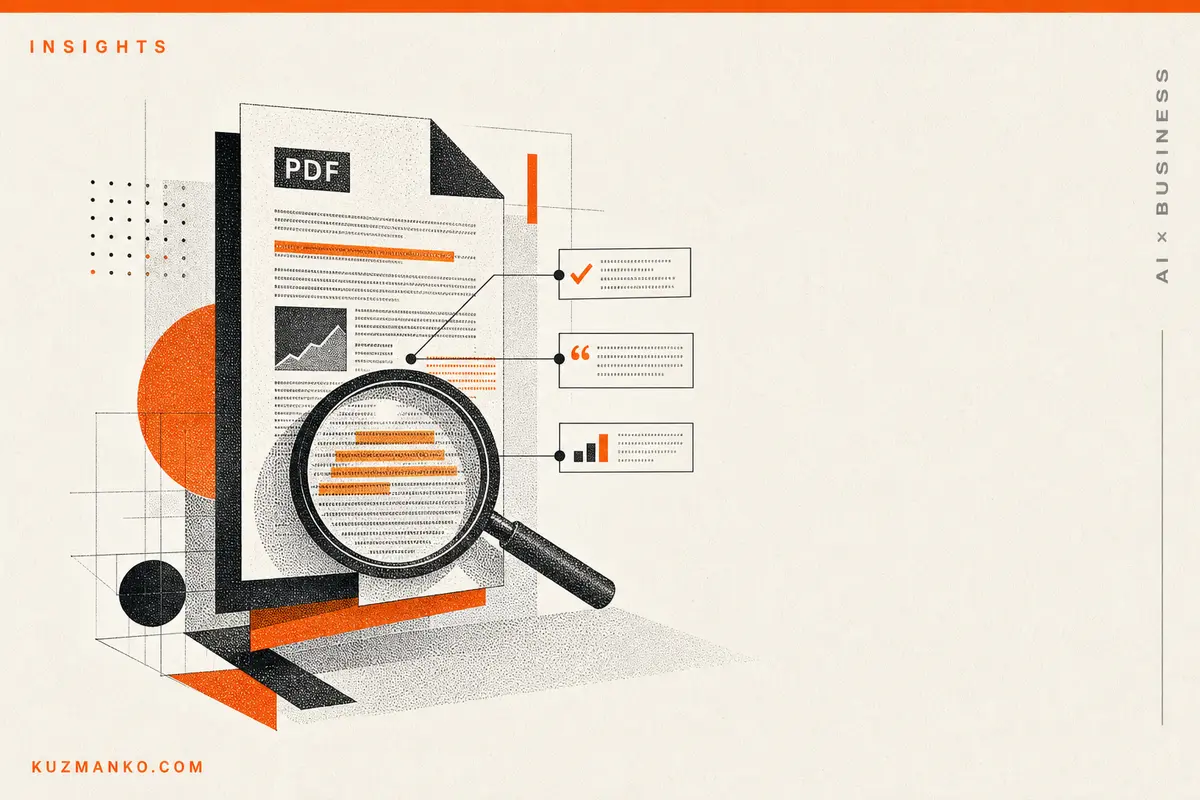
A serious PDF question-answering system should do four things well: extract the document with location metadata, retrieve the most relevant evidence, generate a structured answer, and highlight the exact source lines inside the original file.
That may sound less glamorous than a multi-agent architecture connected to a vector database and a dozen orchestration layers. Good. In enterprise AI, the first version should not impress a conference audience. It should survive review by legal, finance, compliance, procurement, and operations.
A business answer is not complete when it sounds correct. It is complete when the user can inspect where it came from.
This is the central distinction many AI projects miss. RAG, or retrieval-augmented generation, is not merely a way to make a chatbot smarter. In the enterprise, RAG is a document intelligence control layer. Its job is to reduce hallucination, expose evidence, support human judgment, and create a repeatable audit trail.
Why PDF answers fail in real organizations
Most failed document AI initiatives do not fail because the model is weak. They fail because the implementation ignores how organizations actually make decisions.
A contract manager does not need a fluent paragraph that claims a termination clause exists. She needs the clause, the page, the exact wording, and the confidence to escalate if the answer is incomplete. A finance controller does not need a charming summary of a policy. He needs traceable evidence for an approval workflow. A claims analyst does not need a generic answer. She needs a defensible interpretation of a specific document section.
This is why a PDF answer system must treat every answer as a structured object, not as a chat message.
A practical answer should include:
- The direct answer in plain language
- The evidence range, including page and line references
- Exact citations from the document
- A confidence level
- Caveats and missing information
- A machine-readable structure that can be stored, monitored, and reviewed
- A link between the generated answer and the original visual location in the PDF
The last point matters more than many teams realize. Text extraction alone is not enough. In regulated or high-value processes, users often need to see the original context: headings, footnotes, tables, formatting, signatures, numbering, and surrounding clauses.
Start with a small architecture that can be trusted
The best first version is often surprisingly simple. It does not need to begin with embeddings, autonomous agents, or a full semantic search stack. It can start with a disciplined pipeline.
A reliable minimal architecture looks like this:
- Parse the PDF into text lines with page numbers, line numbers, and bounding boxes.
- Interpret the user question and extract concise search terms.
- Retrieve the most likely pages or passages using transparent matching.
- Ask the model to answer only from the retrieved evidence.
- Return a structured response with citations and uncertainty.
- Highlight the cited lines in the original PDF.
This is not primitive. It is professional engineering. Each step has a defined input and output. Each failure can be diagnosed. If the search terms are poor, the problem is question interpretation. If the right page is missing, the problem is retrieval. If the answer overreaches, the problem is generation and grounding.
That separability is what makes the system governable.
answer: The document mentions sinusoidal positional encodings and learned positional embeddings.
evidence:
  page: 5
  lines: 38-44
  citation: We use sine and cosine functions of different frequencies...
confidence: high
caveats: The answer is limited to the retrieved section and should be reviewed if other appendices discuss alternatives.
highlight:
  page: 5
  bounding_boxes: stored_from_pdf_parser
This kind of schema changes the conversation. The model is no longer a mysterious oracle. It becomes one component inside a controlled business process.
Why not just send the whole PDF to the model?
Long context windows are useful, but they do not eliminate the need for retrieval. Sending an entire document, or hundreds of documents, into a model may work for a demo. It becomes expensive, slow, and harder to control in production.
Real enterprise documents are rarely neat. They include scanned pages, appendices, tables, exhibits, conflicting versions, multilingual clauses, signatures, and references to other files. The question is not always, “Where does this phrase appear?” It is often, “Which obligations apply if this condition changes?” or “What exceptions exist across all supplier agreements signed after a certain date?”
Retrieval is not only about token savings. It is about focus and accountability.
Good retrieval provides:
- A narrowed evidence set
- A clear reason why specific pages were selected
- A way to debug wrong answers
- Lower model cost
- Better latency
- Lower exposure of irrelevant sensitive content
- A foundation for audit and monitoring
This is particularly important when AI is used to support non-deterministic business processes. AI allows organizations to automate judgment-heavy work that was previously dependent on human review. But the human-in-the-loop principle remains critical. The goal is not to force a human to approve every micro-step. That would simply recreate the old bottleneck. The goal is to help one expert supervise hundreds of AI-assisted decisions with clear exceptions, evidence, and escalation paths.
Keyword search is not embarrassing. It is explainable.
Many teams rush to vector databases because embeddings feel more advanced. Sometimes they are necessary. But the first retrieval layer should often be explainable before it becomes semantic.
If a legal user asks about “positional encoding” and the system shows that the phrase appears on page 5, the logic is understandable. If the system says a passage was selected because its similarity score is 0.78, the business user has learned almost nothing.
That does not mean keyword search is sufficient. It breaks quickly when the wording changes, when abbreviations are used, when symbols replace words, or when the user asks conceptually rather than literally. A user may write “epsilon” while the document uses “ε”. A finance policy may say “material variance” while the user asks about “large deviation”.
The right production direction is hybrid:
- Keyword retrieval for transparency and exact matches
- Synonym and domain dictionaries for professional language
- Embeddings for semantic similarity
- Re-ranking for evidence quality
- Rules for must-have terms in legal or regulatory contexts
- Human review queues for low-confidence or high-risk answers
The sequence matters. Start with traceability. Add semantic power carefully. Do not bury the evidence trail under a black box too early.
The business value is not the chatbot. It is the audit layer.
A PDF RAG system becomes valuable when it supports a real operational decision. That could mean accelerating contract review, identifying regulatory obligations, answering insurance policy questions, comparing technical specifications, or extracting risks from supplier documentation.
In each case, the productivity gain comes from reducing manual search and improving consistency. But the financial value depends on trust. If employees do not trust the answer, they will still read the whole document. If auditors cannot reconstruct the answer, the system will not be approved for serious use. If managers cannot measure failure modes, the project will remain a toy.
This is why AI implementation is not a technical task alone. It requires deep AI knowledge, but also professional experience in business processes, governance, risk, and management. The strongest systems are built by teams that understand both the model and the work being transformed.
There are many self-declared AI experts who can assemble an impressive prototype. Far fewer can design an operating model that holds up inside a finance department, legal department, or industrial operation. Education matters. Academic depth matters. Field experience matters. AI is multidisciplinary by nature, and the advantage often belongs to people who can connect research, domain expertise, process design, and implementation discipline.
What the system must capture from the PDF
The extraction stage is the foundation. If it is weak, the rest of the system will compensate badly.
A robust PDF parser should capture:
- Page number
- Line number or block number
- Text content
- Bounding box coordinates
- Reading order
- Section headings where possible
- Table structure where possible
- Font signals such as bold, size, or heading style when useful
- Document metadata and version identifiers
Bounding boxes are especially important because they allow the system to highlight the cited evidence in the original PDF. This is where the user experience becomes credible. The user sees the answer, clicks the citation, and lands on the exact source location.
For enterprise use, this extraction should also preserve document identity. If the same policy exists in several versions, the answer must reference the correct version. “Page 12” is not enough if nobody knows which file was used.
The response schema should allow “not found”
One of the most important capabilities in enterprise AI is the ability to refuse gracefully.
A good system must be able to say:
- The answer was not found in the provided document.
- The retrieved evidence is insufficient.
- The document contains conflicting statements.
- The answer depends on a definition outside the retrieved section.
- A human review is required.
This is not a weakness. It is a control. In many business settings, a confident false answer is worse than no answer. A structured “not found” response protects the process and gives the user a path forward.
Where agents fit, and where they do not
For a single PDF, a full agentic architecture may be unnecessary. But as the workflow expands, agents become useful. An agent might compare multiple contracts, request missing documents, classify clauses, open a review task, or update a CRM or ERP system after approval.
The important point is that agents need infrastructure. Organizations should develop internal capabilities to create, manage, monitor, and retire AI agents. In the future, information systems departments will increasingly behave like human resources departments for digital workers: onboarding agents, assigning permissions, reviewing performance, managing risk, and removing agents that no longer serve the organization.
This is also why companies need to advance on two tracks at the same time. The first is AI literacy: employees must learn how to communicate effectively with models and use AI tools responsibly. The second is agent development: the organization must build platforms and governance for repeatable automation.
These tracks are different. AI tools often require employees to change work habits, which can make adoption harder than expected. AI agents, when designed well, can operate behind existing workflows and require less behavioral change from frontline teams. Technically, agents may look more complex. Organizationally, they can sometimes be easier to adopt.
Tooling choices: useful, but secondary to architecture
The market is moving quickly. Claude remains one of the strongest systems for broad enterprise knowledge work, especially for reasoning-heavy tasks, although security and data governance must be handled carefully. Claude Code and collaborative Claude workflows are currently among the more practical AI adoption paths for many technical teams. Microsoft Copilot has become a meaningful infrastructure layer, and Copilot Studio is useful for organizations already deep in the Microsoft ecosystem, even if innovation cycles can feel slower in large platform companies. Tools such as n8n are also entering serious enterprise environments, including places where they would once have been dismissed as unsuitable for large organizations.
But tooling is secondary. A weak architecture will not become reliable because it uses a fashionable model. A strong architecture can improve over time as models, retrieval methods, and orchestration tools mature.
The core questions remain stable:
- Can the system show evidence?
- Can users inspect the source?
- Can the organization audit decisions?
- Can failures be diagnosed?
- Can humans supervise at scale?
- Can the process be improved without rebuilding everything?
A practical implementation roadmap
For organizations building a PDF answer system, the right roadmap is not to start with maximum sophistication. It is to start with maximum clarity.
A sensible first phase includes:
- Choose one high-value document workflow.
- Define what a correct answer must contain.
- Build PDF extraction with page, line, and bounding box metadata.
- Implement transparent retrieval before adding semantic search.
- Force the model to answer from evidence only.
- Return structured JSON, not only natural language.
- Highlight the cited source inside the PDF.
- Add human review for low-confidence and high-impact cases.
- Monitor misses, bad citations, and unsupported claims.
- Expand to hybrid retrieval and multi-document workflows only after the evidence loop works.
This path is slower than a demo and faster than a failed transformation. It respects the fact that AI in business is not about connecting a model to files. It is about designing a decision process that can be trusted.
The real lesson: trust is built in the small lines
Enterprise RAG does not begin with vectors. It begins with the user’s ability to verify the answer.
Vectors, agents, long context windows, orchestration frameworks, and model choice all matter. But they matter after the system can prove where its answer came from. In serious business environments, trust is built through evidence, repeatability, governance, and thoughtful human oversight.
A PDF answer system with citations and source highlighting may look modest compared with the grand language of AI transformation. In practice, it is one of the most important building blocks of operational AI. It turns documents into decision infrastructure. And that is where the real value begins.