
The short answer: this is what mature AI adoption looks like
Hugging Face’s shift to weekly releases for its huggingface_hub Python library is not just a story about faster DevOps. It is a practical example of how enterprises should deploy AI in operational workflows: let AI accelerate judgment-heavy work, let deterministic systems verify facts, and keep humans at the critical approval point.
That combination matters. Many organizations still frame AI as a choice between full automation and human work. The more useful question is different: how can one skilled person supervise hundreds of reliable AI-assisted processes instead of manually executing one process at a time?
The future of enterprise AI is not a model running freely through the organization. It is a controlled system where models produce, software validates, and people govern.
For CIOs, CTOs, finance leaders, and operations executives, this is the real signal. AI value will not come only from dramatic replacement projects. It will come from compressing repeatable bottlenecks that currently slow delivery, consume senior attention, and create operational drag.
Why a weekly release cycle changes more than engineering velocity
The huggingface_hub package sits close to the foundation of the modern AI development stack. It connects developers to the Hugging Face Hub and supports major libraries across the ecosystem, including Transformers, Datasets, Diffusers, and sentence-transformers.
When improvements wait four to six weeks for release, friction spreads across the ecosystem. Bugs remain unresolved for longer. Developers lose confidence in the infrastructure. Product teams wait for fixes that are technically complete but operationally stuck.
A weekly release rhythm changes the economics of software maintenance:
- Bugs reach users faster after being fixed.
- Small improvements stop accumulating into risky large releases.
- Maintainers spend less time coordinating release logistics.
- Developers gain confidence that the platform is alive and responsive.
- The organization reduces the invisible cost of delayed value.
This is not only an engineering benefit. It is a finance and operations issue. Delayed releases are a form of trapped working capital. The work has already been done, but the business has not yet captured the value.
The important design pattern: AI writes, code checks, humans decide
The most interesting part of the workflow is not that a language model helps write release notes. Many organizations already use AI to summarize pull requests, draft Slack updates, or generate changelog text.
The important part is the architecture.
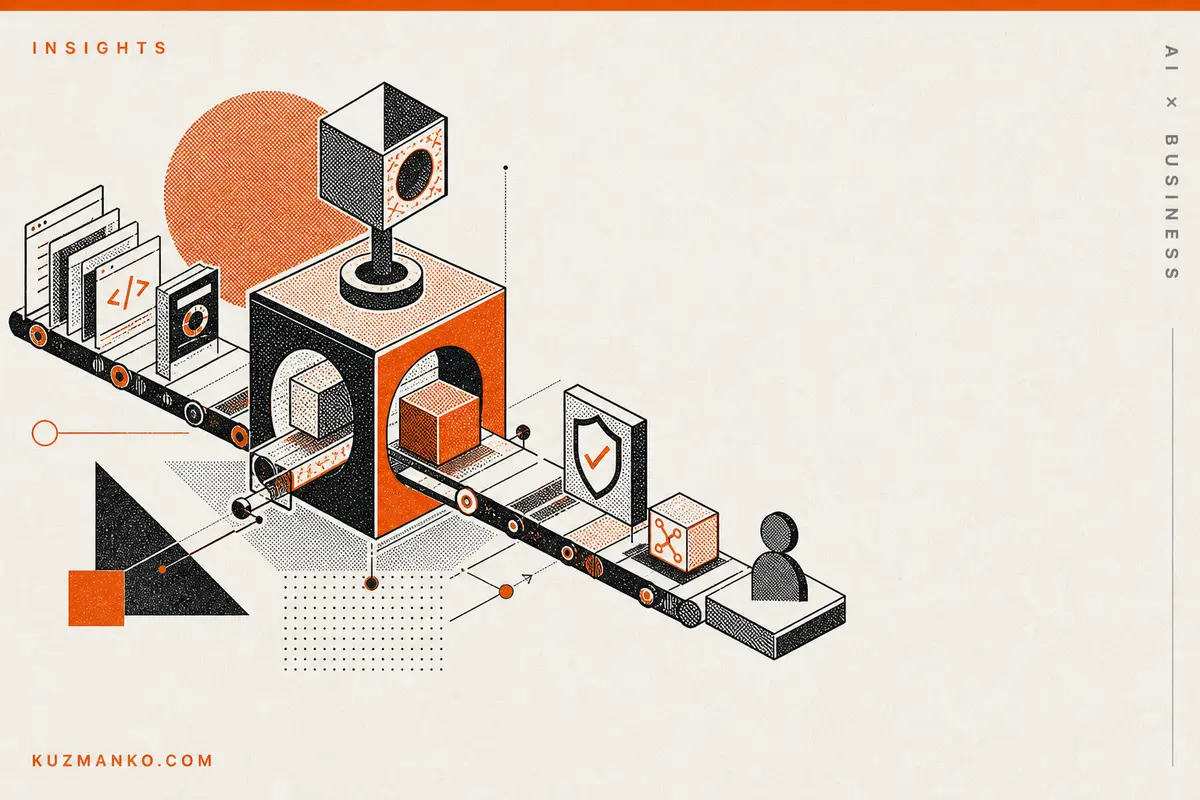
Hugging Face does not ask the model to become the source of truth. The release system first creates a deterministic manifest from commit history. That manifest defines which pull requests and changes belong in the release. The AI model then drafts the human-readable release notes. After that, scripts verify whether the draft includes the expected items and avoids unrelated additions.
If the model misses something or invents something, the system sends it back for correction.
The pattern is simple and powerful:
- Deterministic systems define the facts.
- The model performs the language and synthesis work.
- Automated checks compare output against the source of truth.
- A human approves the final release.
This is the architecture enterprises should study. It avoids the false promise of autonomous AI doing everything, while still removing a meaningful operational burden.
Human in the loop is not enough. Human at scale is the goal
Many AI governance conversations stop at the phrase human in the loop. That is necessary, but not sufficient.
If every AI-assisted process requires the same level of human attention as the manual process it replaced, the organization has not gained much. It may even create a new bottleneck, where employees spend their days approving machine output instead of doing higher-value work.
The better objective is human supervision at scale.
In this release workflow, the human is not manually assembling every changelog line, checking every commit, preparing every publication step, and writing every internal update. The human reviews a prepared artifact after automated verification has already reduced the risk.
That is the right division of labor:
- AI handles non-deterministic drafting and synthesis.
- Code handles deterministic validation.
- Humans handle quality, context, and accountability.
This distinction is critical for enterprise AI strategy. AI is not purely technical. It combines domain expertise, process understanding, management judgment, security awareness, and strong implementation experience. Organizations that treat it as a tool installation project will underperform.
Open models are becoming a strategic option, not only a philosophical one
The Hugging Face approach also points to an important enterprise trend: open and replaceable components are becoming strategically useful.
The workflow uses orchestration through GitHub Actions, an agentic coding environment, an open-weight model from Z.ai, inference infrastructure, and secure publishing mechanisms. The specific stack is less important than the principle: the process is not locked to one closed model vendor.
For enterprises, that matters for several reasons:
- Procurement teams gain more leverage.
- Security teams can evaluate deployment options with more flexibility.
- Engineering teams can swap models as quality, latency, or cost changes.
- Legal teams can better reason about data exposure and vendor dependency.
- AI teams can benchmark performance instead of accepting vendor claims.
This does not mean closed models are irrelevant. They remain highly valuable. Anthropic, for example, continues to move quickly and has become one of the most compelling enterprise AI players, especially with practical tools such as Claude Code and Claude-based collaboration workflows. Microsoft Copilot is also improving and remains a useful enterprise infrastructure layer, especially inside Microsoft-heavy environments, though large platforms often move more slowly than specialized AI companies.
The real point is not open versus closed as ideology. The point is architectural optionality. Enterprises should design workflows so models can be replaced, evaluated, and governed.
The cost story is small, and that is why it matters
A reported cost of roughly a quarter of a dollar per full release process is not impressive because it is dramatic. It is impressive because it is mundane.
Enterprise AI often gets evaluated through oversized transformation narratives: replacing departments, reinventing entire business models, or building futuristic autonomous systems. Those projects may exist, but a large share of near-term ROI will come from automating small recurring constraints.
If a senior maintainer spends half a day every week preparing a release, and AI-assisted automation turns that into a short review, the financial impact compounds:
- Senior engineering time is freed for higher-value work.
- Releases become more predictable.
- Errors from manual coordination decrease.
- Delivery cadence improves without expanding headcount.
- The organization builds confidence in controlled AI automation.
This is operational efficiency in its most practical form. It is not a demo. It is a better workflow.
Supply chain security becomes non-negotiable when agents enter CI/CD
AI in software delivery introduces a new risk profile. Once agents begin assisting releases, writing artifacts, triggering workflows, or interacting with repositories, the software supply chain becomes even more sensitive.
That is why secure publishing and toolchain control matter. Using short-lived identity-based publishing instead of static package tokens is not a minor detail. Pinning tools to specific versions and verifying integrity with hashes is not administrative overhead. These are the controls that make automation acceptable in serious environments.
A simplified enterprise checklist should include:
- Use short-lived credentials wherever possible.
- Avoid long-lived publishing tokens in CI/CD.
- Pin agent tools and verify checksums.
- Separate generation from validation.
- Log every AI-assisted action.
- Require human approval for production release gates.
- Maintain rollback procedures and incident playbooks.
AI does not reduce the need for DevSecOps maturity. It raises the price of not having it.
What enterprise leaders should take from this case
The Hugging Face example offers a practical blueprint for organizations far beyond AI libraries. Any team with recurring documentation, release, compliance, review, reporting, or coordination work can apply the same logic.
A useful method is to classify workflow components into three categories:
- Mechanical work that should be fully automated.
- Language and synthesis work that AI can accelerate.
- Judgment and accountability work that humans must own.
This classification is more useful than asking whether a process can be automated. Most enterprise processes are mixed. The winning organizations will decompose them intelligently.
Consider release management, customer support escalation, procurement review, compliance evidence collection, financial commentary, knowledge base updates, and internal audit preparation. In each case, AI can help with non-deterministic interpretation and drafting, but deterministic systems must validate facts, constraints, permissions, and policy compliance.
AI agents need infrastructure, not improvisation
This case also reinforces a broader organizational point: companies need internal capabilities for building and managing AI agents.
Agentic workflows should not be random experiments owned by isolated enthusiasts. Enterprises need a platform for agent creation, monitoring, permissions, evaluation, and lifecycle management. Microsoft Copilot Studio can be useful inside Microsoft ecosystems. Tools such as n8n are also entering large organizations because they make workflow automation and agent orchestration more accessible than many leaders expected.
The future information systems department may look partly like an HR department for AI agents. It will need to know which agents exist, what they are allowed to do, how they perform, when they should be retired, and which human owner is accountable for them.
At the same time, organizations must advance on two tracks:
- AI literacy, so employees know how to communicate effectively with models and use AI tools responsibly.
- AI agent development, so the enterprise can automate processes without forcing every employee to change daily habits.
This distinction is often missed. AI tools require behavior change from employees, which can make adoption harder than expected. AI agents, when designed well, can improve workflows behind the scenes with less disruption to existing work patterns.
A warning: AI implementation is not for amateurs
There is a growing market of self-proclaimed AI experts who sell confidence faster than they build competence. Large enterprises can often filter this noise. Small and mid-sized businesses are more vulnerable.
AI implementation requires more than prompt tricks. It requires relevant education, business experience, technical understanding, governance discipline, and the ability to translate operational reality into reliable AI-supported processes.
Academia matters here. So does field experience. The strongest AI practitioners are often multidisciplinary: they understand models, but they also understand management, process design, organizational constraints, finance, compliance, and human behavior.
That combination is exactly what AI implementation demands. A release pipeline is never only a technical artifact. It is a business process with risk, accountability, timing, cost, and trust attached to it.
The strategic lesson
Hugging Face’s weekly release workflow is a strong signal for the next phase of enterprise AI. The lesson is not to copy every tool in the stack. The lesson is to copy the operating principle.
Use AI where ambiguity, language, and synthesis slow people down. Use deterministic systems where accuracy is mandatory. Use humans where judgment and accountability matter. Build security into the workflow from the start. Keep the architecture flexible enough to change models and vendors.
That is how organizations move from AI experimentation to AI operations.
The competitive advantage will belong to companies that do not ask whether AI can replace a process, but how AI can make one expert capable of safely supervising hundreds of better processes.