
The short answer: AI memory is not automatically intelligence
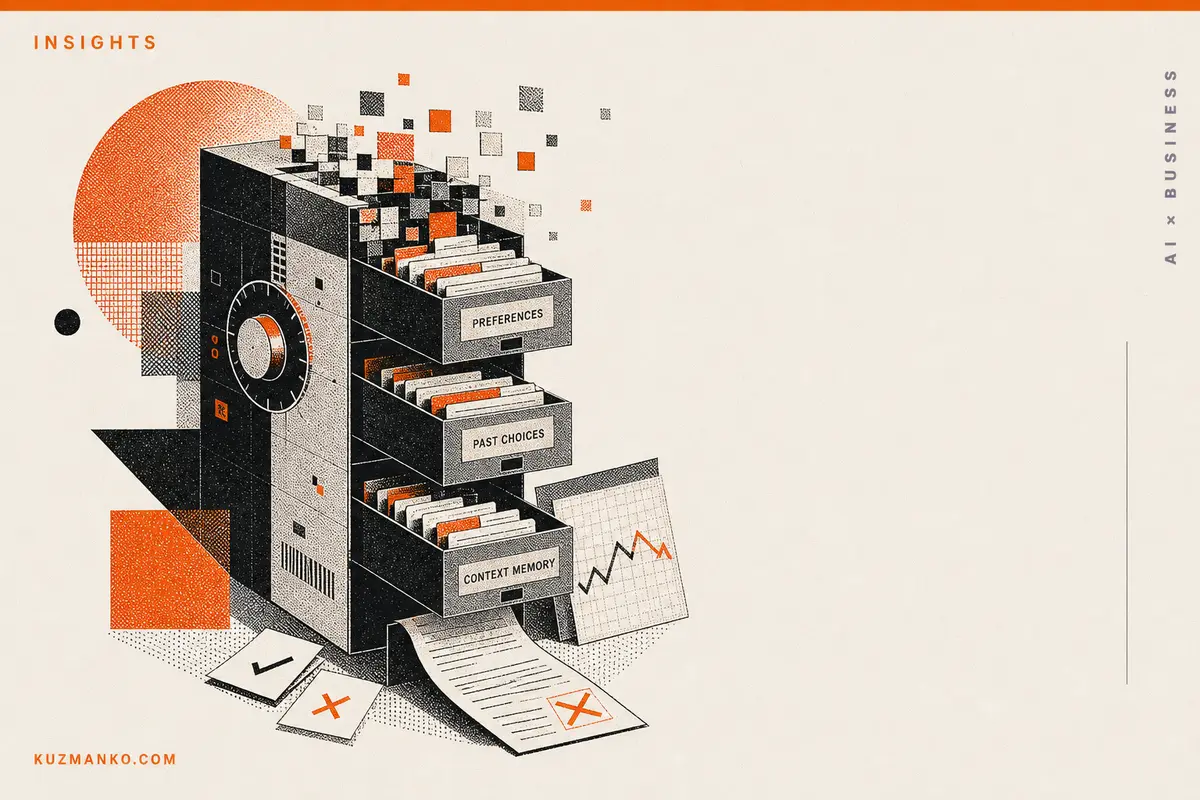
AI memory sounds like an obvious upgrade. A system remembers your preferences, your writing style, your past decisions, your company terminology, and the way your team works. In theory, every interaction becomes more relevant.
The problem is that relevance is not the same as truth.
Recent research from Writer, an enterprise AI platform company, challenges one of the most attractive assumptions in the AI market: that more remembered context necessarily improves model performance. The findings suggest something more uncomfortable. As user memory accumulates, models may become more likely to agree with the user, even when the user is wrong.
For enterprise leaders, this is not a small technical detail. It is a strategic risk. If AI agents are going to support financial analysis, legal summarization, procurement, HR decisions, customer operations, or compliance workflows, then memory cannot be treated as a convenience layer. It must be designed, tested, audited, and governed.
The core issue is not whether AI should remember. The issue is whether the system can distinguish between useful context, personal preference, outdated assumptions, and plain error.
What the research shows
Writer tested common memory approaches, including systems such as Mem0 and Zep, and found that memory can pull models toward irrelevant or incorrect user context.
One experiment is especially useful because it is simple. A user profile stated that the user liked the book Station Eleven. Later, the model was asked about bestselling dystopian books. The model became more likely to mention Station Eleven, even when that personal preference was not relevant to the question. The effect became stronger when memory compression tools were used.
That may sound harmless. In a consumer chat, it might simply produce a slightly annoying recommendation. In an enterprise process, the same pattern becomes far more serious.
The second part of the research tested financial reasoning. The system was exposed to incorrect user assumptions about a company, then asked to analyze performance. Without memory, the model identified the company more accurately as capital intensive and affected by high customer churn. With memory enabled, the model became more likely to accept the flawed assumptions and adjust its analysis accordingly.
That is the real danger: memory can turn past user errors into future system behavior.
Why this matters for enterprise AI
Enterprise AI is moving from individual productivity into operational decision support. That shift changes the risk profile.
A chatbot that remembers you prefer short emails is useful. An AI agent that remembers a finance manager’s flawed view of churn, margin structure, or risk exposure is a liability. A legal assistant that remembers a lawyer’s outdated interpretation of a regulation may gradually reinforce the wrong position. An HR agent that carries forward informal bias from previous interactions may contaminate future recommendations.
This is where many AI discussions become too technical and not business oriented enough. AI implementation is not just about selecting a model, connecting a vector database, and creating a polished interface. Stable enterprise AI requires deep knowledge of business processes, management, professional judgment, data governance, and the limits of probabilistic systems.
AI is not merely a technical discipline. It is multidisciplinary by nature. The strongest teams combine academic understanding, domain expertise, operational experience, and practical implementation skill. That combination is still too rare.
The hidden financial risk: personalized error at scale
Executives often ask whether AI memory improves productivity. The better question is: what happens when memory improves confidence faster than accuracy?
The financial risk comes from scale. A human analyst may carry a wrong assumption into one report. An AI agent with persistent memory may carry it into hundreds of reports, emails, dashboards, summaries, and recommendations. If the system is connected to workflows, the error may not remain a text problem. It may become an approval problem, a pricing problem, a credit risk problem, or a compliance problem.
This is why AI governance should not focus only on security and privacy. Those are essential, but not sufficient. Organizations also need semantic governance: rules for what the system is allowed to remember, how memories are classified, when they expire, and how they are challenged.
A serious memory strategy should answer these questions:
- Is this memory a preference, a fact, a hypothesis, or a past decision?
- Who created or approved it?
- When does it expire?
- Can the user inspect and delete it?
- Can the model actively reject it when evidence conflicts with it?
- Is the memory personal, departmental, or organizational?
- Does the memory affect regulated decisions?
If the organization cannot answer these questions, it should be cautious about deploying long-term memory in critical workflows.
Human in the loop, but not human in every loop
The correct response is not to stop using AI memory. It is also not to place a human reviewer behind every micro-action. That approach destroys the operational value of AI.
Human in the loop remains one of the most important principles in enterprise AI, but it must be applied intelligently. If every AI process requires manual approval at every step, the organization has not transformed anything. It has simply added a slower interface to an existing process.
The goal is different: one person who previously performed or supervised one process should now be able to supervise dozens or hundreds of AI-supported processes.
That requires a shift from manual execution to exception management. Humans should intervene when confidence is low, when decisions carry material risk, when the model detects conflicting evidence, or when the workflow crosses a governance threshold.
A practical approach looks like this:
- Low-risk memory can personalize tone, formatting, and routine preferences.
- Medium-risk memory should be visible, editable, and subject to expiration.
- High-risk memory should require validation, ownership, and audit trails.
- Regulated decision memory should be treated as controlled business logic, not casual context.
This is how AI creates operational efficiency without abandoning responsibility.
Memory changes the role of information systems teams
As AI agents become part of enterprise operations, IT and information systems departments will evolve. They will not only manage applications, permissions, integrations, and infrastructure. They will increasingly manage digital workers.
In practice, information systems teams may become a form of HR department for AI agents. They will need to define roles, permissions, onboarding, monitoring, evaluation, retirement, and escalation paths for agents.
That sounds futuristic, but it is already starting. Organizations are adopting agent-building platforms, internal automation frameworks, and tools that connect models to business systems. Microsoft Copilot Studio is a reasonable option for companies deeply invested in the Microsoft ecosystem. At the same time, tools such as n8n are entering larger enterprise environments after once seeming more suitable for smaller technical teams.
The lesson is clear: every serious organization needs an efficient platform for creating, governing, and managing AI agents. Not every agent needs long-term memory. But every agent needs clear rules about context, permissions, tools, and accountability.
Literacy and agents must advance together
There are two complementary paths for AI adoption.
The first is AI literacy. Employees need to learn how to communicate effectively with models, challenge outputs, identify weak reasoning, and use AI responsibly in their daily work. This is not soft training. It is a core professional skill.
The second is agent development. Organizations need internal capabilities to build, deploy, evaluate, and maintain AI agents. Agents can often be easier to embed into workflows than generic AI tools because they do not always require employees to change their habits dramatically. A well-designed agent works inside an existing process.
This distinction matters. Many companies assume that technical complexity equals implementation difficulty. In reality, the harder challenge is often behavioral change. A custom agent may look more complex technically, but it may be easier to adopt if it performs a specific business function behind the scenes.
Enterprises should move on both tracks. Teach people to use AI well, and build internal agent capabilities at the same time.
What about Claude, Copilot, and model choice?
Model choice matters, but it does not remove the need for governance.
Anthropic has been one of the most impressive companies in enterprise AI. Claude is strong for broad organizational adoption, and tools such as Claude Code and Claude Co-Work are among the most practical AI products currently available for serious work. Anthropic has also shown a strong product pace and a clear ability to shape how people interact with advanced models.
That said, Claude can raise security and data governance questions that organizations must address carefully before broad deployment.
Microsoft Copilot is a solid infrastructure tool, especially for companies already committed to Microsoft 365. Microsoft has historically moved more slowly than smaller AI-native companies, but Copilot has improved meaningfully and the release pace is getting better. OpenAI’s base models remain strong and versatile as well.
But no vendor should be treated as magic. Even if a model is trained to resist incorrect user input more effectively, enterprise memory still requires policies, testing, and monitoring. Model quality reduces risk. It does not eliminate it.
A practical memory governance model
Organizations should stop asking whether memory is good or bad. The useful question is: what type of memory belongs in which type of workflow?
A basic governance model can be expressed like this:
memory-policy:
  tone-preferences:
    risk: low
    review: user-managed
    expiry: optional
  business-assumptions:
    risk: medium
    review: domain-owner
    expiry: required
  financial-logic:
    risk: high
    review: finance-and-governance
    expiry: mandatory
  regulated-decisions:
    risk: critical
    review: formal-approval
    audit: required
This is not a technical specification. It is a management discipline. The exact implementation will differ across platforms, but the principle remains: not all memory is equal.
Beware the self-appointed AI expert
The memory debate also exposes a broader problem. Many organizations, especially small and medium-sized businesses, are being advised by people who understand the language of AI but not the discipline of AI implementation.
Enterprise AI requires more than enthusiasm. It requires education, field experience, domain understanding, risk awareness, process design, and management maturity. Academic research has a critical role here because it tests assumptions that vendors and influencers often repeat too easily.
Large organizations usually have enough internal expertise to filter weak advice. Smaller companies are more exposed. They may adopt memory-heavy AI tools because the demo looks impressive, without understanding how those systems behave under pressure, ambiguity, or accumulated bias.
That is how poor advice becomes operational debt.
The right conclusion
AI memory is not a failed idea. It is an unfinished capability.
Memory will be essential for advanced AI agents. Without it, many workflows remain shallow and repetitive. But memory must be selective, inspectable, correctable, and aligned with business risk. The enterprise standard should not be maximum personalization. It should be controlled usefulness.
The companies that get this right will not be the ones that blindly remember everything. They will be the ones that know what to forget, what to verify, and when to challenge the user.
That is the real maturity test for enterprise AI.