
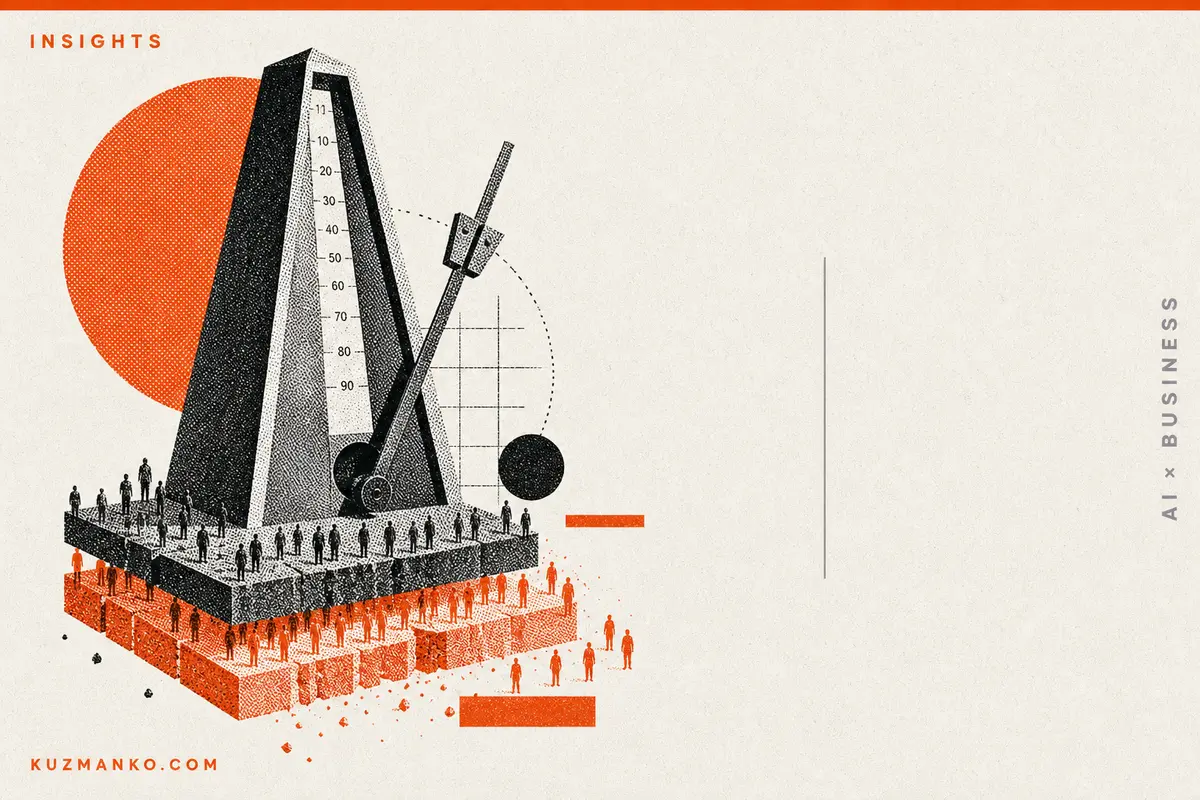
The real lesson from Meta is not that AI replaces jobs
Meta's reported AI-driven restructuring, affecting roughly 20% of its workforce through layoffs, transfers, and redesigned roles, should not be read as a simple automation headline. The more important lesson is sharper: AI changes the operating model before most companies know how to manage the new one.
Mark Zuckerberg's internal admission that mistakes were made, and that more are likely, is unusually candid for a CEO leading a high-stakes transformation. It is also strategically important. If one of the most resourced technology companies in the world cannot execute AI workforce redesign without friction, then every enterprise should treat AI transformation as a serious managerial discipline, not a technical rollout.
AI is not only a productivity tool. It is a new layer of organizational labor that must be designed, governed, measured, and supervised.
That distinction matters. Buying tools is easy. Redesigning judgment-based work is hard.
Why 20% workforce impact changes the conversation
A workforce shift of this scale is not optimization. It is a new corporate architecture.
When a company moves thousands of employees into AI-related roles while reducing other teams, it signals that AI is no longer a side capability handled by innovation groups. It is becoming part of the production system. The question for leaders is no longer whether AI can help employees write faster emails or summarize meetings. The real question is:
Which parts of the business can be executed by software agents, which require human judgment, and which require a hybrid operating model?
This is where many companies get confused. They look at AI through a technology lens and ask what the model can do. The better question is operational: what process can be redesigned now that non-deterministic execution is possible?
Traditional software is excellent when the process is predictable. AI is valuable when the process previously required interpretation, prioritization, language, research, exception handling, or judgment. That is why AI agents are so disruptive. They do not merely automate clicks. They can participate in work that used to require a person to think through ambiguity.
Human-in-the-loop is essential, but it cannot become a bottleneck
The human-in-the-loop principle is critical. Enterprises should not allow AI agents to run sensitive processes without supervision, auditability, escalation rules, and accountability. But there is a trap: if every AI action requires a human to approve it manually, the organization has not transformed anything. It has simply created a more complicated workflow.
The goal is not to replace one employee with one agent. The goal is to help one capable employee supervise, improve, and govern hundreds of AI-driven micro-processes.
That requires a different management model:
- Humans approve policies, boundaries, and exceptions.
- Agents execute defined categories of work within controlled environments.
- Riskier decisions are escalated based on confidence, financial exposure, customer impact, or regulatory sensitivity.
- Managers measure agent performance like they measure team performance.
- Process owners continuously improve prompts, workflows, data access, and evaluation criteria.
This is where the future of IT becomes interesting. Information systems departments will increasingly act like human resources departments for AI agents. They will provision agents, define roles, manage permissions, monitor performance, retire ineffective agents, and maintain governance standards.
That sounds technical, but it is not only technical. It combines information systems, operations, management, risk, data architecture, and business expertise.
The uncomfortable truth: AI transformation requires real expertise
Meta's admission should also cool the market's excessive confidence in shallow AI consulting. There are too many self-proclaimed AI experts who have learned the vocabulary but lack the business experience, operational depth, academic grounding, or implementation history required to advise serious organizations.
Large enterprises can usually filter weak advice. Small and mid-sized businesses are far more exposed. They often receive generic playbooks, tool recommendations, or prompt workshops that do not survive contact with real processes, real data, real compliance constraints, and real employees.
AI implementation is multidisciplinary. It requires knowledge of models, but also knowledge of the professional domain. It requires academic seriousness, but also field experience. It requires experimentation, but also governance. The best AI leaders are not only technologists. They understand how work actually happens.
This is why Meta's situation matters beyond Silicon Valley. The company is not just deploying AI. It is discovering, in public, that AI transformation is an organizational science.
Two tracks every enterprise needs: literacy and agents
Companies should not choose between teaching employees to use AI tools and building AI agents. They need both.
The first track is AI literacy. Employees must learn how to communicate effectively with models, evaluate outputs, challenge hallucinations, protect sensitive information, and integrate AI into their daily work. This is now a core professional skill, not a niche capability.
The second track is AI agent development. Organizations need internal capability to create, deploy, monitor, and improve agents that execute repeatable business processes. This requires platforms, standards, security models, data access policies, and operational ownership.
These two tracks behave differently.
AI tools require employees to change habits. That can be difficult. Even if the tool is technically simple, adoption may be slow because it changes how people write, analyze, search, document, decide, or collaborate.
AI agents can sometimes be easier to adopt operationally because they do work in the background. Employees do not always need to change their entire workflow. The organization needs to design the agent well, connect it to systems, and define supervision. Technically it may look more complex, but behaviorally it can be easier to integrate.
That distinction is important for executives planning budgets. Training alone will not create automation capacity. Agents alone will not create an AI-capable workforce. The competitive organizations will advance on both fronts.
The platform question is becoming strategic
Meta can build deeply customized AI infrastructure. Most companies cannot. They need practical platforms that allow teams to build and manage agents quickly, securely, and repeatedly.
For Microsoft-heavy organizations, Copilot and Copilot Studio are becoming important infrastructure. Copilot has not always moved as fast as the more focused AI-native vendors, but it has improved significantly and remains valuable because it sits close to enterprise identity, documents, email, collaboration, and security controls.
Anthropic's Claude remains one of the most compelling enterprise systems, especially because of the quality of interaction, reasoning style, and applied workflows around Claude Code and collaborative work patterns. The challenge, as always, is security architecture, data governance, and enterprise fit.
At the same time, tools such as n8n are entering environments that once looked too conservative for this kind of workflow automation. Large organizations are becoming more open to modular automation layers because the demand for AI process creation is growing faster than traditional IT delivery models can support.
The strategic issue is not which tool wins this quarter. The strategic issue is whether the company has an internal engine for agent creation and governance.
What CFOs should take from Meta's move
For finance leaders, Meta's restructuring raises a direct question: how should AI productivity be measured?
The weakest approach is to count licenses and assume value. The second weakest approach is to chase headcount reduction as the primary metric. AI can reduce labor in some areas, but its larger value is often operational leverage: shorter cycle times, fewer handoffs, better exception handling, higher throughput, improved service levels, and faster analysis.
CFOs should ask for metrics such as:
- Cost per completed process.
- Average handling time before and after agent deployment.
- Number of processes supervised per employee.
- Error rates and rework rates.
- Percentage of exceptions escalated to humans.
- Revenue impact from faster response or better prioritization.
- Risk exposure created or reduced by automation.
If finance only asks how many jobs AI can remove, it will miss the deeper transformation. The better question is how much more organizational output can be generated by the same number of skilled people.
Communication is part of the operating model
Zuckerberg's careful refusal to overpromise stability is worth noting. Employees are not naive. They know AI will change roles. What damages trust is not the change itself, but unclear logic, unrealistic promises, and sudden execution.
Leaders need a communication model that is honest without becoming chaotic:
- Explain which processes are being redesigned and why.
- Separate role changes from performance judgments.
- Show where new roles are being created.
- Define how employees can reskill into AI-related work.
- Admit uncertainty where uncertainty is real.
- Avoid pretending that every change is painless.
This is especially relevant for technology companies, SaaS firms, financial services organizations, and Israeli growth companies that are now asking how aggressively to deploy AI agents. The lesson is simple: speed without trust creates resistance. Trust without execution creates stagnation.
The executive takeaway
Meta's restructuring is not a warning to avoid AI. It is a warning to treat AI seriously.
The companies that win will not be the ones that run the most demos. They will be the ones that build the best operating model around human judgment, agent execution, governance, and measurable business value.
AI is not a technical project. It is a management discipline. It demands deep knowledge, serious implementation experience, academic rigor, and an honest understanding of how business processes actually work.
Zuckerberg's admission is valuable because it normalizes something every executive should accept early: mistakes will happen. The question is whether the organization has the capability to detect them, correct them, and keep moving.
That is the real AI advantage.