
AI agents for service and support
AI agents that handle first-line support and coordination, answer from your own knowledge base and hand over to a person with the full context.
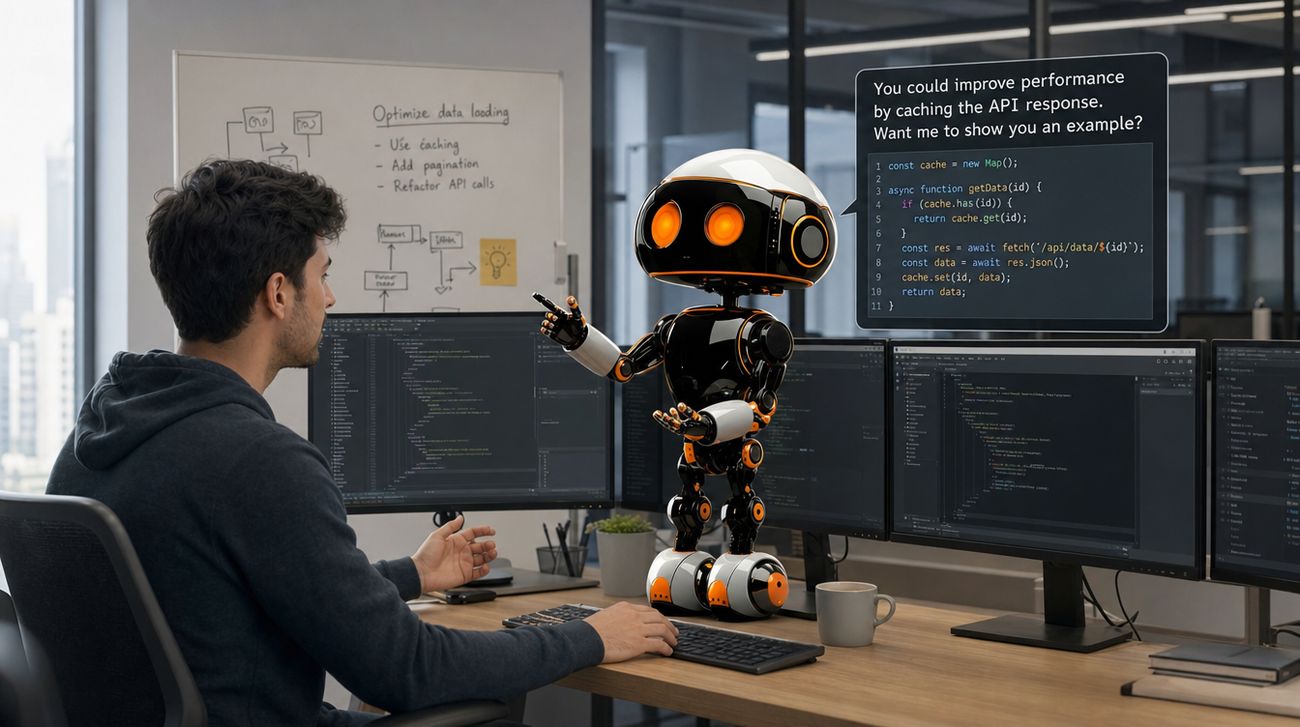
We automate the repetitive work in service, sales, operations and back office, with AI where it adds value and plain automation where it doesn't. Measured in hours saved, response times and cost per case.
New AI-based processes deployed at clients
AI agents live in production
Projects delivered
Last updated
AI automation consulting is finding the repetitive tasks and processes in a business, such as answering leads, updating the CRM or handling service requests, and moving them to automatic execution, with AI components where judgement on text, voice or data is needed. KO AI maps the process first, then builds, connects and measures the automation.
Most automation projects fail for a simple reason: they automate a bad process. We start from the business result, the hours, the response time, the cost per case, and only then choose the tool. Sometimes that is a workflow platform, sometimes custom code, and sometimes the process needs to be re-engineered first, which is what our forward deployed engineering teams do.
KO AI has deployed 500+ new AI-based processes at clients. We work with mid-size and large organizations in Israel and Europe, from offices in Tel Aviv, Prague and Porto.
Eight areas where business process automation with AI saves time, shortens response times and improves the customer experience.
AI agents that handle first-line support and coordination, answer from your own knowledge base and hand over to a person with the full context.
Automatic, consistent follow-up by email, SMS, WhatsApp and voice agents, so no lead waits and every contact is logged.
Voice and chat assistants for inbound and outbound calls, call summaries and routing to the right agent, to raise the efficiency of the contact centre.
Workflows built into your CRM and ERP that keep records current, close service loops and trigger the next step without manual work.
Reading, extracting and classifying documents such as invoices, forms, claims and contracts, with a confidence score and a human check where it matters.
Automations that route requests, summarise threads and keep teams and customers informed, in the tools people already use.
The recurring tasks of managers and employees, from reports to approvals, automated so time goes to the work that matters.
When a platform isn't enough, our developers build an automation in code that fits the organization's exact requirements.
The main difference is autonomy and how much the process itself changes. In most organizations the answer is a mix: automation for the repetitive work, an AI agent where judgement is needed, and FDE when the process has to be rebuilt.
| Criterion | Business process automation | AI agent | Forward deployed engineering |
|---|---|---|---|
| How it works | A fixed scenario: if X happens, do Y. | Gets a goal, assesses the situation and plans a sequence of actions itself. | Redesigns the whole process, with rules, models and people at engineered decision nodes. |
| What it fits | Repetitive, linear tasks at high volume. | Steps that need judgement, with exceptions and changing conditions. | Processes that are slow, costly or error-prone end to end. |
| When something breaks | The scenario stops and waits for a fix. | Can correct itself, within limits and permissions. | Thresholds and fallback paths route the case to the right person. |
| AI components | Usually basic AI for reading and classifying data. | Agentic reasoning across the task. | The right component per node: rule, ML model, language model or person. |
| Where to learn more | This page | AI agent development | Forward deployed engineering |
We map the process with the people who run it and measure the baseline: volume, time per case and errors.
Plain automation, an AI agent, or re-engineering first. We pick the simplest option that meets the target.
On a workflow platform or in code, connected to your CRM, ERP and core systems, under your security policies.
We measure against the baseline, add monitoring, and train the team that will own the automation.
KO AI isn't tied to one technology. For fast delivery we use low-code platforms such as n8n, Make and Microsoft Copilot Studio. For complex, high-volume or core-business processes our developers write a custom solution in code, for example in Python, and connect it to your existing systems.



For European clients we design automations for GDPR from the start: data minimisation, access control, logging, and EU data residency where it is required.
When a process needs to be rebuilt, not only automated: engineers and consultants who re-engineer it into an AI-based process inside your organization.
Enterprise AI agents and custom AI/ML systems, built to run in production.
Where AI creates value, the roadmap and governance, from the boardroom to the model layer.
Tell us about it, and we'll show you whether automation, an AI agent or a re-engineered process should take it over.